A Pioneer Bridging Impressionism and Cubism
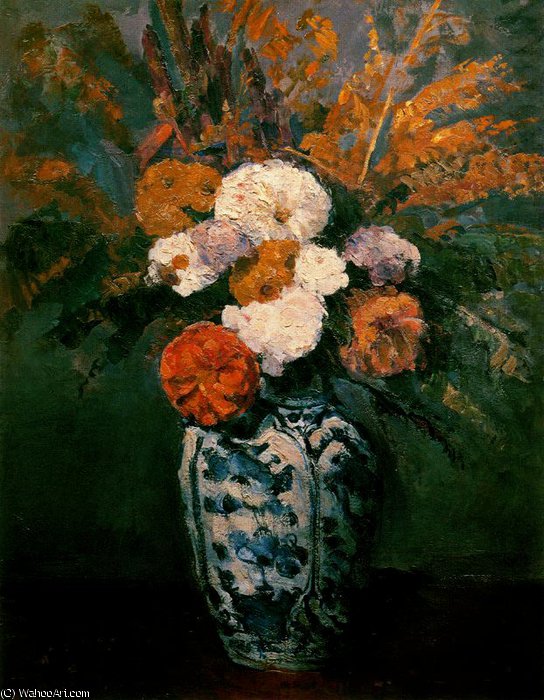
Paul Cézanne’s “untitled (1168)” stands as an emblem of artistic transformation, embodying the anxieties and aspirations of a generation grappling with the burgeoning ideas of modern art. Painted circa 1905-1906, this deceptively simple still life—a vase brimming with blossoms—represents far more than just botanical representation; it’s a deliberate challenge to established conventions and a foundational step toward the revolutionary aesthetic championed by Cubism.
- Subject Matter: The composition centers around a white porcelain vase adorned with delicate blue floral motifs, holding an assortment of flowers – vibrant orange lilies juxtaposed against sunny yellow daffodils, blushing pink roses mingling with regal purple orchids and fiery red poppies. Scattered amongst the blooms are verdant leaves, meticulously rendered to convey textural depth.
- Style: Cézanne’s approach defies easy categorization. While undeniably rooted in Impressionistic principles of capturing fleeting light and color—evident in the subtle gradations of hue—he abandons Impressionism's pursuit of optical realism. Instead, he employs a technique characterized by flattened planes and geometric simplification, anticipating the radical fragmentation characteristic of Cubist explorations.
Technique: The Pursuit of Structure
Cézanne’s masterful execution reveals an unwavering commitment to underlying structure—a concept that profoundly influenced subsequent artists. He eschewed traditional brushstrokes in favor of a deliberate layering process, applying paint thickly to create palpable surface texture. This impasto technique isn't merely decorative; it serves to sculpt the forms within the canvas, emphasizing volume and solidity. Cézanne meticulously observed the contours of objects, reducing them to basic geometric shapes—cylinders, cones, and planes—a method that anticipates Picasso’s and Braque’s groundbreaking Cubist reconstructions.
Historical Context: A Reaction Against Illusion
“untitled (1168)” emerged during a period of intense artistic debate. Impressionism had dominated the art world for decades, prioritizing sensory experience over intellectual representation. Cézanne responded to this prevailing aesthetic by rejecting illusionistic depiction altogether. He sought instead to convey an inner vision—a distillation of observed reality into its essential components. This stance aligns perfectly with the broader philosophical currents of the time, reflecting a growing disillusionment with Romantic idealism and a burgeoning fascination with scientific observation.
Symbolism & Emotional Impact
Beyond its formal innovations, “untitled (1168)” resonates with deeper symbolic significance. Flowers have long been associated with beauty, fragility, and renewal—themes that Cézanne skillfully captures through his careful color palette and textural rendering. The vase itself symbolizes containment and harmony, mirroring the artist’s desire to impose order upon perceived chaos. Ultimately, the painting evokes a sense of contemplative stillness, inviting viewers to contemplate the enduring power of nature and the transformative potential of artistic exploration—a legacy that continues to inspire artists and collectors alike.