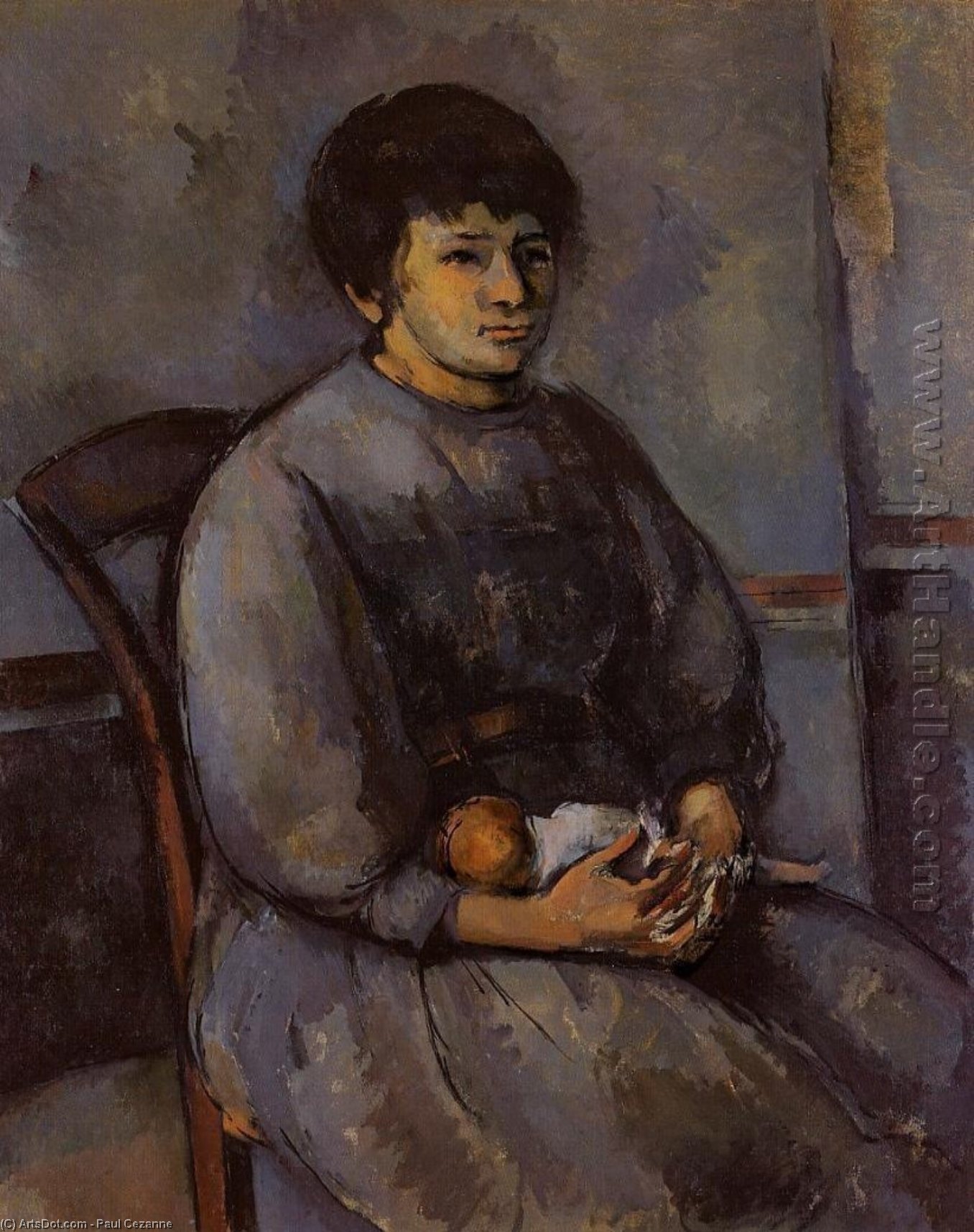
Young Girl with a Doll
Paul Cézanne’s “Young Girl with a Doll,” painted in 1894, stands as a cornerstone of Post-Impressionism—a movement that irrevocably altered the course of artistic expression. More than just a portrait, it's an embodiment of Cézanne’s revolutionary vision for depicting reality, prioritizing structure and form over mere optical representation.
The Painting's Composition
At first glance, the scene appears simple: a young girl seated in a chair, holding a doll. However, Cézanne meticulously crafted this composition to convey profound emotional depth. The muted blue background serves as an anchor for the figure’s presence, emphasizing her stillness and contemplative gaze. Notice how Cézanne utilizes bold brushstrokes—irregular, textured marks that disrupt traditional perspective—to sculpt the chair and create a palpable sense of volume.
Artist's Style and Influence
Cézanne wasn’t interested in capturing fleeting impressions of light; instead, he sought to distill the essence of his subject into geometric forms. This approach profoundly influenced subsequent artists like Vincent van Gogh, who adopted Cézanne’s expressive brushwork and simplified shapes to convey emotion. Cézanne's insistence on flattening space—reducing depth perception—was a deliberate rejection of Impressionism’s obsession with capturing atmospheric effects.
Other Notable Works
Beyond “Young Girl with a Doll,” Cézanne produced an impressive body of work exploring landscapes and still lifes, demonstrating his unwavering commitment to experimentation. Consider “L'Estaque under Snow,” part of the E. G. Buhrle Collection in Switzerland—a masterful depiction of winter light and texture achieved through meticulous layering of color and brushstrokes. Similarly, “Self-Portrait in a Felt Hat,” housed at the Bridgestone Museum of Art in Japan, reveals Cézanne’s self-awareness and his ability to convey psychological nuance.
“Young Girl with a Doll” exemplifies Cézanne’s distinctive style—a testament to his enduring legacy as one of the most influential painters of the late nineteenth century.