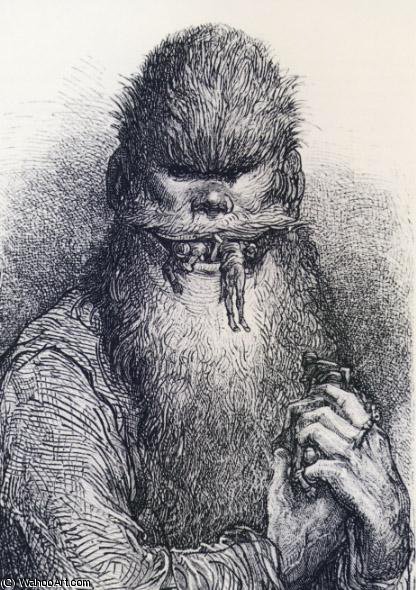
A Study in Shadow and Isolation: Gustave Doré's Prisoners’ Round
Gustave Doré’s “Prisoners’ Round,” completed shortly before his tragic demise in 1890, stands as a haunting testament to the artist’s profound engagement with psychological themes and his masterful command of etching technique. Inspired by Honoré Daumier’s lithograph depicting Newgate Prison’s exercise yard—a scene rife with social commentary on penal reform—Doré transformed this visual reference into an emotionally resonant exploration of confinement, despair, and the human condition. The artwork's enduring power lies not merely in its meticulous detail but also in its ability to convey a palpable sense of unease and vulnerability.
- Historical Context: Doré’s work emerged during a period marked by significant social anxieties surrounding Victorian Britain’s justice system and the treatment of incarcerated individuals. Daumier's lithograph served as a catalyst for artistic reflection on moral responsibility and the dehumanizing effects of institutionalization, concerns that resonated deeply within Doré’s own worldview.
- Composition & Technique: The etching is characterized by a strikingly shallow perspective, compressing the space into an almost claustrophobic tableau dominated by dark blues and greens—colors deliberately chosen to evoke feelings of oppression and melancholy. Doré employs dense hatching and cross-hatching with exceptional precision, meticulously simulating the texture of brick walls and clothing fabric, creating a surface that pulsates with palpable physicality.
- Subject Matter & Symbolism: At its core, “Prisoners’ Round” depicts a group of men walking in a circle around a prison yard, their faces illuminated by sparse shafts of light—a visual metaphor for the cyclical nature of suffering and the futile pursuit of freedom. The solitary figure at the forefront, gazing outwards with an expression of quiet contemplation, embodies Doré's preoccupation with existential questions and the individual’s confrontation with mortality.
- Emotional Impact: Viewing “Prisoners’ Round” evokes a visceral response—a feeling of profound sadness mingled with apprehension. Doré’s masterful manipulation of chiaroscuro amplifies this emotional intensity, highlighting the subjects’ faces and emphasizing the stark contrast between light and shadow. The artwork compels contemplation on themes of isolation, vulnerability, and the inescapable realities of human existence.
- Influence & Legacy: Doré's etching has exerted considerable influence on subsequent artistic endeavors, notably Stanley Kubrick’s “A Clockwork Orange,” where it served as inspiration for a pivotal scene—a deliberate appropriation that underscores the artwork’s enduring relevance to discussions about morality and societal control. Its meticulous detail and evocative atmosphere continue to captivate audiences today, cementing Doré's place as one of the foremost illustrators of his era.
Further Research: Explore Vincent van Gogh’s artistic influences and stylistic parallels with Doré’s oeuvre. Consider how both artists wrestled with themes of psychological distress and sought to convey profound emotional truths through their visual representations. Examining similar artworks from the Romantic period can illuminate the broader cultural landscape that shaped Doré's creative vision.