Gustave Dore
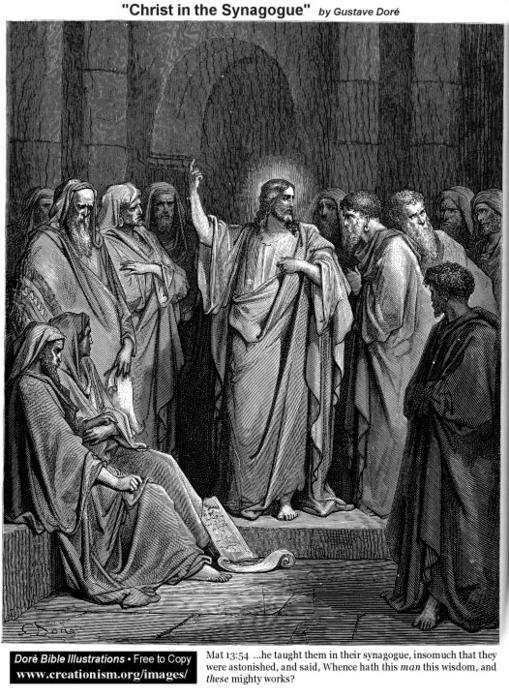
Delve into Gustave Doré's masterful engraving 'Christ in the Synagogue,' capturing a poignant biblical scene with meticulous detail and dramatic lighting—a cornerstone of Romantic art.
Explore the dramatic wood engravings & illustrations of Gustave Doré (1832-1883). Master of Romanticism, famed for Biblical scenes, Dante's Inferno, and literary masterpieces. Discover his influential art!
A Dramatic Encounter: Gustave Doré’s “Christ in the Synagogue”
Gustave Doré's "Christ in the Synagogue" stands as a testament to Romanticism’s enduring fascination with biblical narratives and its masterful manipulation of visual language. Created around 1867, this engraving captures a pivotal moment from Jesus Christ’s ministry – his teachings within a Jewish synagogue – transforming it into an emotionally charged tableau that continues to resonate with viewers today. Published alongside Dickens' *Oliver Twist*, Doré’s contribution cemented his reputation as one of the foremost illustrators of his era and established him as a pioneer in the art of engraving.
Composition and Technique: Mastering Light and Shadow
Doré’s genius lay not merely in depicting biblical scenes but in executing them with unparalleled precision and dramatic flair. The composition is deliberately claustrophobic, drawing the eye inward towards Christ—a figure positioned slightly off-center yet dominating the visual space thanks to a halo effect that radiates outwards. Surrounding him are figures rendered with meticulous detail, arranged in a semi-circular fashion that conveys both movement and palpable anticipation. Doré skillfully employed hatching and crosshatching techniques – hallmarks of engraving – to sculpt tonal variations across the plate, creating an illusion of depth and texture that elevates the image beyond mere representation. Fine lines delineate facial features, drapery folds, and architectural elements with breathtaking accuracy, demonstrating a dedication to realism rarely achieved in other artistic mediums.
Symbolism and Emotional Resonance: Reverence and Contemplation
Beyond its technical brilliance, “Christ in The Synagogue” is laden with symbolic significance. The halo surrounding Christ embodies divine holiness, underscoring his role as savior and illuminating the scene’s spiritual core. The attentive expressions of those gathered within the synagogue convey reverence and curiosity—a palpable desire to absorb Christ's words and wisdom. Doré’s masterful use of lighting – emanating from above and subtly behind Christ – amplifies this dramatic effect, reinforcing the importance of the central figure and fostering a mood of solemn contemplation. The inclusion of a seated figure holding a scroll symbolizes Jewish law and tradition, highlighting the dialogue between faiths during Jesus' time.
Historical Context: Romanticism’s Grip on Biblical Imagery
The engraving emerged from the crucible of Romanticism, an artistic movement characterized by emotional intensity, imaginative storytelling, and a preoccupation with grand themes—particularly those rooted in religion and mythology. Doré’s work reflects this aesthetic sensibility through its dramatic chiaroscuro (light and shadow), its expressive rendering of human figures, and its commitment to conveying profound psychological states. Published concurrently with Dickens' novel, “Oliver Twist,” the engraving benefited from the widespread readership of Victorian literature, furthering Doré’s artistic influence and solidifying his place in art history.
A Legacy Enduring Through Reproduction
Today, a high-quality reproduction of "Christ in The Synagogue" offers an opportunity to experience Doré's unparalleled artistry firsthand. Its striking monochrome palette—dominated by shades of gray—captures the essence of Romanticism’s aesthetic while preserving the engraving’s remarkable textural detail. Whether adorning a study or gracing a grand salon, this iconic image continues to inspire awe and contemplation, reminding us of the enduring power of art to communicate profound spiritual truths.