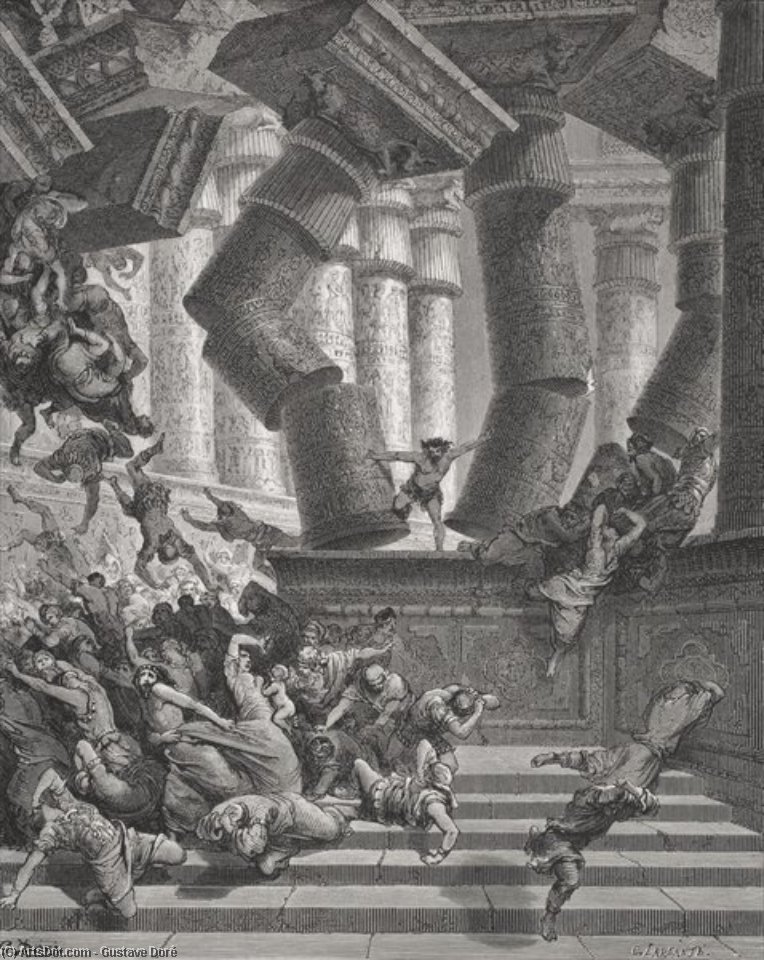
Death of Samson: A Monumental Testament to Romantic Drama
Gustave Doré’s “Death of Samson” (1866) stands as a cornerstone of Romantic illustration, capturing the visceral horror and grandeur inherent in biblical narrative. More than just a depiction of a pivotal moment—the downfall of Israel's champion after his defiance of God—it’s an exquisitely crafted visual meditation on power, retribution, and the inevitable decay of even the most formidable structures.
- Composition & Perspective: Doré masterfully employs diagonal lines generated by collapsing pillars to convey instability and impending doom. Figures are densely clustered in the foreground, creating a claustrophobic atmosphere that draws the viewer into the scene’s unfolding tragedy. Overlapping perspectives subtly suggest depth, mirroring the biblical tale's narrative progression.
- Style & Technique: Executed with breathtaking precision using etching techniques—a process favored by Doré for its ability to achieve remarkable tonal range and textural detail—the engraving embodies Romantic idealism. Fine lines dominate, meticulously rendering architectural elements and clothing folds, while hatching and cross-hatching create a palpable sense of roughness and solidity.
- Color Palette & Lighting: Stripped bare of color, “Death of Samson” relies entirely on shades of gray to amplify its dramatic impact. Strong directional lighting illuminates the central action—Samson’s desperate struggle against the crumbling edifice—highlighting musculature and conveying an overwhelming feeling of urgency.
- Symbolism & Emotional Resonance: The colossal pillars represent not merely physical structures but also the edifice of Samson's pride and defiance. Their collapse symbolizes the inevitable ruin of ambition unchecked by divine judgment, resonating with themes of vulnerability and despair. Doré’s masterful portrayal evokes a profound emotional response—a chilling awareness of mortality and the futility of resisting fate.
- Historical Context: Created during a period marked by burgeoning scientific inquiry alongside fervent religious fervor, “Death of Samson” reflects the Romantic movement's preoccupation with emotion and imagination. Doré’s work cemented his reputation as one of the era’s foremost illustrators, influencing generations of artists and shaping perceptions of biblical stories.
A reproduction from ArtsDot offers an unparalleled opportunity to experience Doré’s artistic genius firsthand—to immerse oneself in a visual masterpiece that continues to captivate audiences with its dramatic intensity and enduring relevance. Its meticulous detail and tonal richness faithfully recreate the original engraving, transforming it into a stunning centerpiece for any discerning interior.