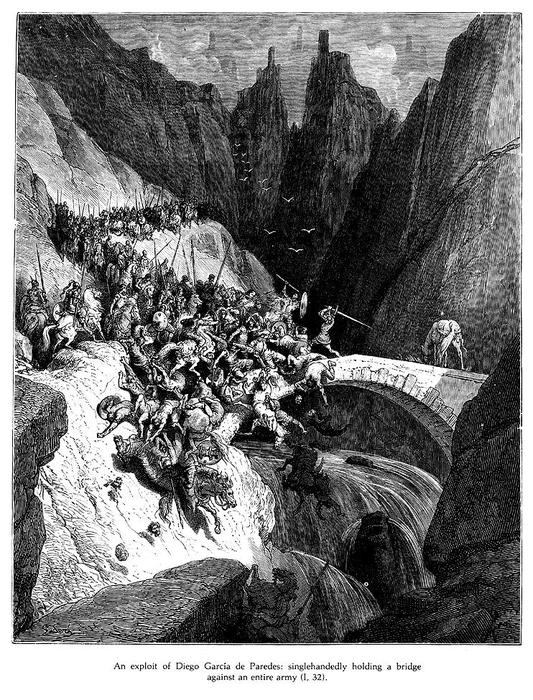
This monumental wood engraving depicts a pivotal moment from Miguel de Cervantes’ *Don Quixote*, capturing Diego Garcia de Paredes bravely defending a bridge against overwhelming odds. Doré’s meticulous technique—characterized by hatching, cross-hatching, and strong diagonal lines—creates a dynamic composition brimming with texture and conveying the intensity of medieval chivalry. The artwork exem
Don Quixote (46): A Dramatic Encounter with Myth and Reality
Paul Gustave Doré’s “Don Quixote” is more than just an illustration; it's a visceral distillation of Cervantes’ epic tale, rendered in the masterful style of 19th-century Romantic engraving. Published in 1860 as part of *Illustrations for Don Quixote*, this monumental print captures a pivotal moment – a desperate siege of a bridge by a lone defender against overwhelming odds—transforming literature into breathtaking visual drama. The artwork’s immediate impact is one of palpable tension, achieved through Doré's signature use of chiaroscuro, where stark contrasts between light and shadow sculpt the scene with astonishing precision.
- Composition & Perspective: The artist employs a dynamic pyramidal composition, guiding the viewer’s eye upwards towards the towering cliffs and distant peaks—a deliberate echo of medieval landscape paintings intended to convey grandeur and awe. Linear perspective skillfully diminishes the scale of figures and structures as they recede into the background, reinforcing the feeling of vastness and emphasizing the vulnerability of the besieged hero.
- Technique & Materials: Doré’s technique is rooted in the meticulous process of wood engraving—a painstaking method involving carving intricate lines onto a wooden block before transferring ink to paper through multiple impressions. This laborious process resulted in exceptional detail and tonal gradation, capturing the textures of stone, armor, and clothing with remarkable accuracy.
- Symbolism & Emotional Resonance: The lone figure on the bridge embodies resilience and unwavering determination against insurmountable adversity—a central theme within Cervantes’ novel. Doré brilliantly conveys this spirit through expressive lines and shading, conveying not merely a depiction of battle but also an exploration of courage and sacrifice.
The artwork's stylistic influences are firmly anchored in Romanticism, reflecting the period’s fascination with dramatic narratives and idealized landscapes. Doré’s meticulous attention to detail aligns perfectly with the Romantic impulse to represent nature and human emotion with uncompromising realism—a departure from Neoclassical restraint that championed emotional intensity and imaginative storytelling. It stands as a testament to Doré's ability to transform literary concepts into unforgettable visual experiences, cementing his place as one of the most influential illustrators of his time.
- Color Palette: Strikingly devoid of color, “Don Quixote” relies entirely on shades of gray—a deliberate choice that amplifies the dramatic effect and focuses attention on form and texture. Doré skillfully manipulates tonal variations to simulate the roughness of rock surfaces and the sheen of armor, creating a convincing illusion of depth and materiality.
- Line Work & Texture: Doré’s masterful line work—characterized by hatching and cross-hatching techniques—is paramount in conveying both visual detail and textural nuance. Fine lines delineate individual figures and architectural elements with precision, while denser hatching creates shading and simulates the ruggedness of mountainous terrain.
“Don Quixote” continues to resonate today as an exemplar of Romantic illustration—a powerful reminder that art can transcend mere representation, capturing not only what is seen but also what is felt. Its enduring appeal lies in its ability to distill the essence of Cervantes’ masterpiece into a single unforgettable image, inviting viewers to contemplate themes of heroism, perseverance, and the confrontation between idealism and reality.