A Descent Into Darkness: Analyzing Gustave Doré’s “Forgers”
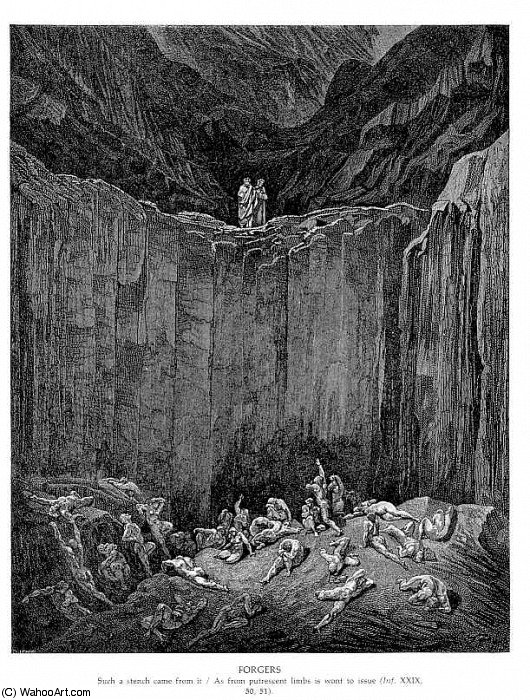
Gustave Doré's "Forgers," etched with meticulous detail onto copper plate and subsequently printed, stands as a haunting testament to Romanticism’s fascination with the sublime—a visual exploration of torment, judgment, and the inescapable consequences of transgression. Created around 1867, this monumental engraving captures a scene directly drawn from Dante Alighieri's *Inferno*, specifically Canto IX, where Virgil and Dante descend into Hell’s ninth circle – Limbo Dei – inhabited by those who once possessed virtue but succumbed to pride. Doré doesn’t merely depict the biblical narrative; he transforms it into an emotionally resonant experience for the viewer, cementing his place as a pioneer of dramatic illustration.
- Composition & Scale: The artwork commands attention immediately with its expansive vertical format, pulling the eye downwards into the abyss depicted below. Doré skillfully divides the image into two distinct realms – the upper section featuring two figures representing divine judgment and the lower expanse populated by tormented souls writhing in agony. Symmetry plays a subtle role, mirroring the chasm’s edges to heighten the sense of imbalance and impending doom.
- Technical Mastery: Doré's technique is exemplary. Employing hatching and cross-hatching with unparalleled precision, he achieves remarkable textural depth—roughness characterizes the rocky landscape while the figures exhibit varying degrees of smoothness depending on their position relative to the ethereal light source emanating from above. This masterful manipulation of line work underscores Doré’s dedication to capturing both form and atmosphere.
- Symbolism & Emotional Resonance: The vast chasm itself embodies the immensity of sin and despair, mirroring Dante's depiction of Hell as an infinite expanse devoid of comfort or redemption. The two figures at the apex symbolize divine authority—judges overseeing the eternal suffering below. Their impassive gaze reinforces the inescapable gravity of moral accountability.
- Romantic Horror & Influence: Doré’s work embodies the Romantic movement's preoccupation with darkness, emotion, and the grotesque. He skillfully utilizes chiaroscuro – dramatic contrasts between light and shadow – to amplify the scene’s horror and evoke a visceral response from the audience. This stylistic choice aligns perfectly with Dante’s poetic vision of Hell as a realm of psychological torment rather than mere physical pain.
Historical Context & Dante's Inferno Inspiration
Doré’s engraving arose during a period marked by intellectual ferment and artistic experimentation. The Romantic era championed emotion over reason, prioritizing imagination and subjective experience—traits vividly reflected in Doré’s portrayal of Hell. Dante’s *Inferno*, published in 1833, profoundly impacted European art and literature, establishing a precedent for visualizing the afterlife with unflinching realism and psychological depth. Doré meticulously translated Dante's poetic descriptions into visual form, capturing not only the physical horrors of Limbo Dei but also the profound spiritual anguish experienced by its inhabitants.
Detailed Analysis: Line Work & Texture
The artwork’s textural richness stems from Doré’s painstaking application of line work—primarily hatching and cross-hatching—a technique honed through years of experience engraving copper plates. These lines aren't merely decorative; they are integral to conveying the scene’s atmosphere and creating a palpable sense of movement within the tormented landscape below. The artist’s meticulous attention to detail ensures that every ridge, crevice, and wrinkle is rendered with breathtaking accuracy—a testament to Doré’s unwavering commitment to capturing both form and feeling.
Concluding Impression: A Legacy of Dramatic Imagination
“Forgers” remains a cornerstone of Romantic illustration, demonstrating Doré's unparalleled ability to transform literary narratives into emotionally compelling visual experiences. Its enduring power lies in its capacity to evoke feelings of dread, pity, and contemplation—a reminder that art can transcend mere representation, delving into the depths of human psychology and confronting us with uncomfortable truths about morality and suffering. It stands as a timeless masterpiece, securing Doré’s place among the most influential artists of his era.