Born in Strasbourg in 1832, Gustave Doré possessed a remarkable talent from youth, demonstrating maturity beyond his years through early caricaturing endeavors. His prolific career spanned illustration, painting, and sculpture, cementing his legacy as a visionary artist who skillfully blended Romanticism’s emotive power with emerging realist sensibilities.
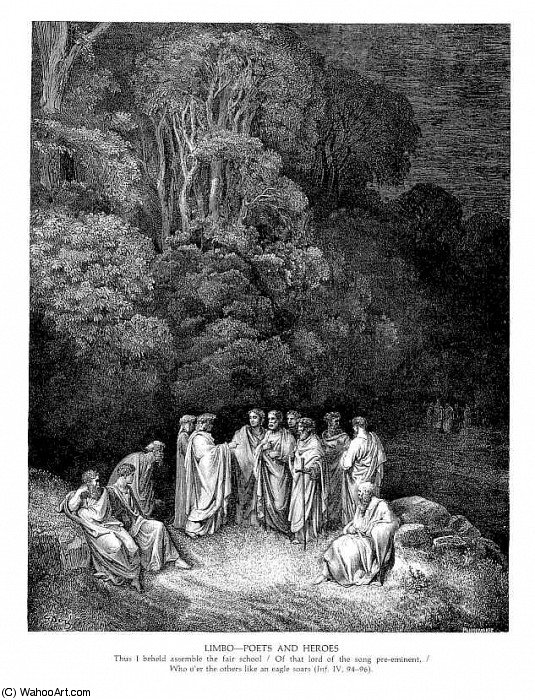
This striking black and white engraving
Limbo Poets and Heroes: A Descent Into Dante’s Inferno
This engraving by Gustave Doré captures a moment of profound contemplation amidst the bleak landscape of Dante Alighieri's *Inferno*, offering viewers an arresting glimpse into the psychological drama at the heart of one of literature’s most enduring narratives. Executed in 1869, Doré’s masterful depiction isn’t merely a visual representation; it’s a carefully crafted embodiment of Dante’s theological vision and a testament to the artist's unparalleled skill in translating complex ideas into powerfully evocative imagery.
- Subject Matter & Narrative Context: The artwork portrays a group of figures—likely poets and heroes—gathered within a shadowy forest, mirroring the purgatorial realm depicted in Dante’s epic poem. This liminal space represents the intermediary stage between Heaven and Hell, symbolizing intellectual struggle and moral reckoning. Doré brilliantly captures the atmosphere of Dante's Inferno, conveying the oppressive darkness and despair that characterize this journey through torment.
- Style & Technique: Doré’s signature style is characterized by its meticulous linework—a technique honed during his prolific career as a printmaker—resulting in an astonishing level of detail. Employing burin engraving on copper plate, he achieved tonal gradations through hatching and cross-hatching, creating textures that convincingly simulate the rough bark of trees and the somber hues of the underworld. This painstaking process underscores Doré’s dedication to capturing not just what is seen but also what is felt.
- Composition & Perspective: The pyramidal composition directs the viewer's gaze towards a central clearing, emphasizing the figures’ vulnerability against the overwhelming backdrop of the forest. Linear perspective skillfully renders depth, reinforcing the sense of spatial recession and enhancing the dramatic impact of the scene. Doré’s masterful use of shading contributes to this illusion of realism, immersing the audience in Dante’s harrowing vision.
- Symbolism & Emotional Resonance: The forest itself serves as a potent symbol—representing both confinement and transformation—reflecting Dante's exploration of human morality and spiritual redemption. The figures’ postures convey introspection and sorrow, mirroring the psychological torment experienced by those traversing purgatory. Doré succeeds in conveying the emotional weight of Dante’s poem, prompting viewers to contemplate themes of suffering, faith, and moral responsibility.
- Historical Significance: Doré's engraving stands as a cornerstone of Victorian illustration and exemplifies the Romantic preoccupation with exploring profound philosophical ideas through visual storytelling. It cemented Doré’s reputation as one of the foremost artists of his time and continues to inspire admiration for its technical brilliance and artistic sensitivity. Its enduring appeal speaks to the universal fascination with Dante’s masterpiece and Doré's ability to translate its spirit into unforgettable imagery.
This reproduction offers a stunning opportunity to experience the grandeur of Dante’s Inferno through Doré’s unparalleled artistry—a timeless testament to the power of visual storytelling and the enduring legacy of Victorian illustration.