According to the Old Testament of the Bible, Aaron ( AIR-ən or ARR-ən) was an Israelite prophet, high priest, and the elder brother of Moses. Information about Aaron comes exclusively from religious texts, such as the Hebrew Bible, the New Testament (Luke, Acts, and Hebrews),
and the Quran.
The Hebrew Bible relates that, unlike Moses, who grew up in the Egyptian royal court, Aaron and his elder
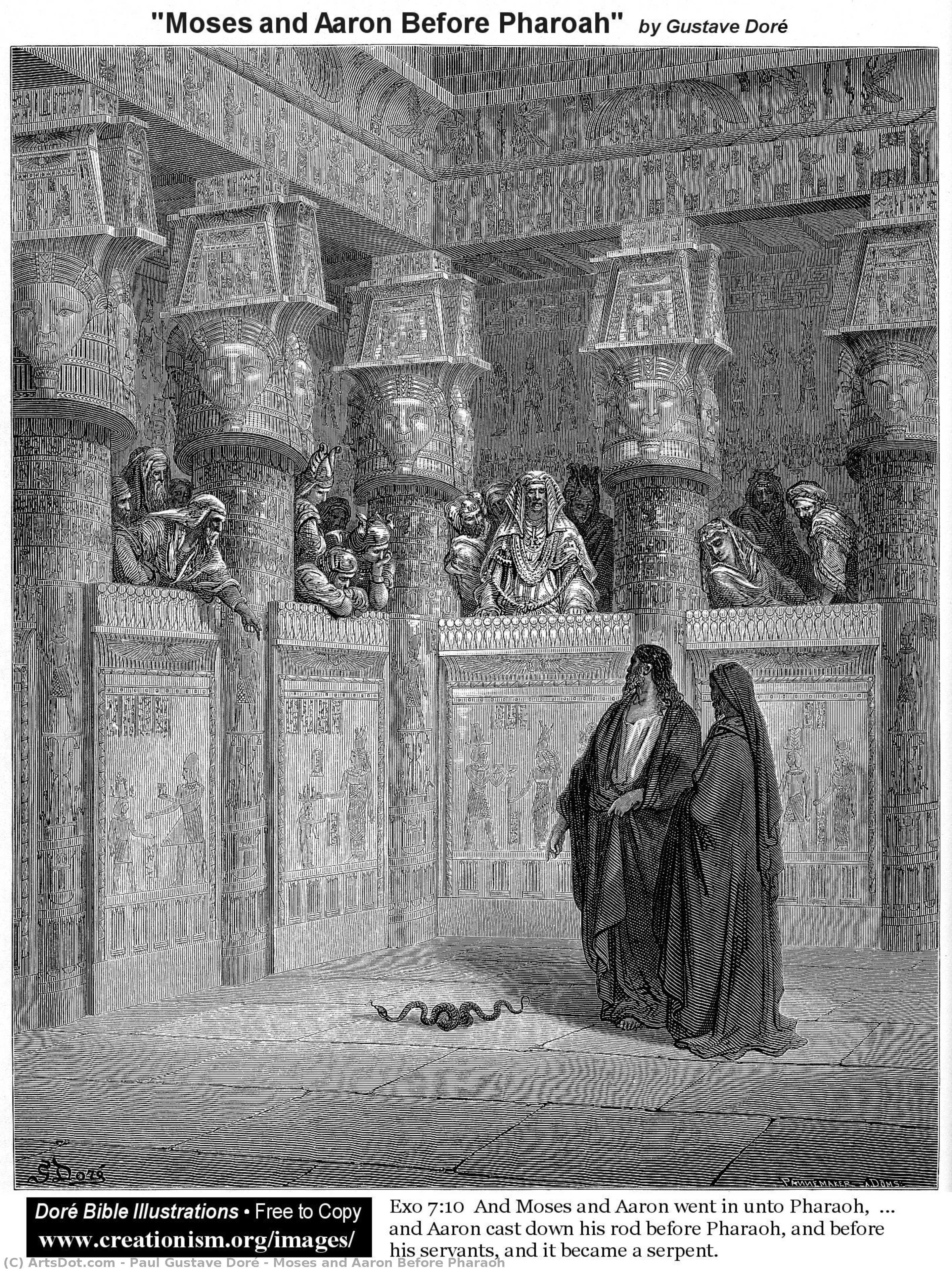
A Dramatic Encounter: Moses and Aaron Before Pharaoh
Paul Gustave Doré’s “Moses and Aaron Before Pharaoh” isn't merely an illustration; it’s a meticulously crafted tableau of biblical drama rendered in the uncompromising language of Romantic realism. Executed around 1867, this monumental wood engraving captures a pivotal moment from Exodus—the confrontation between Moses and Aaron before Pharaoh—a scene brimming with tension, authority, and the unwavering determination to liberate Israel from Egyptian oppression. Doré’s artistic vision transcends simple storytelling; he seeks to convey not just what happened but *how* it felt, immersing viewers in the grandeur of ancient Egypt and the palpable urgency of divine intervention.
- Composition & Setting: The engraving's masterful composition immediately establishes a sense of scale and importance. Doré divides the scene into distinct zones—the central figures of Moses and Aaron dominating the foreground against a backdrop of colossal columns adorned with elaborate capitals—creating a visual hierarchy that underscores Pharaoh’s regal presence and the Israelites’ desperate plea for freedom. The architectural elements serve as conduits for conveying emotion, mirroring the solemnity of the occasion.
- Line Work & Texture: Doré's signature technique—the direct method of engraving—allowed him unparalleled control over detail and tonal variation. Countless intersecting lines, primarily hatching, sculpt the forms of Moses, Aaron, Pharaoh, and the surrounding figures, generating a rich tapestry of textures that mimic stone surfaces and drapery folds. The density of hatching subtly communicates depth and emphasizes contours, bringing the scene to life with remarkable immediacy.
- Symbolism & Emotion: Beyond its narrative depiction, “Moses and Aaron Before Pharaoh” resonates with profound symbolic significance. Moses’ resolute gaze embodies courage and faith—a steadfast refusal to yield to tyranny—while Aaron’s posture reflects piety and priestly duty. The faces of the onlookers convey apprehension and hope, mirroring the anxieties and aspirations of the Israelites awaiting deliverance. Doré skillfully captures the emotional core of the biblical narrative, conveying a sense of drama and spiritual fervor.
- Historical Context & Style: Produced during the Victorian era, this engraving exemplifies the Romantic movement’s preoccupation with grand narratives and emotive expression. Doré's style aligns perfectly with the aesthetic sensibilities of his time—characterized by meticulous realism combined with theatrical flair—establishing him as a cornerstone of 19th-century illustration and cementing his legacy as one of history’s most influential artists.
- Technical Mastery: The engraving itself is a testament to Doré's technical prowess. Each line was painstakingly carved into a copper plate, meticulously inked, and pressed onto paper—a laborious process that demanded unwavering precision and patience. This technique ensured exceptional clarity and tonal gradation, elevating the artwork beyond mere representation to achieve an almost sculptural quality.
Explore this iconic masterpiece in stunning high-resolution reproductions at ArtsDot.