A Symphony in Shadow and Light: Exploring Gustave Doré’s Orlando Furioso
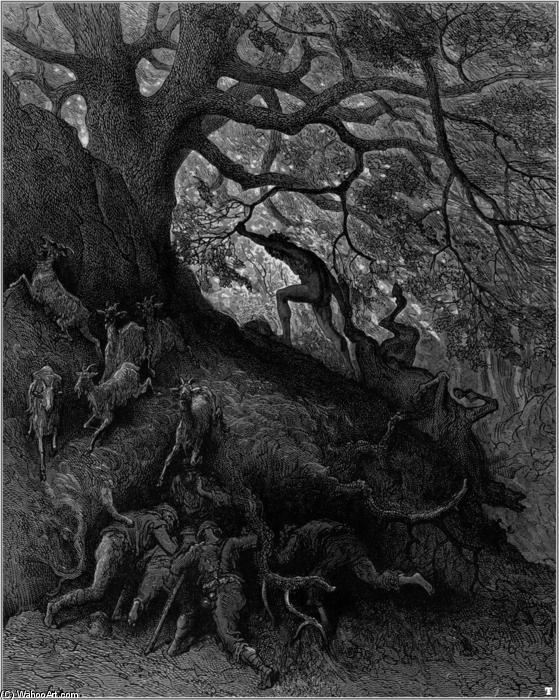
Gustave Doré's monumental woodcut illustration of Ludovico Ariosto’s *Orlando Furioso* stands as a testament to Romantic artistic fervor—a dramatic distillation of chivalric legend infused with psychological depth. Published around 1872, this artwork isn’t merely a depiction of the epic poem; it’s an embodiment of its spirit, capturing the tumultuous clash between idealism and despair that defines Ariosto's narrative. Doré’s masterful technique—characterized by meticulous cross-hatching and precise linework—transformed the printed page into a richly textured landscape of emotion and movement.
- The Composition: The image centers on a towering tree trunk, serving as an archway framing the central scene – Orlando climbing amidst a dense forest populated by fantastical creatures and human figures embroiled in a desperate struggle for survival. This architectural element immediately establishes a sense of grandeur and confinement simultaneously, mirroring the psychological complexities explored within the poem.
- Technique: Doré’s genius lay in his ability to convey atmosphere through line alone. The extensive use of cross-hatching creates an illusion of depth and texture, particularly evident on the tree bark and foliage—materials rendered with astonishing realism despite their inherent limitations of medium. This painstaking process demanded considerable skill and patience from Doré's assistants, resulting in a print that possesses an unparalleled level of detail.
- Symbolism: Beyond its visual splendor, *Orlando Furioso* is laden with symbolic resonance. The chaotic scene represents the fractured psyche of Orlando himself—consumed by obsession and driven to madness by his unattainable love for Angelica. The presence of both human and animalistic figures underscores the poem’s exploration of primal instincts alongside noble ideals.
- Historical Context: Doré's engraving emerged during a period marked by significant artistic innovation, reacting against the prevailing academic style of the time. Influenced by Romantic painters like Eugène Delacroix and Caspar David Friedrich, Doré sought to evoke emotion and convey psychological states—a departure from the idealized representations favored by earlier generations.
- Emotional Impact: The stark contrasts between light and shadow amplify the drama of the scene, emphasizing Orlando’s vulnerability against the backdrop of a formidable adversary. Doré's masterful rendering captures not only the physical environment but also the emotional turmoil at its core—a palpable sense of urgency and impending doom that continues to resonate with viewers today.
Doré’s *Orlando Furioso* transcends mere illustration; it is an artistic statement—a profound meditation on love, obsession, and the human condition. Its enduring appeal lies in its ability to transport us back to a time of Romantic idealism while simultaneously confronting us with unsettling truths about human psychology. The meticulous craftsmanship evident in every line speaks volumes about Doré’s dedication to capturing not just what he saw but what he felt—a legacy that secures his place as one of the most influential artists of the Victorian era.