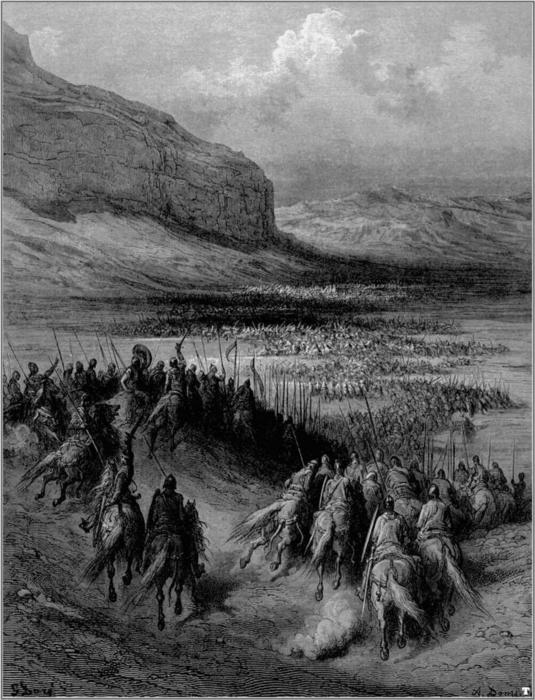
The artwork is part of Doré’s "History of the Crusades" series, showcasing his exceptional ability to depict historical events with vivid realism.
Paul Gustave Doré
Ottomans penetrate Hungary
Gustave Dore
Witness the dramatic clash of armies in Gustave Doré's "Ottomans Penetrate Hungary," a monumental wood engraving capturing the fervor and terror of Crusader warfare. Explore its meticulous de
Explore the dramatic wood engravings & illustrations of Gustave Doré (1832-1883). Master of Romanticism, famed for Biblical scenes, Dante's Inferno, and literary masterpieces. Discover his influential art!
A Clash of Empires: Examining Doré’s “Ottomans Penetrate Hungary”
Paul Gustave Doré's "Ottomans Penetrate Hungary," a wood engraving from his ambitious chronicle of the Crusades, stands as a testament to Romantic artistic fervor and masterful printmaking technique. More than just an illustration, it’s a visceral depiction of historical drama—a moment frozen in time where Christian forces confront the encroaching might of Ottoman armies, capturing the anxieties and grandeur of the era. The artwork's enduring appeal lies not only in its visual splendor but also in Doré’s ability to convey profound emotional resonance through meticulously crafted lines and tonal variations.
Composition and Technique: Orchestrating Movement on Metal
Doré’s compositional genius is immediately apparent upon viewing this print. He employs a pyramidal structure, anchoring the central mass of soldiers and cavalry at its apex—a deliberate choice designed to emphasize dominance and impending conflict. Diagonal lines originating from the horses' movements propel the viewer’s gaze across the scene, mirroring the dynamism of the battle itself. The low horizon line amplifies the scale of the landscape, underlining the sheer magnitude of the confrontation. Crucially, Doré achieves this dramatic effect through painstaking hatching and cross-hatching—a technique perfected in etching and engraving—applied with unwavering precision to define form and texture on the steel printing plate. These lines aren’t merely decorative; they are conduits for conveying volume, depth, and the palpable energy of the battlefield.
Monochromatic Drama: Capturing Emotion Through Tone
The artwork's striking monochrome palette—primarily shades of gray—is far from arbitrary. Doré consciously eschewed vibrant colors to heighten emotional impact and focus attention on tonal variations that illuminate the scene’s mood. The absence of color amplifies the sense of solemnity and underscores the seriousness of the historical narrative. Hatching and shading are employed extensively, creating a convincing illusion of rough terrain—rocky outcrops and undulating hills—and rendering the horses' coats with remarkable realism. Furthermore, subtle gradations of gray contribute to atmospheric perspective, simulating the haze that obscures distant elements and deepening the overall impression of grandeur.
Symbolism Beyond Representation: Echoes of Religious Conflict
“Ottomans Penetrate Hungary” transcends mere visual representation; it embodies symbolic significance rooted in the anxieties surrounding the Crusades. The confrontation between Christian and Ottoman armies symbolizes broader struggles for power and faith—a clash between civilizations grappling with competing ideologies. Doré’s depiction of the soldiers' faces, etched with grim determination, speaks to the psychological toll of warfare and underscores the bravery required to defend Christendom. The vast landscape serves as a backdrop not only for the battle but also as a metaphor for the challenges faced by faith itself—a reminder that righteousness must endure against overwhelming odds.
A Legacy of Romantic Grandeur
Ultimately, Doré’s “Ottomans Penetrate Hungary” exemplifies the core tenets of Romantic art: an obsession with emotion, an appreciation for dramatic narratives, and a commitment to capturing grandeur on a monumental scale. His masterful use of line work—characterized by energetic hatching and delicate cross-hatching—established him as one of the foremost printmakers of his time and cemented his place in artistic history. Reproductions of this iconic image offer collectors and interior designers alike an opportunity to experience Doré’s unparalleled vision – a timeless portrayal of conflict, courage, and the enduring power of art to convey profound emotional truths.