A Grim Testament to Confinement: Analyzing Doré’s “Prisoners in Newgate Prison Exercise Yard”
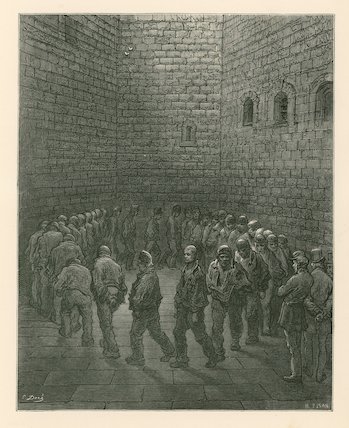
Paul Gustave Doré's engraving, "Prisoners in Newgate Prison Exercise Yard," transcends mere depiction; it embodies a profound exploration of human suffering and the oppressive nature of institutional control. Created during the Victorian era—a period marked by anxieties about social reform and burgeoning interest in psychological realism—the artwork serves as both a visual record of its time and an enduring symbol of despair. Doré’s masterful technique elevates this scene beyond simple observation, transforming it into a powerfully emotive experience for the viewer.
- Subject Matter & Context: The engraving captures a snapshot of Newgate Prison during the mid-19th century, reflecting anxieties surrounding penal reform and the dehumanizing conditions endured by incarcerated individuals. Doré’s work stemmed from his involvement in illustrating Dickens' *Oliver Twist*, cementing his reputation as a storyteller who could convey complex emotions through visual mediums.
- Style & Technique: Doré was undeniably a titan of engraving, employing meticulous detail and dramatic realism to achieve unparalleled expressive power. His technique—characterized by hatching and cross-hatching—allowed him to sculpt tonal variations within the monochrome palette, creating textures that convincingly simulate brickwork and fabric folds. This painstaking process demanded considerable skill and patience, resulting in an image brimming with palpable atmosphere.
- Composition & Perspective: The vertical orientation of the engraving immediately establishes a sense of confinement, mirroring the towering prison walls. Linear perspective guides the eye towards the distant exercise yard, emphasizing depth while simultaneously reinforcing the feeling of isolation. Doré skillfully arranges figures within the frame, creating groupings that heighten the impact of their collective misery.
- Symbolism & Emotional Impact: Beyond its literal representation, “Prisoners in Newgate Prison Exercise Yard” operates on a symbolic level. The oppressive walls represent societal constraints and the loss of freedom, while the postures and expressions of the prisoners convey resignation and sorrow. Doré’s ability to evoke such visceral emotion underscores his artistic genius—he doesn't simply show us prison; he transmits its crushing weight onto the viewer.
- Decorative Potential: Considering its textural richness and evocative mood, this engraving lends itself beautifully to interior design projects seeking a statement piece that speaks to themes of resilience and contemplation. Reproductions offer an opportunity to bring Doré’s dramatic vision into contemporary spaces, reminding us of the enduring power of art to confront uncomfortable truths.