Paul Gustave Louis Christophe Doré, celebrated as Gustave Doré, was a prodigious artist who seamlessly blended illustration, painting, and sculpture. Born in Strasbourg, France, on January 6th, 1832, his artistic journey unfolded during the Romantic era's twilight, marked by evolving aesthetic sensibilities.
Strasbourg
France
1832
1883
Paul Gustave Doré
Monochromatic gray tones dominate the
A Vision of Romantic Drama: Gustave Doré’s “Puss in Boots”
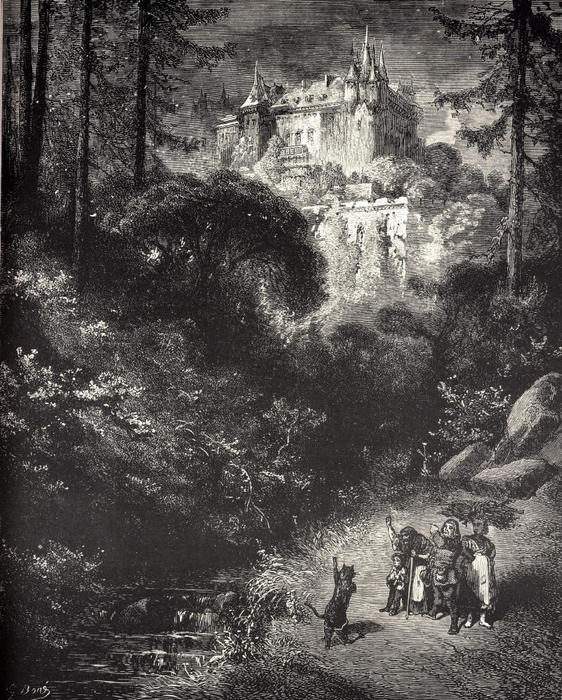
Paul Gustave Doré's "Puss in Boots," etched with meticulous detail onto wood, transcends mere illustration; it embodies the spirit of Romanticism itself. Created between 1865 and 1866 for Alexandre Dumas père’s retelling of the classic tale, this artwork isn’t simply a depiction of a beloved story—it's an immersive experience designed to transport viewers into the heart of adventure and peril. Doré’s masterful command of tonal variation and hatching techniques elevates the image beyond a simple narrative representation, transforming it into a palpable landscape of psychological tension.
- Style & Technique: Doré’s signature style—characterized by bold lines and dramatic shading—is perfectly suited to capturing the essence of Dumas's narrative. He employed wood engraving, a painstaking process involving carving an image onto a block of wood before applying ink and pressing it onto paper multiple times to achieve rich, velvety blacks and subtle gradations of tone. This technique demanded immense patience and precision, resulting in prints that retain remarkable clarity and textural depth even today.
- Composition & Perspective: The pyramidal composition directs the viewer’s gaze upwards towards the imposing castle perched atop a rugged mountain ridge—a visual metaphor for ambition and aspiration. Linear perspective skillfully renders distance, subtly diminishing the size of trees and rocks as they recede into the shadowy forest depths. Atmospheric perspective further enhances this illusion of depth, creating an ethereal quality that underscores the narrative's mood.
- Historical Context: Doré’s work emerged during a period marked by fervent Romantic idealism—a reaction against Enlightenment rationality—and a fascination with folklore and mythology. Dumas’s adaptation of “Puss in Boots” tapped into this cultural zeitgeist, exploring themes of courage, cunning, and the triumph of spirit over circumstance.
Symbolism & Emotional Impact: The dark forest serves as a potent symbol of uncertainty and danger—a formidable obstacle confronting Puss in Boots’s quest for glory. Simultaneously, the castle represents power and authority, embodying both the allure and intimidation inherent in pursuing lofty goals. Doré's masterful use of light and shadow amplifies these symbolic resonances, evoking feelings of suspense, anticipation, and ultimately, hope. The artist’s ability to convey emotion through line alone speaks volumes about his artistic vision—a testament to the enduring power of Romantic art.
Further Exploration: To appreciate Doré's genius fully, consider examining reproductions of other iconic wood engravings from his oeuvre, including scenes from Dante’s Inferno and biblical narratives. These works demonstrate Doré’s unwavering commitment to capturing dramatic emotion and conveying profound psychological insight—qualities that continue to inspire artists and collectors alike.