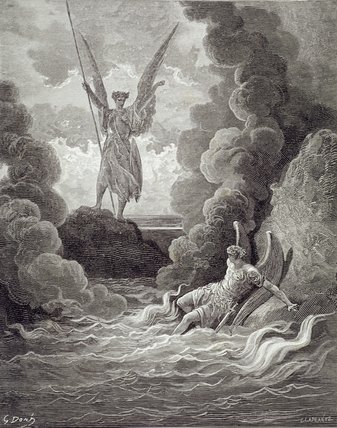
Experience the dramatic power of Gustave Doré's 'Satan And Beelzebub,' a masterful engraving depicting Lucifer’s triumph over Beelzebub amidst turbulent seas and stormy skies—a cornerstone of Christian mythology.
Explore the dramatic wood engravings & illustrations of Gustave Doré (1832-1883). Master of Romanticism, famed for Biblical scenes, Dante's Inferno, and literary masterpieces. Discover his influential art!
A Descent Into Darkness: Examining Gustave Doré’s “Satan And Beelzebub”
The engraving "Satan And Beelzebub," created by Paul Gustave Doré in 1867, stands as a monumental achievement of Victorian printmaking and a chilling depiction of biblical narrative. More than just a visually striking image—characterized by its dramatic chiaroscuro and masterful linework—it’s a profound meditation on themes of rebellion, divine retribution, and the eternal struggle between good and evil. Doré's work captures the visceral horror of Lucifer’s defiance against God, transforming scripture into an unforgettable visual experience.
The Dramatic Composition & Technique
Doré’s artistic prowess is immediately evident in his compositional choices. He employs a powerful diagonal perspective, guiding the viewer’s gaze from Beelzebub’s calamitous fall on the lower right to Satan’s defiant stance atop a rocky outcrop dominating the upper left quadrant. This dynamic arrangement isn't merely aesthetically pleasing; it serves to amplify the narrative tension and underscore the central conflict. The artist skillfully utilized steel engraving, a technique demanding painstaking precision—a burin tool was meticulously etched into a metal plate, transferring lines onto the surface with remarkable accuracy. Layers of hatching and shading achieved through varying line density create an astonishing level of textural detail, conveying both the turbulent atmosphere of the storm-wracked sky and the physicality of the figures involved.
Historical Context & Biblical Symbolism
“Satan And Beelzebub” emerged during a period marked by fervent religious fervor within Victorian England. Doré’s engraving reflects the anxieties surrounding Darwinian evolution and the questioning of traditional beliefs, presenting a stark contrast between divine majesty and demonic corruption. The scene draws heavily from Ezekiel chapter 28, recounting Lucifer's expulsion from Heaven for pride and rebellion against God. Satan’s spear symbolizes his assertion of power—a futile attempt to reclaim dominion over creation—while Beelzebub’s descent embodies utter defeat and despair. The imagery is deliberately unsettling, designed to provoke contemplation on moral responsibility and the consequences of transgression.
Emotional Resonance & Artistic Legacy
Beyond its technical brilliance, Doré's engraving possesses a remarkable emotional depth. The artist expertly captures the psychological torment experienced by Lucifer—his arrogance fueled by ambition—and the palpable terror felt by Beelzebub as he loses his place among the angels. This portrayal resonates powerfully with viewers today, tapping into universal anxieties about mortality and judgment. Gustave Doré’s “Satan And Beelzebub” continues to inspire artists and designers alike, demonstrating the enduring power of visual storytelling and its ability to convey complex theological ideas in a compelling and unforgettable manner. Its influence can be seen in countless subsequent illustrations and artworks exploring themes of darkness, heroism, and spiritual conflict—a testament to Doré’s singular contribution to the artistic canon.