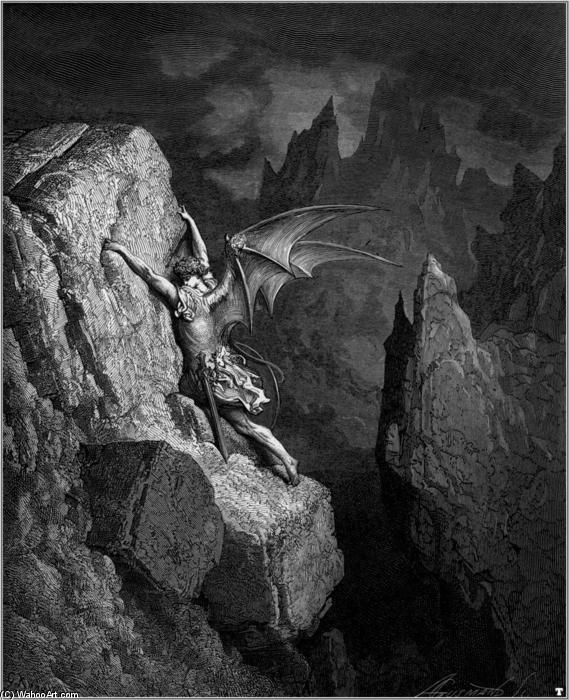
Doré's 'Satan's Flight Through Chaos' depicts a dramatic struggle amidst a turbulent landscape, showcasing Romanticism's power and despair through expressive lines and stark contrasts.
Explore the dramatic wood engravings & illustrations of Gustave Doré (1832-1883). Master of Romanticism, famed for Biblical scenes, Dante's Inferno, and literary masterpieces. Discover his influential art!
Satan's Flight Through Chaos: A Descent into Romantic Turmoil
Paul Gustave Doré’s “Satan’s Flight Through Chaos,” created around 1868, is not merely an illustration; it’s a visceral plunge into the heart of despair and defiance. Born from the depths of Milton’s *Paradise Lost*, this black-and-white engraving captures a pivotal moment – Satan's tumultuous descent after his expulsion from Heaven. The artwork transcends its literary origins, becoming a powerful exploration of human struggle against overwhelming forces, rendered with Doré’s signature dramatic flair and technical mastery. It is a scene steeped in Romanticism, an era that prized emotion, individualism, and the sublime—often found in the face of darkness and destruction. The sheer scale of the imagined landscape, coupled with the central figure's desperate struggle, evokes a sense of awe and terror, hallmarks of the Romantic aesthetic.
A Landscape of Despair: Technique and Composition
Doré’s genius lies not only in his imaginative vision but also in his unparalleled skill as an engraver. The piece is a testament to the power of line – thick, dark strokes defining Satan's tormented form and the jagged, unforgiving rocks that surround him. He masterfully employs hatching and cross-hatching techniques, building up layers of tonal variation to create depth and texture. Observe how the light dramatically illuminates Satan’s figure, highlighting his muscularity and the strain etched upon his face, while casting deep shadows across the chaotic landscape. This stark contrast amplifies the sense of isolation and struggle. The composition itself is dynamic; a diagonal thrust propels the viewer's eye upward along a steep incline, mirroring Satan’s desperate flight. The angular shapes – sharp rock formations and pointed wings – contribute to an overall feeling of instability and impending doom. It’s important to remember that Doré rarely cut the woodblocks himself; he designed the image, and skilled artisans translated his vision into physical form—a process that speaks to the collaborative nature of printmaking during this period.
Symbolism in Shadow: Milton's Legacy and Beyond
The artwork is rich with symbolic meaning rooted in *Paradise Lost*. Satan’s fall represents not just a biblical narrative but also a universal allegory for rebellion, pride, and the consequences of defying divine authority. The chaotic landscape isn’t merely a backdrop; it embodies the turmoil of Hell itself – a realm devoid of order and hope. The jagged rocks symbolize the obstacles and suffering that await those who stray from grace. However, Doré's interpretation transcends simple religious iconography. The image resonates with broader themes of human struggle against adversity—a theme particularly relevant during the 19th century, an era marked by social upheaval and industrialization. One can interpret Satan’s defiance as a symbol of individual resistance against oppressive forces, even if that resistance leads to ruin. The absence of color further enhances the sense of bleakness and despair; it strips away any potential for beauty or redemption, leaving only the raw essence of struggle.
An Enduring Emotional Impact: A Window into the Romantic Soul
“Satan’s Flight Through Chaos” continues to captivate viewers today because of its profound emotional impact. The image evokes a sense of dread and awe—a feeling that arises from confronting something both powerful and terrifying. Doré's ability to convey such intense emotion through black-and-white engraving is remarkable. The artwork speaks to the Romantic fascination with darkness, the sublime, and the exploration of human psychology in its most extreme states. It’s a reminder of our own vulnerabilities and the enduring power of myth and legend to illuminate the complexities of the human condition. The piece isn't just about Satan; it is about the universal experience of facing insurmountable odds and the desperate fight for survival—a theme that continues to resonate with audiences across generations.