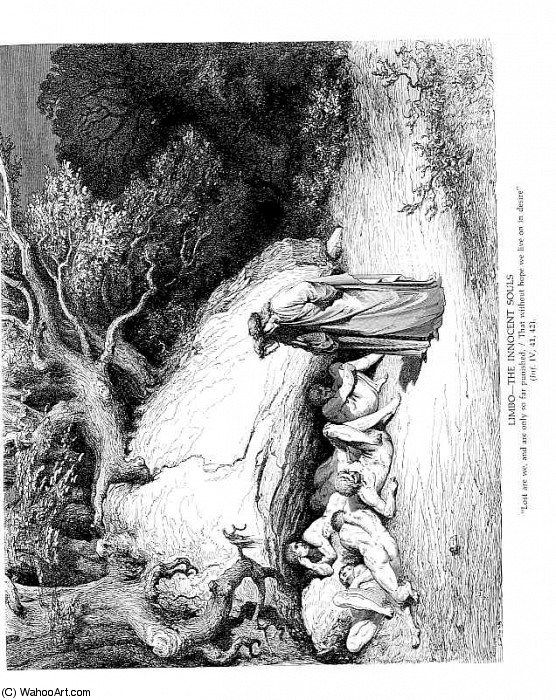
A Descent into Darkness: Analyzing Gustave Doré’s “The Innocent Souls”
Paul Gustave Doré's "The Innocent Souls," a monumental black-and-white engraving, transcends mere visual representation; it embodies the very spirit of Romanticism and delves into profound themes of faith, suffering, and spiritual pilgrimage. Executed in 1869, this artwork serves as a cornerstone of Dante Alighieri’s “Inferno,” capturing the harrowing journey undertaken by Dante and Virgil through Hell's nine circles – a narrative powerfully rendered with Doré’s signature meticulous line work and masterful tonal control.
- Composition & Narrative Depth: The engraving’s complex arrangement immediately draws the viewer into its dramatic core. A central figure, draped in regal robes, descends from above—representing Virgil—supporting Dante as he navigates the treacherous landscape of Hell. Surrounding him are numerous tormented souls clinging to jagged rock formations, symbolizing humanity's struggle against sin and despair. Doré skillfully utilizes overlapping figures and intricate details to convey not just a visual depiction but also an emotional experience.
- Technique & Material Considerations: Doré’s technique is exemplary of the engraving process—a painstaking method involving transferring a design onto a copper plate, etching lines into its surface with acid, and then applying ink before pressing it onto paper. The resulting image boasts exceptional tonal range achieved through hatching and cross-hatching, demonstrating Doré's mastery of printmaking and highlighting the textural richness inherent in the medium.
- Romantic Symbolism & Emotional Resonance: “The Innocent Souls” resonates deeply with Romantic ideals—a preoccupation with emotion, imagination, and the sublime—reflecting Dante’s exploration of moral corruption and divine justice. The pervasive gloom, punctuated by flashes of light illuminating tormented faces, evokes feelings of melancholy and apprehension. Doré's expressive linework captures the palpable anguish of those trapped within Hell’s abyss, prompting contemplation on themes of redemption and spiritual torment.
- Historical Context & Artistic Influence: Produced during a period marked by intellectual ferment—the Victorian era—Doré’s engraving aligns seamlessly with Romantic artistic conventions prevalent at the time. It stands as an influential illustration for Dante's epic poem, cementing Doré’s reputation as one of the foremost visual interpreters of literature and bolstering his legacy as a champion of dramatic storytelling through printmaking.
- Decorative Potential & Artistic Appreciation: Beyond its narrative power, “The Innocent Souls” possesses undeniable aesthetic qualities. Its stark monochrome palette—dominated by shades of gray—creates an atmosphere of solemn grandeur, ideal for incorporating into interior design schemes that prioritize sophistication and contemplative beauty. Reproductions offer a remarkable opportunity to experience Doré’s artistic vision firsthand.