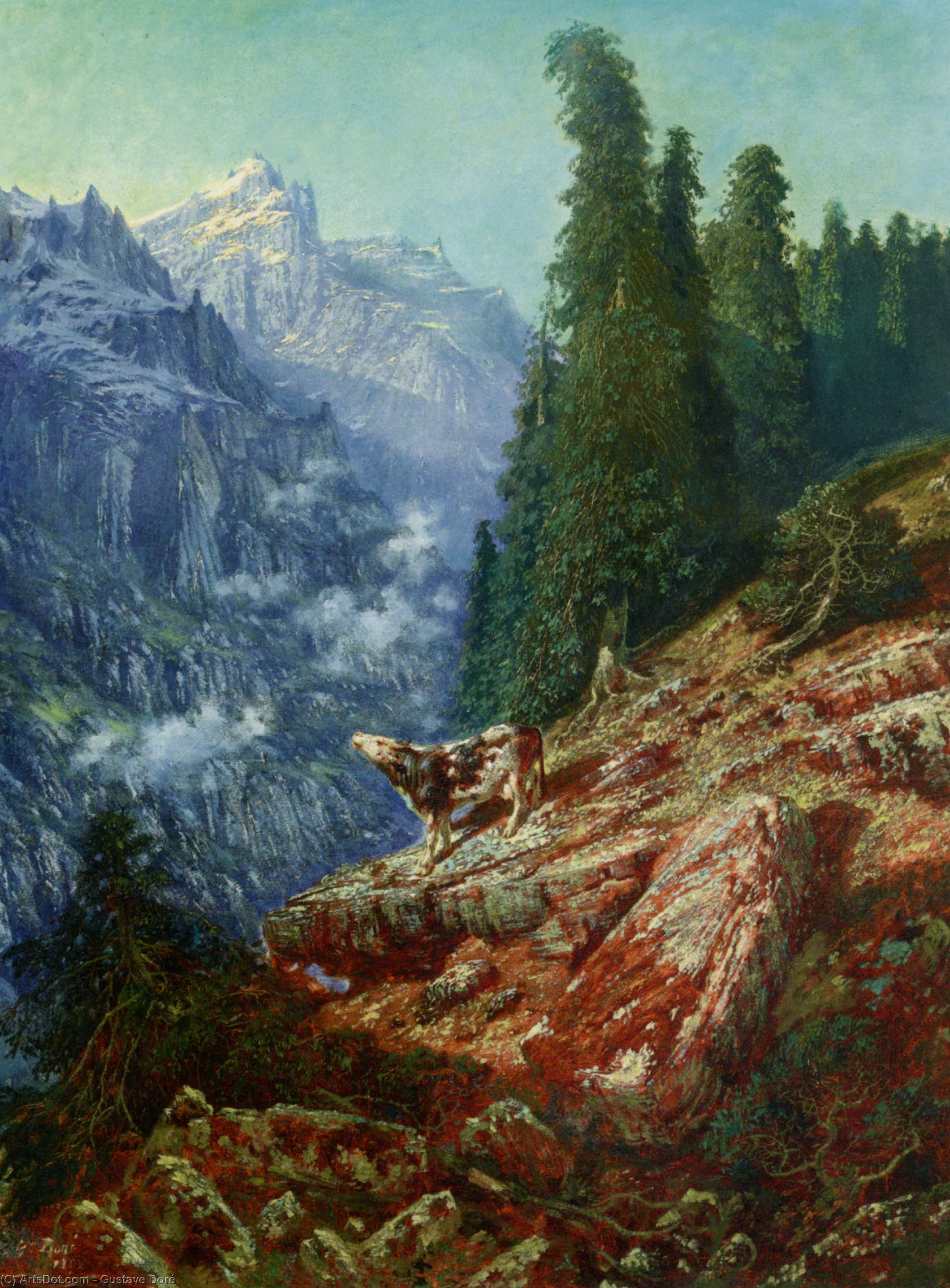
Gustave Doré’s Romantic masterpiece captures a solitary cow contemplating the vast mountain landscape—a poignant symbol of contemplation amidst breathtaking beauty. Explore this iconic 1852 painting and immerse yourself in Doré's dramatic style at ArtsDot.
Explore the dramatic wood engravings & illustrations of Gustave Doré (1832-1883). Master of Romanticism, famed for Biblical scenes, Dante's Inferno, and literary masterpieces. Discover his influential art!
A Moment Frozen in Time: Exploring Paul Gustave Doré’s “The Lost Cow”
Paul Gustave Doré's "The Lost Cow" isn’t merely a depiction of livestock; it’s an embodiment of Romantic idealism distilled onto canvas. Created in 1852, this oil on canvas painting transcends the simple observation of rural life, delving into profound questions about solitude, contemplation, and humanity’s relationship with the sublime beauty of nature. Measuring precisely 130 x 90 cm, the artwork commands attention not just for its size but for Doré's masterful execution—a testament to his unwavering commitment to capturing emotion and atmosphere.
Composition and Technique: Capturing the Essence of Romantic Landscape
Doré’s compositional choices are deliberate and impactful. The central cow stands poised on a precipice overlooking a vast mountainous expanse, immediately establishing a dramatic visual hierarchy. This isn't a pastoral scene designed for comfort; rather, it’s imbued with tension—the cow’s gaze fixed upwards suggests an awareness of the immensity beyond its immediate surroundings, mirroring the Romantic preoccupation with confronting overwhelming forces. Doré skillfully employs atmospheric perspective, layering shades of grey and ochre to convey depth and creating a palpable sense of coldness and isolation. Brushstrokes are loose and expressive, prioritizing tonal variation over meticulous detail—a technique characteristic of Romantic painters who sought to evoke feeling rather than simply reproducing reality.
Historical Context: Romanticism’s Quest for Emotion and Imagination
“The Lost Cow” emerged during the height of Romanticism, a movement that reacted against Enlightenment rationalism with fervent belief in emotion, imagination, and intuition. Artists like Doré wrestled with themes of spirituality, melancholy, and the sublime—the awe-inspiring grandeur of nature that inspires both terror and reverence. The painting reflects this intellectual climate by portraying a landscape imbued with spiritual significance; it’s not simply scenery but a conduit for conveying inner states of mind. Furthermore, the depiction aligns with Romantic artists' fascination with folklore and mythology, hinting at an underlying narrative beyond the surface appearance.
Symbolism: Beyond Appearances – A Reflection of Human Condition
The cow itself serves as a powerful symbol—representing innocence, vulnerability, and perhaps even sacrifice. Its solitary stance reinforces the theme of isolation, prompting viewers to consider the human condition against the backdrop of untamed wilderness. The cliff edge symbolizes precariousness and uncertainty, mirroring life’s challenges and reminding us that beauty can coexist with hardship. Doré's masterful use of color contributes to this symbolic resonance; the muted palette underscores the melancholic mood and emphasizes the cow’s contemplative gaze.
Emotional Impact: An Invitation to Contemplation
Ultimately, “The Lost Cow” succeeds in transporting the viewer to a realm of profound contemplation. It invites us to ponder questions about our place within the natural world and to embrace moments of quiet introspection—a core tenet of Romantic art. The painting’s enduring appeal lies in its ability to evoke feelings of serenity mingled with melancholy, prompting viewers to confront their own emotions and appreciate the beauty of simplicity. For those seeking a stunning reproduction that captures Doré's artistic vision, ArtsDot offers exceptional quality prints crafted with meticulous attention to detail.