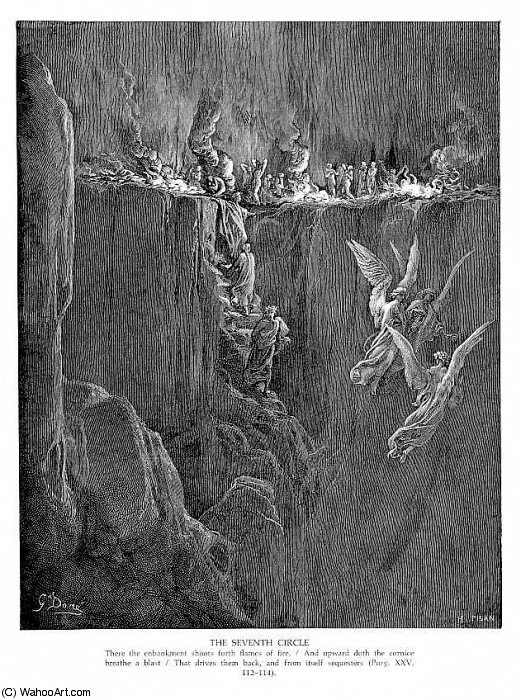
This engraving, ‘The Seventh Circle,’ exemplifies Gustave Doré’s Romantic style through meticulous detail and expressive linework. Created in the mid-19th century, it depicts a harrowing descent into hell as envisioned by Dante Alighieri's *Inferno*, featuring tormented souls engulfed in flames against a backdrop of jagged cliffs and swirling vortexes. Doré skillfully employs dense crosshatching t
A Descent Into Darkness: Gustave Doré’s ‘The Seventh Circle’
Gustave Doré's “The Seventh Circle,” etched with breathtaking precision and imbued with the spirit of Romanticism, transcends mere illustration; it’s a visceral journey into Dante Alighieri’s Inferno—a visual distillation of torment and despair that continues to captivate audiences centuries later. Created in 1869, this monumental engraving embodies Doré's unparalleled ability to translate literary vision into tangible artistic form, cementing his place as one of the foremost printmakers of his era.
- Subject Matter: The artwork depicts Dante and Virgil’s harrowing descent into Hell’s seventh circle—the realm of treachery and deceit—where souls tormented by betrayal are consumed by eternal fire. Doré meticulously captures the dramatic confrontation between virtuous heroes and demonic forces, mirroring the narrative core of Dante's epic poem.
- Style & Technique: Doré’s Romantic style is characterized by a fervent embrace of emotion and imagination, skillfully blended with meticulous detail. Employing the technique of engraving—specifically copper etching—he achieved remarkable tonal range through dense cross-hatching, creating an illusion of depth and texture that rivals oil painting. The process involved transferring a design onto a metal plate, meticulously incising lines to create the image before applying ink and pressing it onto paper.
- Historical Context: Published alongside Dante’s *Inferno*, Doré's engraving served as a crucial visual companion to the literary masterpiece, amplifying its impact on Victorian audiences. It reflects the broader Romantic preoccupation with exploring the darker recesses of human experience—fear, suffering, and moral transgression—and aligns with the movement’s fascination for mythology and biblical narratives.
- Symbolism & Emotional Impact: The swirling flames symbolize punishment and eternal torment, reflecting Dante's depiction of Hell as a landscape of agonizing pain. The anguished expressions on Virgil and Dante’s faces convey profound sorrow and fear, mirroring the psychological drama inherent in the poem. Doré’s masterful use of lighting—a radiant glow emanating from below—further enhances the dramatic atmosphere, emphasizing the vulnerability of humanity against overwhelming forces.
- Composition & Visual Elements: The composition is dominated by a towering cliff face plunging into a vortex of fire, creating a sense of vertigo and conveying the immensity of Hell. Geometric shapes—particularly angular rocks—contrast with organic forms representing human figures and flames, reinforcing the artwork’s visual dynamism. Doré's masterful line work contributes to the overall impression of grandeur and terror.
“The Seventh Circle” remains a testament to Doré’s artistic genius—a haunting reminder of humanity’s capacity for cruelty and despair, yet simultaneously imbued with an enduring fascination for beauty born from darkness. Its exquisite detail and expressive power continue to inspire admiration and serve as a compelling subject for high-quality reproductions.