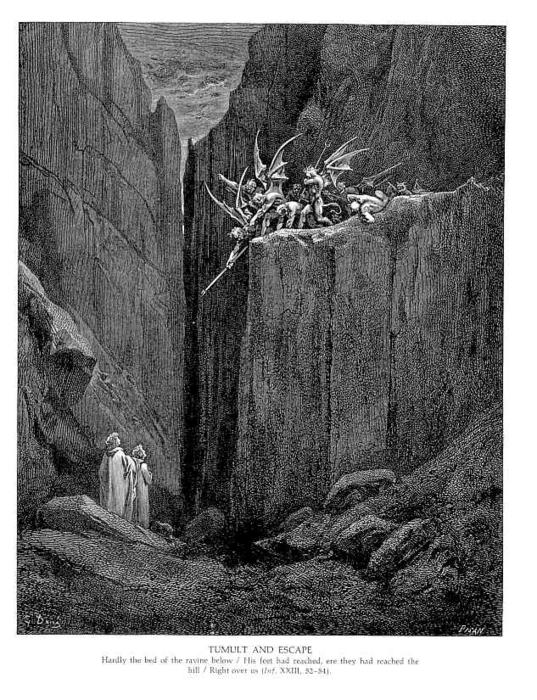
Experience the dramatic intensity of Gustave Doré's 'Tumult and Escape,' an engraving depicting a perilous ravine teeming with demonic creatures as figures strive to ascend from its depths – Romanticism at its finest.
Explore the dramatic wood engravings & illustrations of Gustave Doré (1832-1883). Master of Romanticism, famed for Biblical scenes, Dante's Inferno, and literary masterpieces. Discover his influential art!
Tumult and Escape: A Descent into Dramatic Imagination
A chilling glimpse into the abyss of human experience, Gustave Doré’s “Tumult and Escape” transcends mere visual representation; it embodies a profound exploration of fear, faith, and the struggle for redemption. Executed in meticulous engraving technique—a medium favored by Romantic artists—this artwork captures a scene ripped straight from Dante Alighieri's Inferno, translating the poet’s harrowing vision into a powerfully rendered image that continues to resonate with audiences today.
The Composition: Verticality and Chaotic Movement
Doré’s masterful compositional choices immediately establish a sense of unease. The dominant vertical lines of the ravine dominate the canvas, emphasizing its immense scale and conveying an overwhelming feeling of vulnerability. Diagonal lines intersect within the ravine, guiding the viewer's eye upwards towards the swirling vortex of demonic activity above—a deliberate tactic designed to heighten tension and dramatize the perilous journey depicted. Careful attention to perspective subtly distorts reality, fostering a disconcerting disorientation that mirrors the psychological torment faced by those confronting insurmountable obstacles.
Engraving Technique: Detail and Texture Through Precision
The engraving process itself is remarkable for its intricacy. Doré painstakingly scratched lines into a copper plate using etching tools—a laborious undertaking demanding unwavering concentration and precision. Subsequent inking and printing produced an image characterized by astonishing detail and textural richness. Hatching and cross-hatching techniques were employed extensively to sculpt shading and volume, transforming the rocky landscape into a palpable presence. The resulting surface possesses a remarkable tactile quality, mirroring the artist’s ambition to convey not just what he saw but also how it *felt*.
Symbolism: Inferno's Echoes and Spiritual Struggle
“Tumult and Escape” is steeped in symbolism derived from Dante’s Inferno. The chasm represents the metaphorical abyss of sin and suffering—a journey undertaken by humanity towards spiritual purification. The winged demons embody temptation and evil forces, relentlessly pursuing those attempting to ascend toward salvation. Yet, amidst this overwhelming darkness, two figures stand defiant, representing resilience and unwavering faith. Their posture conveys a mixture of awe and apprehension as they gaze upon the terrifying spectacle unfolding above, underscoring the profound psychological impact of confronting existential dread.
Romantic Vision: Emotion and Sublime Beauty
Doré’s work firmly anchors itself within the Romantic aesthetic—a movement that prioritized emotion over reason and celebrated the sublime beauty found in nature's grandeur alongside its inherent terror. The dramatic chiaroscuro lighting—the interplay between light and shadow—amplifies the emotional intensity of the scene, creating a visceral experience for the viewer. Ultimately, “Tumult and Escape” serves as a testament to Doré’s ability to distill complex philosophical ideas into visually arresting imagery, cementing his legacy as one of Romanticism's most influential illustrators.