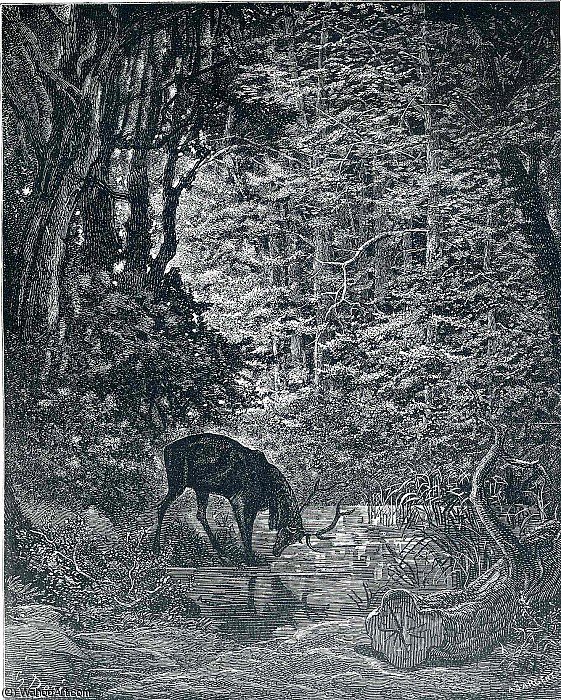
A Vision of Tranquility: Examining Gustave Doré’s “untitled (8116)”
Paul Gustave Doré's "untitled (8116)" stands as a testament to the enduring power of Romantic engraving, transporting viewers back to a bygone era defined by meticulous detail and an unwavering commitment to realism. Executed in 1879, this striking monochrome print captures a serene forest scene teeming with wildlife—a deliberate choice reflecting Doré’s fascination with both natural beauty and biblical narratives, themes that would dominate his prolific artistic output throughout his career.
- Composition & Subject Matter: The artwork centers around a magnificent stag positioned prominently near the water's edge, surrounded by dense foliage. Doré skillfully employs linear perspective to convey depth, guiding the eye upwards through the layered trees and creating an illusion of expansive space. Scattered animals—deer, rabbits, birds—further enrich the scene, portraying a microcosm of the natural world brimming with life.
- Technique & Style: Doré’s masterful technique is rooted in the art of wood engraving – a painstaking process involving carving intricate lines into a metal plate and transferring ink onto paper. The resulting image boasts an astonishing level of textural detail achieved through hatching and cross-hatching, meticulously rendering shadows and form with remarkable precision. This method lends itself particularly well to capturing the ruggedness of bark and the subtle nuances of animal fur, contributing significantly to the artwork’s immersive quality.
- Color Palette & Lighting: Strikingly devoid of color, “untitled (8116)” relies entirely on shades of gray—ranging from darkest charcoal to pale ivory—to establish a mood of contemplative stillness. The diffused lighting suggests an overcast day, casting soft shadows that heighten the sense of tranquility and emphasizing the textures of the forest landscape.
- Symbolism & Emotional Impact: Beyond its aesthetic beauty, Doré’s print carries symbolic weight. The stag, often associated with nobility and strength, embodies resilience and grace amidst vulnerability—a motif prevalent in Romantic art. More broadly, the scene evokes feelings of reverence for nature and a yearning for solitude, inviting contemplation on themes of harmony between humanity and the environment.
- Historical Context: Doré’s work emerged during a pivotal moment in European artistic history – the waning years of Romanticism. Influenced by artists like Caspar David Friedrich and Eugène Delacroix, Doré sought to convey profound emotional experiences through meticulously rendered images rooted in observation. His prints served as visual companions to literary masterpieces, furthering the Romantic ideal of uniting art and intellect.
Further Exploration: To delve deeper into Doré’s artistic vision and appreciate the legacy of Romantic engraving, we encourage you to visit
the artwork database for high-quality reproductions and scholarly insights. You can also discover more about Doré’s life and artistic influences at
Doré's Artist Profile. Don’t miss our article on “Paul Gustave Doré: A Master of Romantic Realism & the Illustrated Imagination” for a comprehensive understanding of his contribution to art history!
Learn More