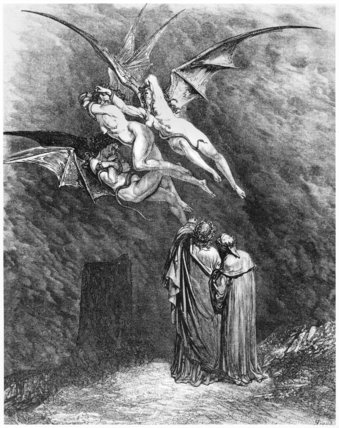
Virgil Dante And The Erinyes: A Descent Into Darkness Rendered in Dramatic Monochrome
Paul Gustave Doré’s *Virgil Dante And The Erinyes* stands as a monumental achievement of Romantic illustration, capturing the visceral horror and psychological torment inherent within Dante Alighieri's *Inferno*. Executed as a wood engraving—a technique prized for its precision and tonal range—the artwork transcends mere depiction; it strives to embody the very essence of Dante’s harrowing journey through Hell.
- Composition & Narrative Depth: The scene unfolds with masterful dynamism. Doré centers his gaze on Dante and Virgil, positioned strategically at the lower right, immediately establishing a focal point for the viewer's eye. Above them looms the trio of winged figures—the Erinyes—dominating the upper expanse, conveying an overwhelming sense of movement and unease. This deliberate arrangement isn’t merely aesthetically pleasing; it reflects Dante’s perilous quest for salvation amidst unimaginable suffering.
- Technique & Linework Mastery: Doré's skill lies in his meticulous linework—a hallmark of engraving. Thick, bold lines delineate the colossal rock formations and monumental figures, while finer lines meticulously capture drapery folds, facial expressions, and subtle textural nuances. Hatching and cross-hatching techniques are deployed extensively to sculpt tonal values, creating a palpable illusion of three dimensionality that surpasses what would be achievable with paint alone.
- Symbolism & Emotional Resonance: The monochromatic palette—primarily shades of gray—amplifies the artwork’s emotional impact. It underscores the bleakness and despair of Hell, mirroring Dante's internal struggle as he confronts sin and damnation. The Erinyes themselves symbolize retribution and divine justice, embodying the terrifying consequences of earthly transgressions.
- Historical Context & Romantic Idealism: Produced in 1869, *Virgil Dante And The Erinyes* exemplifies the Romantic movement’s fascination with dramatic narratives and emotional intensity. Doré's work aligns perfectly with Dante’s poetic vision—a profound exploration of morality and human psychology—solidifying its place as a cornerstone of Victorian art.
- Lighting & Atmosphere: Dramatic directional lighting casts long shadows, emphasizing musculature and intensifying the scene’s oppressive atmosphere. This masterful use of chiaroscuro contributes significantly to the artwork's unsettling mood, mirroring Dante’s descent into darkness and reinforcing the overarching theme of existential terror.
More than just a visual representation of Dante’s Inferno, Doré’s engraving is an immersive experience—a testament to his unparalleled ability to translate literature into unforgettable imagery. Its enduring power resides in its capacity to evoke profound contemplation on themes of morality, faith, and the human condition.