A Tumultuous Scene: Exploring Pollock’s ‘Sin título (Hombre desnudo con cuchillo)’
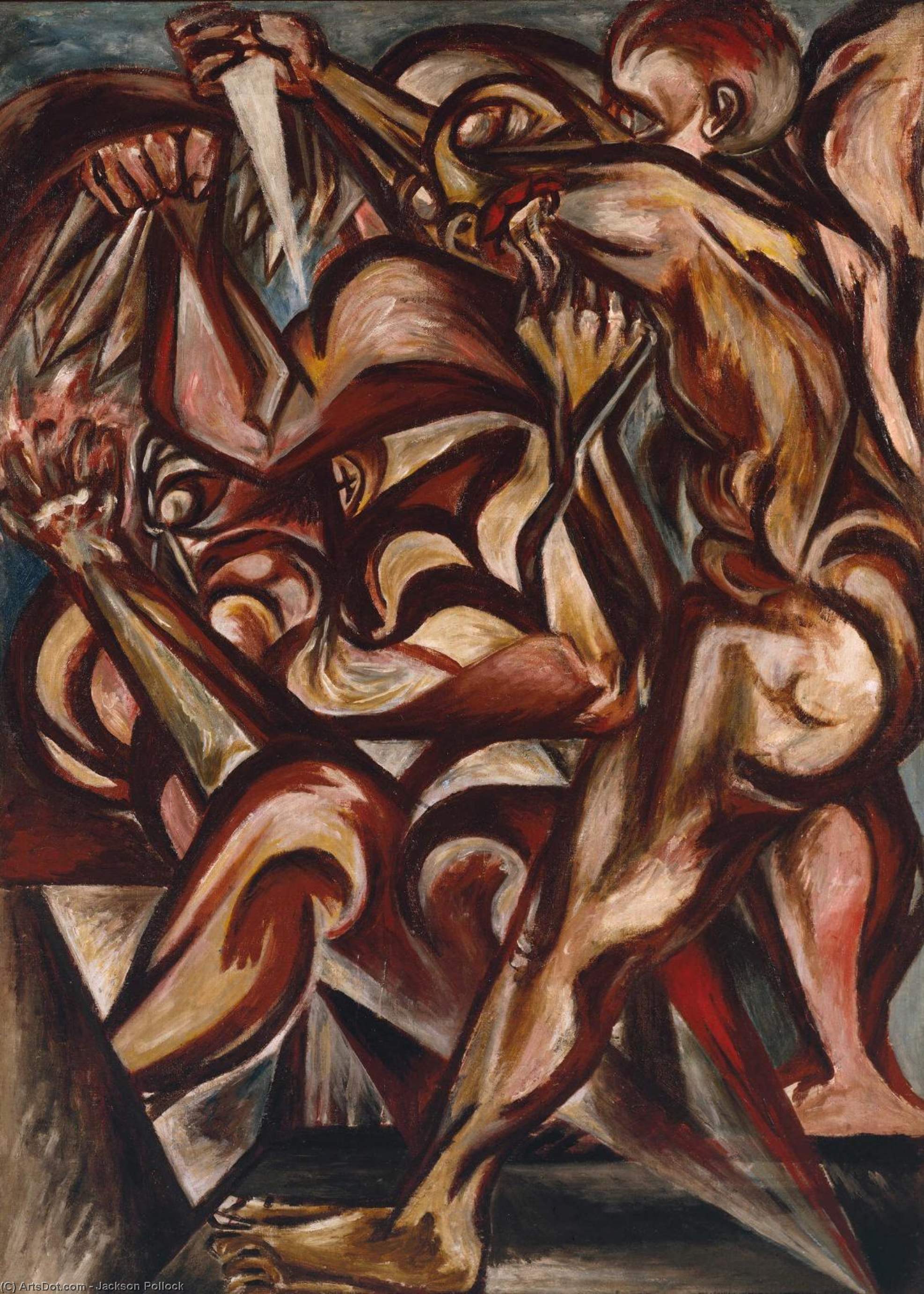
This powerful, untitled work by Jackson Pollock – often referred to as *‘Sin título (Hombre desnudo con cuchillo)’* or “Untitled (Nude Man with Knife)” – is a visceral exploration of conflict and human struggle. Created sometime during his prolific career, this oil painting stands as a compelling example of the artist’s move towards abstraction and emotional intensity, predating but foreshadowing the all-over compositions for which he became world renowned.
Decoding the Composition & Style
The artwork immediately commands attention with its chaotic energy. A tightly packed composition features overlapping figures locked in what appears to be a violent confrontation. Pollock eschews traditional perspective, flattening the picture plane and presenting forms in a simplified, almost geometric manner. This deliberate distortion, coupled with strong diagonal lines, generates a sense of unease and dynamic movement. The style is deeply rooted in
Expressionism, sharing affinities with early Cubist explorations of fragmented form, yet forging its own unique path towards pure abstraction.
Technique & Materiality
Pollock’s masterful handling of oil paint is evident throughout the work. He employs a robust impasto technique – applying thick layers of paint – to create rich texture and emphasize the raw energy of the scene. The color palette, dominated by deep reds, browns, and blacks, evokes feelings of blood, shadow, and primal aggression. Flashes of white and grey punctuate the darkness, heightening the dramatic contrast. The visible brushstrokes are not merely a means of application but become integral to the expressive power of the painting, revealing the artist’s physical engagement with the canvas.
Symbolism & Interpretation
While the precise narrative remains open to interpretation, the presence of a nude man wielding a knife suggests themes of vulnerability, threat, and perhaps even sacrifice. The struggle depicted could be read as an external conflict or an internal psychological battle. The abstraction allows for multiple readings; it’s not about *what* is happening so much as *how* it feels.
It's a potent representation of the anxieties and uncertainties prevalent in the mid-20th century. The work resonates with existential themes, reflecting a world grappling with post-war trauma and societal upheaval.
Historical Context & Pollock’s Evolution
Jackson Pollock (1912–1956) was a pivotal figure in the development of Abstract Expressionism, an American post-World War II art movement that emphasized spontaneous, automatic, or subconscious creation. Though this work precedes his famous “drip paintings,” it demonstrates key elements of his artistic trajectory: a rejection of traditional representation, a focus on emotional expression, and an innovative approach to materials and technique. His later drip paintings would build upon these foundations, solidifying his reputation as one of the most influential artists of the 20th century. This piece offers a fascinating glimpse into Pollock’s formative years, revealing the seeds of his groundbreaking style.
Emotional Impact & Aesthetic Appeal
‘Sin título (Hombre desnudo con cuchillo)’ is not a comfortable painting; it's designed to provoke and unsettle. The intense emotion conveyed through form and color creates a powerful visceral response in the viewer. Its dramatic composition and bold aesthetic make it a striking statement piece, capable of adding depth and intrigue to any collection or interior space.
- Ideal for collectors seeking early works by a modern master.
- A compelling focal point for contemporary living spaces.
- An inspiring addition to art-focused interiors.