A Vortex of Subconscious Emotion
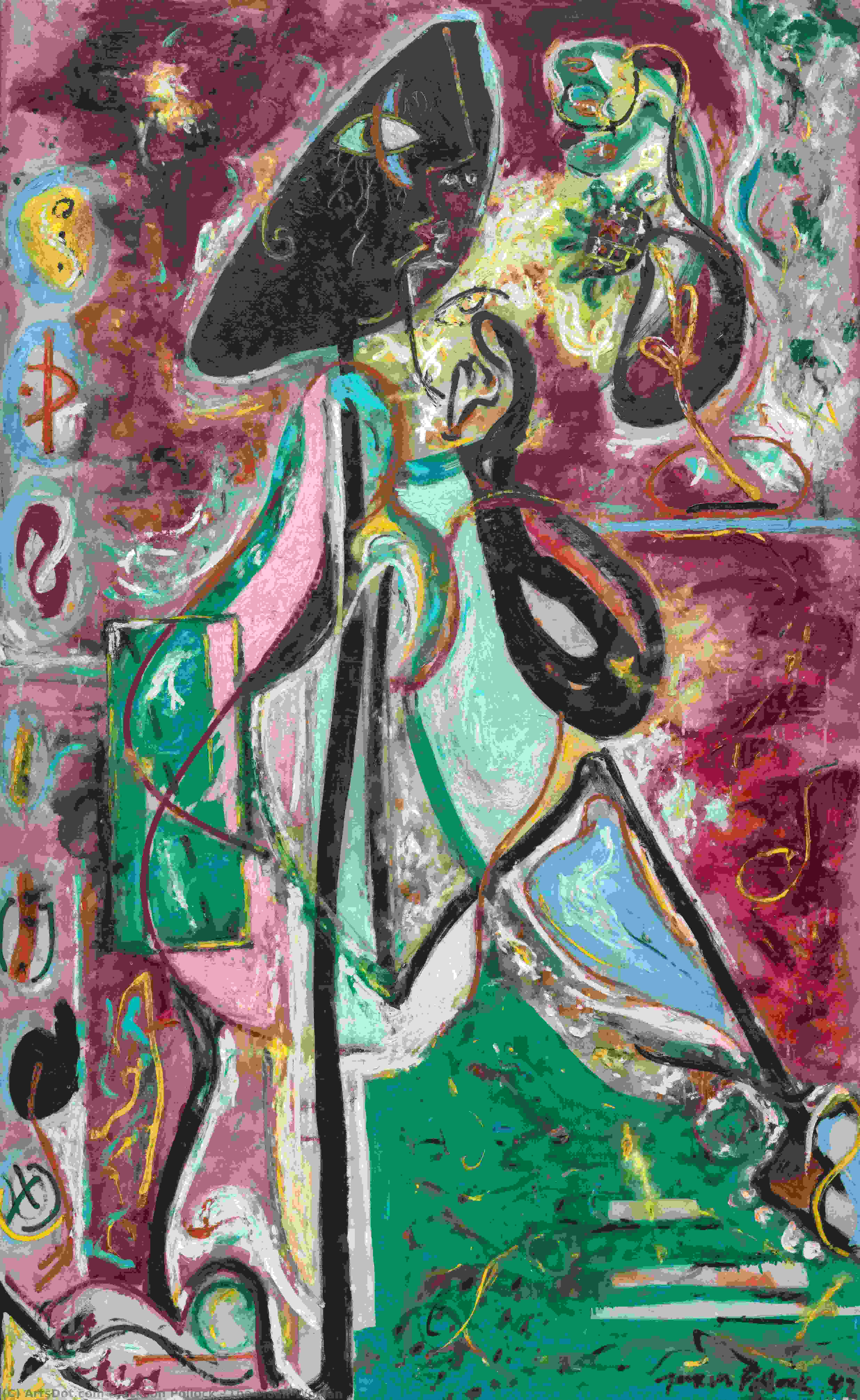
To stand before Jackson Pollock’s "The Moon-Woman" is to enter a realm where the boundaries between reality and the subconscious begin to dissolve. At first glance, the viewer is met with an unsettling beauty, a swirling vortex of color and form that defies the traditional constraints of representation. The painting does not merely present a subject; it invites an exploration of layers. Within its chaotic expanse, one might discern an amorphous figure—a woman suspended in a cosmic dance—yet this shape is perpetually shifting, caught in a rhythmic struggle with the surrounding pigment. It is a piece that demands more than a passing glance; it requires a deep, meditative engagement to uncover the secrets hidden within its energetic layers.
The emotional resonance of the work is amplified by a vibrant and unapologetic color palette. Bold strokes of red, blue, yellow, and green collide and intertwine across the canvas, creating a sense of dynamic tension. These hues are not blended into smooth gradients but are applied with a raw, visceral intensity that mirrors the turbulent psyche of the artist himself. For the collector or interior designer, this painting serves as a powerful focal point, capable of injecting a sense of movement, drama, and profound depth into any sophisticated space.
The Alchemy of Drip and Gesture
The technical mastery displayed in "The Moon-Woman" lies in Pollock’s revolutionary drip technique, a method that fundamentally altered the course of art history. Moving away from the traditional easel, Pollock utilized industrial enamel paints, pouring and splashing them onto canvases stretched upon the floor. This approach allowed gravity and momentum to become active participants in the creative process. The resulting texture is a mesmerizing tapestry of splatters, pools, and intricate lines that create a palpable sense of three-dimensional depth.
This method, often referred to as action painting, transformed the act of creation into a physical performance. Every drip and trail of paint is a record of a spontaneous gesture, a frozen moment of intense physical effort. This technique allows the viewer to trace the artist's movements across the canvas, feeling the rhythm and the "all-over" composition that characterizes his most iconic works. For those seeking a high-quality reproduction, capturing this intricate texture and the unpredictable flow of pigment is essential to preserving the soul of the original masterpiece.
A Synthesis of Surrealism and Modernity
Historically, "The Moon-Woman" serves as a fascinating bridge between disparate artistic movements. Pollock’s journey was deeply influenced by Surrealism, particularly the concept of automatism—the practice of allowing the hand to move without conscious control to tap into the unconscious mind. Yet, the painting also whispers of the influence of Pablo Picasso; one can detect echoes of Picasso’s fractured forms in the depiction of a curvaceous arm and the hauntingly singular motif of an eyeball.
This synthesis of styles creates a visual language that is both ancient and modern. The work carries a spiritual resonance, perhaps touched by Pollock's early exposure to the raw energy of Native American art, yet it remains firmly rooted in the anxieties and complexities of the mid-20th century. To possess a reproduction of "The Moon-Woman" is to hold a piece of history that embodies the transition from structured representation to the boundless freedom of Abstract Expressionism. It is an invitation to embrace chaos, to find beauty in the unstructured, and to celebrate the enduring power of human expression.