A Symphony in Crimson and Violet: The Luminous Soul of ‘After Annealing’
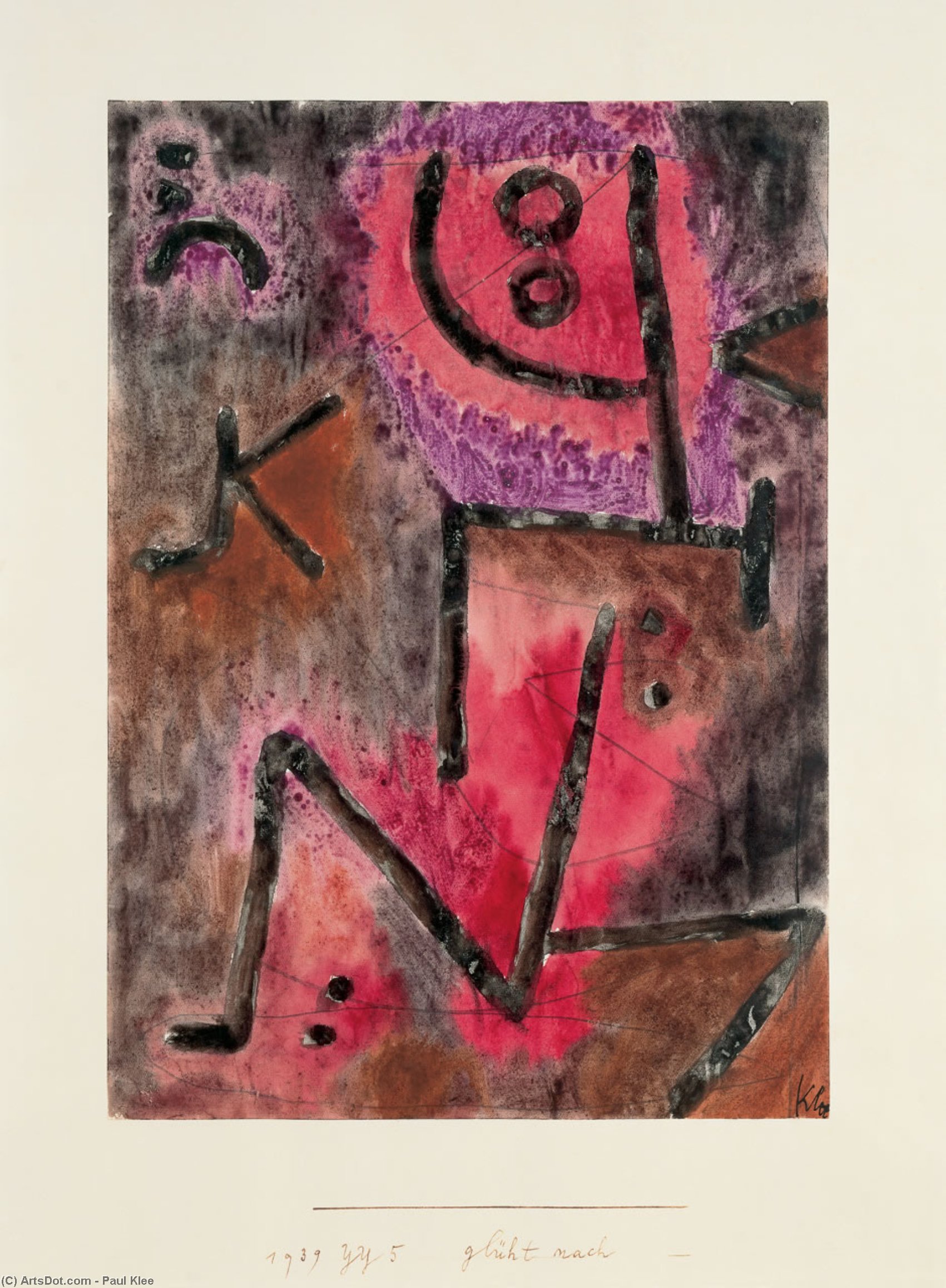
In the twilight of his extraordinary life, amidst the gathering shadows of a world consumed by the flames of World War II, Paul Klee produced “After annealing,” a work that serves as a radiant defiance against despair. Painted in 1940, this masterpiece is far more than a mere arrangement of pigment on paper; it is a vibrant tapestry woven with threads of crimson, pink, and deep violet, acting as a visual sanctuary for the weary soul. To gaze upon this piece is to witness Klee’s profound belief that art possesses the unique power to transcend political anxieties and communicate universal truths that exist far beyond the reach of human conflict.
The painting embodies a mature, refined stage of Klee’s aesthetic journey, where the complexity of his earlier explorations distilled into a more simplified, yet no less potent, vocabulary of form. There is an inherent rhythm to the composition, a sense of musicality that reflects his deep-seated connection to auditory harmony. As the eye wanders through the layers of color, one feels the pulse of a silent song, where every stroke and shape contributes to a larger, breathing organism of light and shadow.
The Dance of Automatism and Controlled Chaos
Technically, “After annealing” is a masterclass in the delicate balance between spontaneity and intention. Klee utilized watercolor and gouache on paper, employing a method known as automatism—a technique inspired by Surrealist thought that allowed his subconscious impulses to guide the brush. This approach resulted in an intricate, mesmerizing network of overlapping shapes, where circles and triangles appear to coalesce and disperse in a state of perpetual motion. The artist’s hand moves with a deceptive ease, layering pigments with such precision that subtle gradations of color emerge, creating a sense of internal luminosity.
For the discerning collector or interior designer, the allure of this piece lies in its textural depth. The way certain shapes are partially obscured by subsequent washes of color creates a fascinating visual dialogue between what is revealed and what is hidden. This layering does not merely add complexity; it provides a sense of atmospheric weight, making the artwork feel as though it possesses its own internal climate—a warm, serene environment that invites prolonged contemplation.
A Legacy of Resilience and Emotional Resonance
The historical context of 1940 lends an almost sacred gravity to this work. As Europe faced unprecedented upheaval, Klee remained steadfast in his pursuit of aesthetic beauty, using abstraction as a shield against the horrors of reality. The title itself, suggesting a process of heating and cooling to achieve strength and durability, serves as a poignant metaphor for the human spirit surviving the fires of adversity. This symbolic resonance makes the piece not only a significant historical artifact but also an emotionally charged companion for any space.
Integrating a high-quality reproduction of “After annealing” into a curated interior offers more than just a splash of color; it introduces a focal point of profound intellectual and emotional depth. Whether placed in a modern minimalist gallery or a classic, richly textured study, the painting’s vibrant palette and rhythmic geometry provide an enduring sense of peace and inspiration. It is a testament to the idea that even in our darkest hours, beauty remains an indestructible force, capable of illuminating the most sophisticated of environments.