A Whimsical World: Decoding Paul Klee’s ‘Arie des Tenor-Buffo’
Arie des Tenor-Buffo, by Swiss-German artist Paul Klee, is a captivating work that invites viewers into a realm of playful ambiguity and subtle emotional depth. Created sometime during Klee's prolific career (1879-1940), this piece exemplifies his unique artistic language – a blend of Expressionism, Cubism, and Surrealism filtered through a distinctly childlike sensibility.
Subject & Composition: A Stage for the Imagination
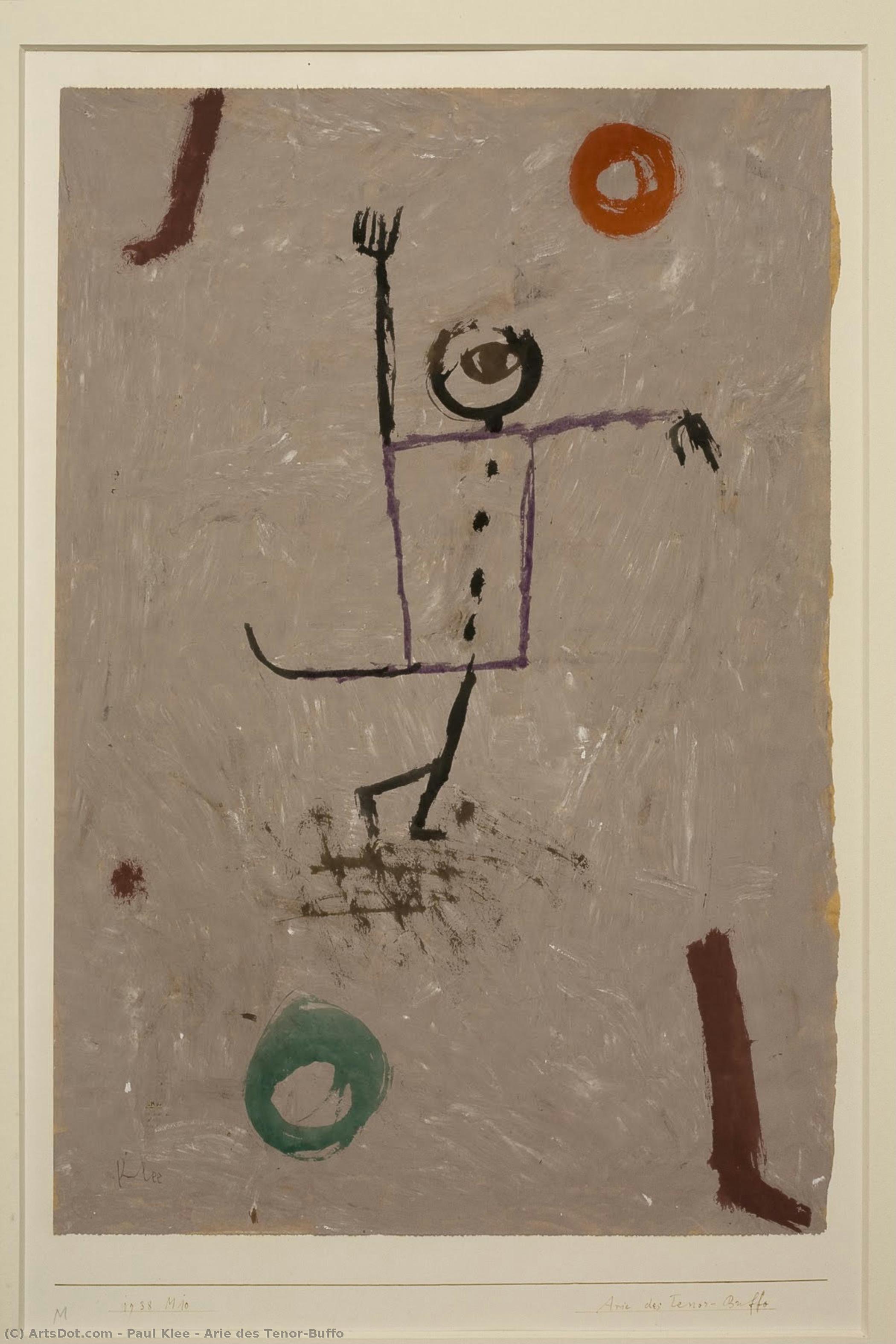
The artwork centers around a solitary, stylized figure positioned slightly off-center against a textured background. The figure, though humanoid in form, is deliberately simplified – an archetype rather than a portrait. Its raised arms suggest a gesture of communication, supplication, or perhaps even performance, hinting at the “tenor-buffo” (comic tenor) referenced in the title. Scattered circles punctuate the composition, adding to the enigmatic quality and potentially symbolizing planets, eyes, or abstract concepts. The vertical orientation emphasizes the figure’s presence while maintaining a sense of isolation.
Style & Technique: Naive Artistry & Tactile Surfaces
Klee's style in
Arie des Tenor-Buffo leans towards *naive* or folk art, characterized by its deliberate simplicity and rejection of academic realism. Bold outlines define the forms, while minimal detail encourages imaginative interpretation. The color palette is muted and earthy – greys, browns, ochres – punctuated by strategic pops of purple and teal that draw the eye and add visual interest. Klee’s masterful brushwork creates a rich texture, inviting tactile exploration even in reproduction. He layered paint to build depth and character, demonstrating his profound understanding of color theory—a subject he explored extensively in his influential writings, *The Paul Klee Notebooks*.
Historical Context: Bauhaus & Beyond
Paul Klee was a pivotal figure in modern art, deeply influenced by the artistic currents of his time. His association with the Bauhaus school – where he taught alongside Wassily Kandinsky – fostered an environment of experimentation and interdisciplinary thinking. Klee’s work reflects this ethos, seamlessly blending painting, drawing, and theoretical inquiry. He wasn't simply *creating* art; he was investigating the fundamental principles of form and design. This piece, while not explicitly tied to a specific Bauhaus project, embodies the school’s commitment to abstraction and functional aesthetics.
Symbolism & Interpretation: Unlocking Hidden Meanings
The symbolism within
Arie des Tenor-Buffo is open to interpretation, which is characteristic of Klee's work. The circles could represent celestial bodies, all-seeing eyes, or simply abstract forms contributing to the overall composition. The figure’s posture suggests vulnerability and a desire for connection. The title itself – referencing a comedic operatic role – adds another layer of complexity, hinting at performance, disguise, and perhaps even social commentary. Klee often imbued his works with personal meanings and reflections on the human condition, inviting viewers to engage in their own process of discovery.
Emotional Impact & Interior Design
The overall emotional tone is melancholic yet introspective, tinged with a sense of mystery. The ambiguity of the figure’s actions and the muted color palette evoke feelings of quiet contemplation. As an interior design element, a reproduction of
Arie des Tenor-Buffo would lend itself well to spaces seeking a touch of sophisticated whimsy. Its earthy tones complement neutral palettes, while its abstract form adds visual interest without overwhelming the room. It’s particularly suited for studies, libraries, or living areas where a sense of calm and intellectual stimulation is desired.
- Style: Naive Art, Expressionism, Cubism, Surrealism
- Materials: Oil or Acrylic on Canvas/Paper (presumed)
- Color Palette: Earthy tones – greys, browns, ochres – with accents of purple and teal.
- Key Themes: Isolation, Communication, Performance, Ambiguity