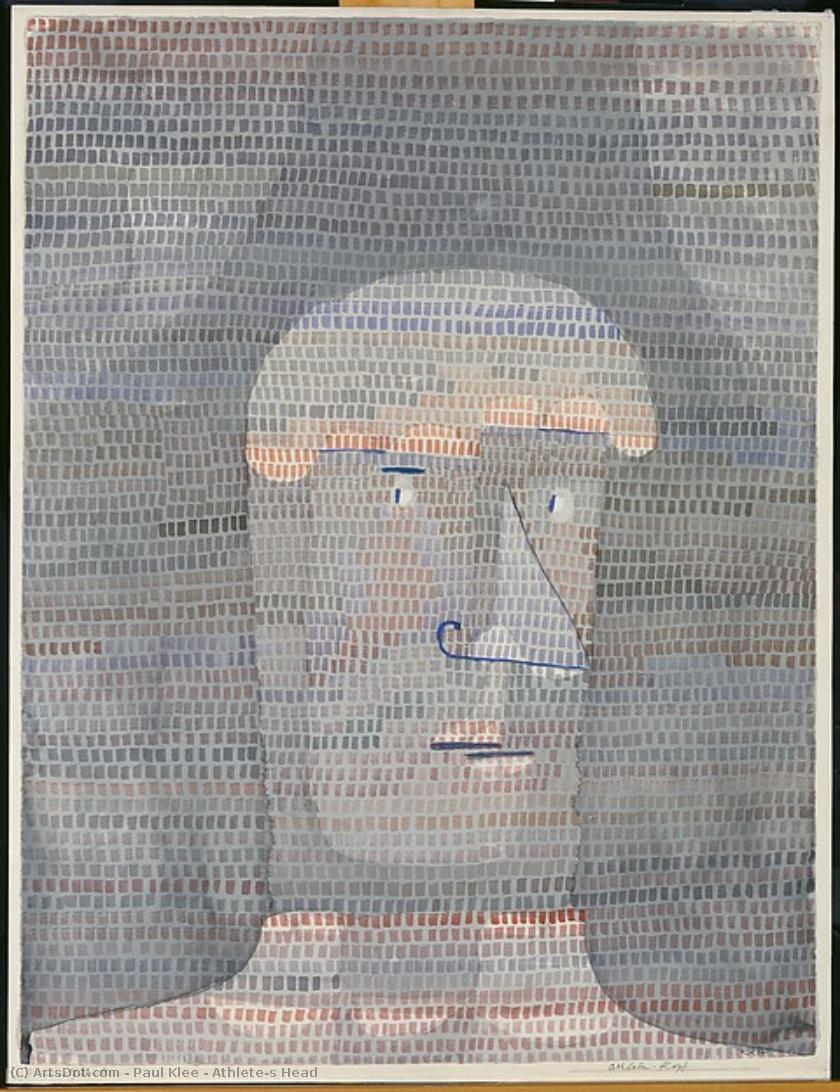
Athlete's Head

Admire 'Athlete's Head' by Paul Klee – a captivating watercolor portrait with a blue background & nose piercing. Explore Klee’s unique style, reminiscent of Bauhaus & Surrealism. Hand-painted reproduction available.


Paul Klee (1879 - 1940)

Discover Paul Klee (1879-1940): Swiss-German artist blending Expressionism, Cubism & Surrealism. Explore his color theory, Bauhaus influence, and playfully insightful art.

A Meditation on Form and Color – Exploring Paul Klee’s Athlete's Head

  • Subject Matter: This striking watercolor depicts the head of a man, rendered with remarkable detail despite its abstract treatment. The artist eschews conventional portraiture, prioritizing instead a concentrated focus on facial features—specifically the nose piercing—to convey an arresting gaze directly at the viewer.
  • Style and Technique: Klee’s approach aligns seamlessly with his broader artistic philosophy, embodying the principles of geometric abstraction championed during the early years of the 20th century. The painting utilizes bold lines and vibrant hues – predominantly shades of blue – to create a visual experience that transcends mere representation. These deliberate choices echo the influence of Expressionism and Cubism, demonstrating Klee’s masterful ability to synthesize disparate artistic traditions into a cohesive aesthetic.
  • Historical Context: Created in 1932, “Athlete's Head” emerged during a period marked by significant artistic experimentation and intellectual ferment. The Bauhaus movement was gaining momentum, promoting functional design alongside artistic innovation, and artists like Klee were actively engaged in pushing the boundaries of visual language. This artwork reflects the broader cultural preoccupation with exploring new forms of expression while grappling with anxieties surrounding societal change.
  • Symbolism: Beyond its formal qualities, “Athlete's Head” carries subtle symbolic resonance. The nose piercing itself can be interpreted as a gesture of defiance or vulnerability—a visual paradox that invites contemplation on themes of identity and perception. Furthermore, the pervasive blue color palette evokes feelings of serenity and introspection, suggesting an inner landscape mirroring the artist’s contemplative state.
  • Emotional Impact: The painting's quiet intensity captivates the viewer with its understated beauty. Klee’s masterful use of watercolor lends a luminous quality to the composition, capturing the ephemeral nature of light and emotion. “Athlete's Head” serves as a testament to Klee’s ability to distill complex psychological ideas into a deceptively simple visual form—a piece that continues to resonate with audiences today.