A Symphony of Amber and Line: The Luminous World of Paul Klee
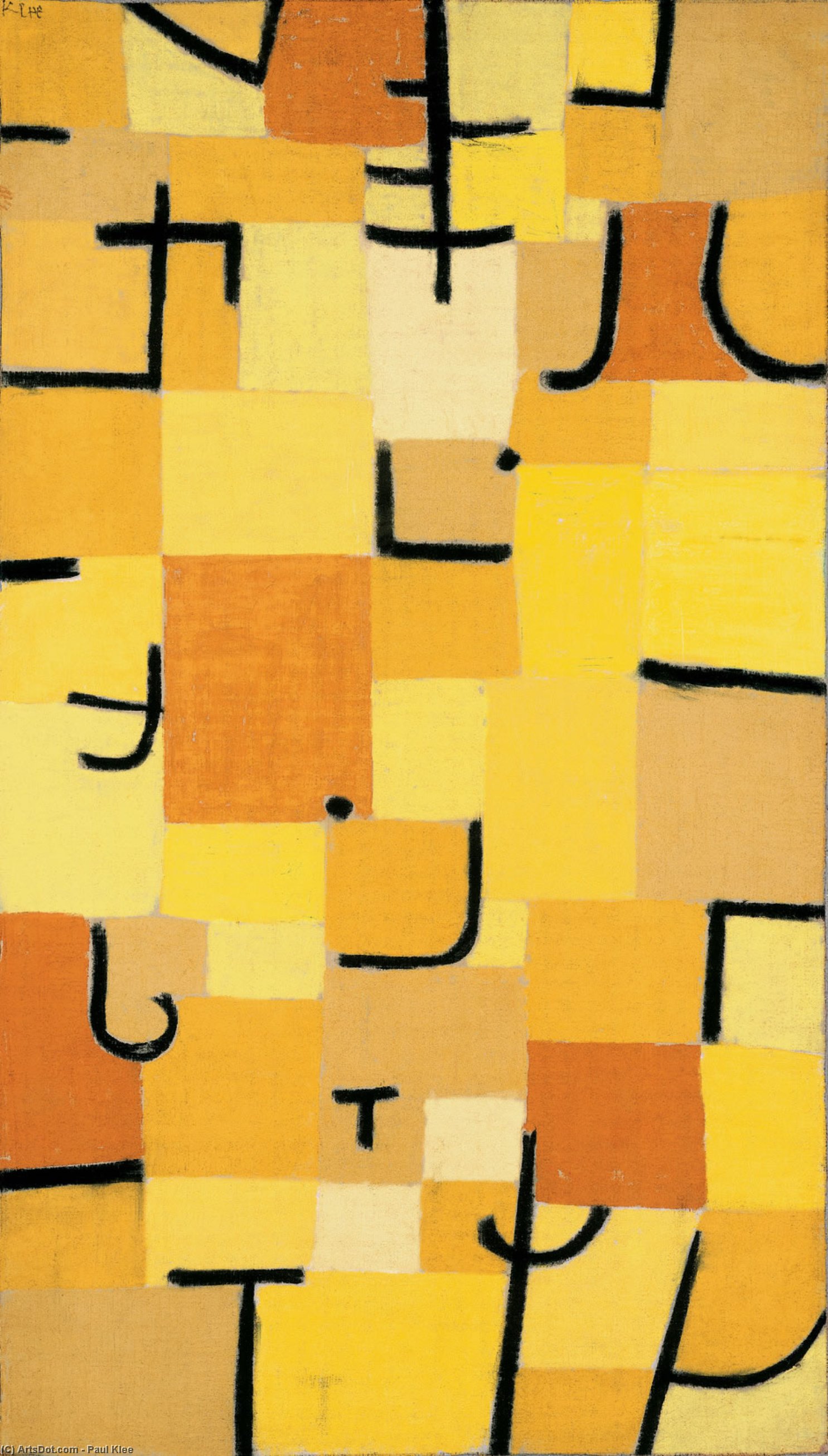
In the vast landscape of twentieth-century modernism, few artists possess the ability to weave together the mathematical precision of geometry with the whimsical spontaneity of a dream quite like Paul Klee. His 1937 masterpiece, “Characters in Yellow,” serves as a breathtaking testament to this duality. At first glance, the viewer is enveloped by a warm, radiant glow, a sun-drenched mosaic of ochre, lemon, and deep amber that seems to pulse with an inner light. This is not merely a painting of color; it is an exploration of how color can dictate mood, creating an atmosphere that feels simultaneously structured and liberated. The artwork invites the observer into a rhythmic dance where every square and every stroke contributes to a larger, harmonious melody.
The composition is anchored by a sophisticated grid-like structure, a technique reminiscent of Cubist principles that provides a sense of architectural stability. Yet, Klee masterfully disrupts this order through the introduction of organic, curvilinear forms that drift across the canvas like ancient, forgotten symbols. These dark, fluid lines—resembling calligraphic characters or perhaps tiny, dancing figures—interact with the rigid squares to create a captivating visual tension. It is within this interplay between the predictable and the unpredictable that the soul of the piece resides. For the discerning collector or interior designer, this balance makes the work an extraordinary centerpiece, capable of adding both intellectual depth and a sense of playful energy to a contemporary space.
Technique and the Alchemy of Color
To look closely at “Characters in Yellow” is to witness Klee’s profound mastery of oil painting and his unique approach to layering. The artist utilized meticulous glazing techniques, applying thin, translucent layers of pigment to achieve a luminous depth that appears to glow from within the canvas itself. Each square in the grid is not a flat block of color but a subtle gradient of tone, ranging from pale, airy yellows to heavy, earth-bound browns. This careful modulation of light and shadow gives the abstract composition a tactile, almost three-dimensional quality. The dark brown lines that define the "characters" are applied with an expressive fluidity, their varying thicknesses suggesting the movement of a hand caught in a moment of pure inspiration.
This technical brilliance serves a deeper symbolic purpose. Klee, whose life was deeply intertwined with the rhythms of music, often approached the canvas as if composing a score. The grid acts as the rhythmic meter, while the wandering lines represent the melodic improvisations. There is an inherent mystery in the "characters" themselves; they are ambiguous, existing in the liminal space between writing and drawing, between human form and abstract symbol. This ambiguity allows the viewer to project their own narratives onto the work, making every encounter with the painting a personal, transformative experience.
An Invitation to Emotional Resonance
Beyond its formal excellence, “Characters in Yellow” possesses an emotional resonance that is rare in the realm of pure abstraction. While many works of the era sought to confront the viewer with the harsh realities of a fracturing world, Klee’s work from this period often retains a sense of optimism and whimsy. The warmth of the palette evokes feelings of comfort, sunlight, and vitality, making it an ideal selection for those looking to infuse a room with warmth and light. It is a piece that does not demand attention through aggression, but rather earns it through a gentle, persistent charm.
For the art lover seeking to bring a touch of historical significance into their home, a high-quality reproduction of this work offers more than just decoration; it offers a window into the mind of a visionary. Whether placed in a minimalist gallery setting or a richly textured living space, the painting acts as a focal point of contemplation. It reminds us that even within the most structured frameworks, there is always room for the spontaneous, the beautiful, and the profoundly human.