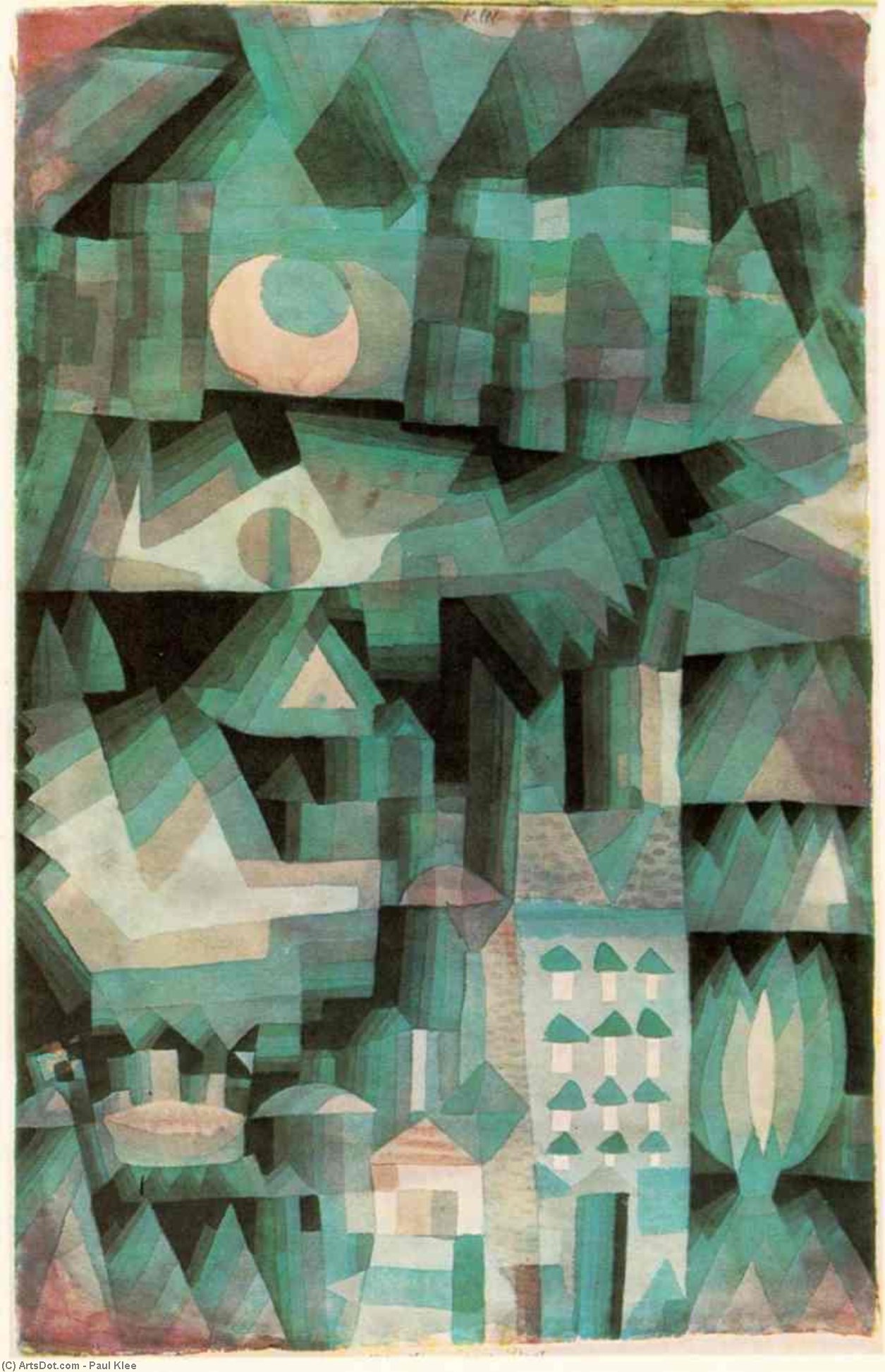
Explore Paul Klee’s Dream City – a mesmerizing cityscape rendered in Cubist style and vibrant greens, embodying the artist's signature playful abstraction and capturing the evocative mood of 1921. Discover this captivating artwork and bring its timeless beauty into your home.
A Symphony of Geometric Forms: Exploring Paul Klee’s “Dream City”
Paul Klee's "Dream City," painted in 1921, isn’t merely a depiction of urban architecture; it’s an embodiment of the artist’s groundbreaking approach to abstraction and his unwavering belief in art as a conduit for emotional resonance. This enigmatic cityscape transcends literal representation, inviting viewers into a realm where color and shape intertwine to convey profound ideas about perception and imagination. The painting immediately captivates with its bold palette—primarily shades of green—dominating the composition and establishing an atmosphere of tranquility yet hinting at hidden complexities. These greens aren’t uniform; they ripple across the canvas, suggesting movement and layering, mirroring Klee's fascination with musical harmonies and his desire to capture intangible sensations.
- Style & Technique: “Dream City” exemplifies Klee’s signature Cubist-influenced style, characterized by fragmented planes and overlapping geometric shapes. Unlike traditional landscapes that strive for accurate depiction, Klee deliberately disrupts perspective, presenting a stylized view of the city as if seen through a dreamlike haze. The artist employed watercolor and gouache on paper, layering pigments to achieve luminous effects and creating textures that contribute to the painting’s tactile quality.
- Historical Context: Created during the Weimar Republic—a period marked by political instability and artistic experimentation—the painting reflects the broader intellectual currents of its time. Surrealist ideas were gaining traction alongside Cubism, prompting artists to explore subconscious imagery and challenge conventional notions of reality. Klee’s work aligns with this movement's emphasis on intuition and emotional expression, rejecting academic conventions in favor of a more personal vision.
- Symbolism & Interpretation: The prominent clock face serves as a powerful symbol—a motif recurrent throughout Klee’s oeuvre—representing time, memory, and the cyclical nature of existence. Its placement within the cityscape suggests that even urban environments are governed by rhythms beyond human comprehension. Furthermore, the scattered architectural elements – buildings and trees – could be interpreted as representing individual components contributing to the larger tapestry of life, each holding its own significance.
- Emotional Impact: “Dream City” evokes a feeling of contemplative serenity mingled with subtle unease. The muted greens and geometric forms create a visual space that invites introspection, prompting viewers to consider their relationship to the environment and to contemplate the mysteries of consciousness. Klee’s masterful use of color and form communicates not just what is seen but also what is felt—a testament to his ability to transform abstract ideas into emotionally evocative imagery.
For discerning collectors and interior designers seeking inspiration, ArtsDot.com offers exceptional reproductions of “Dream City,” meticulously crafted to preserve the artwork’s original vibrancy and textural nuances.