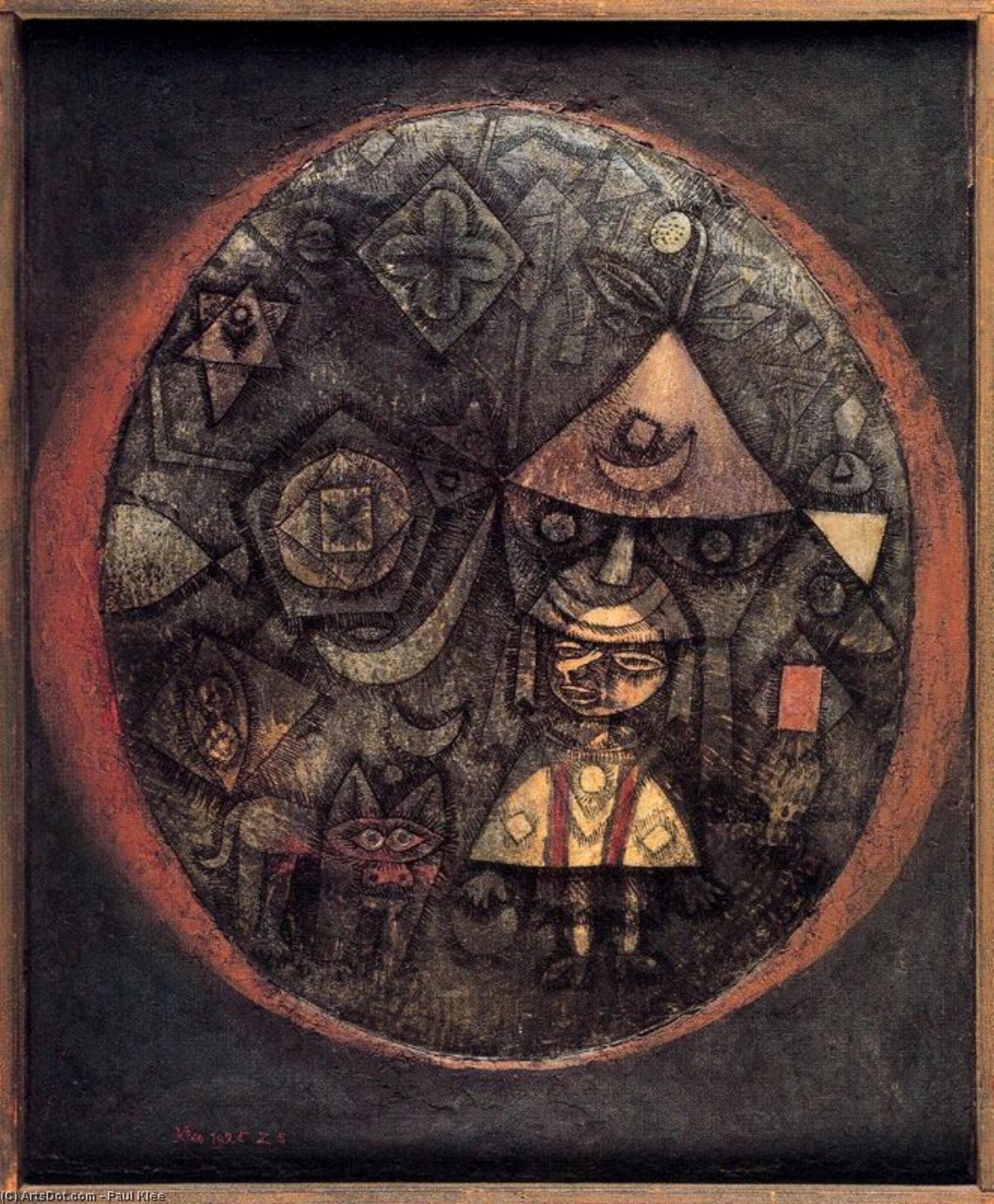
A Symphony of Color and Form: Exploring Paul Klee’s “Dwarf Fairy Tale”
Paul Klee’s “Dwarf Fairy Tale,” painted in 1938 during the tumultuous years preceding World War II, stands as a testament to his unwavering commitment to abstract expressionism—a style that prioritizes emotion and intuition over literal depiction. More than just a visual spectacle, it's an invitation into Klee’s inner world, where geometric shapes intertwine with organic forms, creating a landscape both familiar and utterly alien.
- Subject Matter: The painting depicts a fantastical scene featuring a dwarf, a woman, a cat, and various symbolic objects—a bowl, a cup, and a vase—arranged within an amorphous expanse of color.
- Style: Klee’s distinctive style is characterized by its playful abstraction, blending elements of Cubism with Surrealist influences. The fragmented perspectives and overlapping planes challenge conventional notions of representation, emphasizing instead the artist's subjective experience.
Technique: Watercolor and Gouache on Paper
Klee employed a masterful combination of watercolor and gouache pigments applied to textured paper—a technique that lends itself beautifully to capturing subtle tonal variations and creating an ethereal luminescence. The layering process allows for gradual blending, resulting in a rich tapestry of hues that pulsates with life.
- Watercolor Layering: Klee began by applying thin washes of watercolor, establishing the foundational color palette and defining broad contours.
- Gouache Accents: Subsequent gouache strokes added denser pigments—primarily yellows and reds—creating vibrant accents that punctuate the overall composition.
Historical Context & Symbolism
Painted amidst the escalating anxieties of Europe’s descent into fascism, “Dwarf Fairy Tale” reflects Klee's preoccupation with themes of vulnerability, resilience, and the transformative power of imagination. The dwarf figure embodies childlike innocence—a stark contrast to the looming threat of war—while the woman represents nurturing strength. The cat symbolizes cunning and observation, adding a layer of complexity to the narrative.
Symbolic Objects:
- The bowl and cup represent sustenance and contemplation, inviting viewers to pause and reflect on the painting’s deeper meanings.
- The vase embodies beauty and harmony—a visual reminder of Klee's belief in art as a conduit for spiritual enrichment.
Emotional Impact: A Journey Into Inner Consciousness
“Dwarf Fairy Tale” transcends mere visual representation, captivating the viewer with its evocative atmosphere and conveying a profound sense of melancholy mingled with optimism. The painting’s undulating colors and asymmetrical arrangement stimulate the imagination, prompting contemplation on questions of identity, perception, and the human condition. It remains an enduring emblem of Klee's artistic vision—a celebration of creativity as a means of confronting darkness and embracing the boundless possibilities of inner experience.