A Symphony of Color and Form: Exploring ‘Enlightenment of Two Sectarians’ by Paul Klee
Paul Klee's “Enlightenment of Two Sectarians,” painted in 1918, stands as a testament to the artist’s singular vision—a masterful blend of Expressionist fervor and Cubist fragmentation that transcends mere representation. More than just an image on canvas, it embodies Klee’s profound engagement with musical principles and his unwavering belief in art's capacity to convey inner experience. This striking piece exemplifies his distinctive approach to color theory and geometric abstraction, solidifying his place among the pioneers of modern art.
The Expressionist Spirit: Emotion Embodied in Color
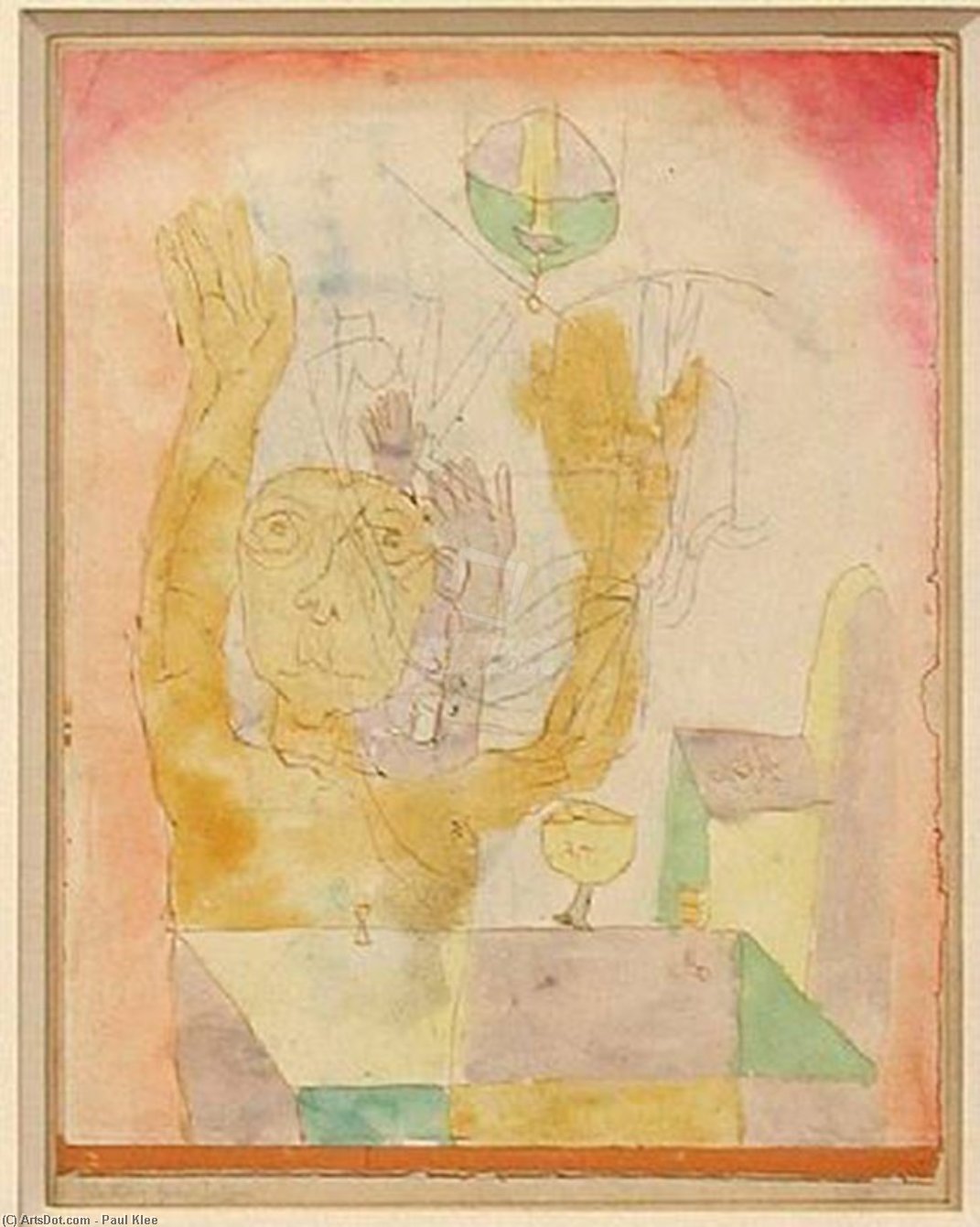
Created during a period marked by significant artistic upheaval—the burgeoning avant-garde movement challenging traditional conventions—’Enlightenment of Two Sectarians’ pulsates with an emotive energy characteristic of Expressionism. Klee eschewed meticulous realism, prioritizing instead the conveyance of feeling through bold hues and dynamic compositions. The dominant reds and yellows dominate the palette, radiating warmth and intensity, mirroring perhaps a spiritual yearning or a celebration of vitality. These colors aren't merely decorative; they are deliberately deployed to stimulate psychological resonance within the viewer—a technique deeply rooted in Klee’s fascination with musical harmony.
Cubist Fragmentation: Deconstructing Perception
Despite its expressive core, ‘Enlightenment of Two Sectarians’ incorporates elements of Cubism, subtly disrupting visual perception and presenting multiple viewpoints simultaneously. The figures are fragmented into geometric shapes – squares, rectangles, triangles – reflecting Klee's exploration of spatial relationships and challenging the viewer to reconsider conventional notions of perspective. This fragmentation isn’t random; it serves as a conduit for conveying complexity and ambiguity—mirroring the multifaceted nature of human consciousness itself.
Geometric Harmony: Musical Influence Revisited
As a musician by inclination, Klee consistently sought parallels between visual art and music. The arrangement of shapes within ‘Enlightenment of Two Sectarians’ echoes musical notation, demonstrating his conviction that form and color could operate in tandem to create an immersive experience akin to listening to a piece of music. Consider the positioning of the cups and table—they are strategically placed to guide the eye across the canvas, creating a visual rhythm reminiscent of melodic contours. This deliberate structuring reflects Klee’s belief that art should aspire to communicate ideas beyond surface appearances.
Symbolic Depth: A Reflection on Faith
The painting's title itself hints at its symbolic significance—referencing “sectarians,” individuals devoted to distinct faiths or beliefs. The figures are positioned in a contemplative posture, suggesting introspection and spiritual contemplation. Klee’s use of color – particularly the reds – evokes associations with passion and illumination, symbolizing enlightenment and divine grace. Through his masterful manipulation of form and hue, Klee invites viewers to contemplate profound questions about faith, identity, and the human condition—a testament to the enduring power of art as a vehicle for conveying intangible ideas.
- Artist: Paul Klee
- Year Created: 1918
- Style: Expressionism / Cubism
- Medium: Acrylic Paint on Canvas
- Size: 22 x 17 cm
Discover the captivating world of Paul Klee! Explore his innovative art, Bauhaus influence, & unique symbolic language. Expert analysis & high-quality reproductions at WikiArt.