A Nocturnal Symphony of Line and Shadow
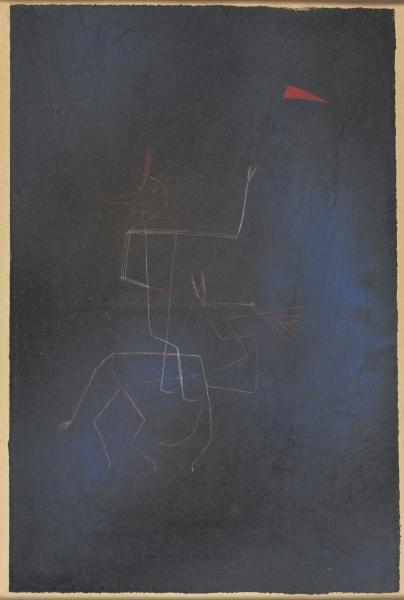
To encounter Paul Klee’s Ghost Rider Late in the Evening is to step across the threshold of the waking world and into a realm where the boundaries of reality begin to dissolve. Painted in 1929, this enigmatic masterpiece serves as a profound meditation on movement, mystery, and the subconscious. At first glance, the viewer is met with a stark, nocturnal atmosphere, dominated by deep charcoal grays and midnight blacks that suggest a landscape shrouded in the heavy stillness of night. Yet, within this darkness, a spectral energy pulsates. The central figure—a rider astride a horse—emerges not through realistic rendering, but through delicate, hesitant white lines that seem to flicker like candlelight against an encroaching gloom. This use of linear form creates a sense of restless motion, as if the rider is caught in a fleeting moment of transition between the physical and the spiritual.
Klee, a master of synthesizing diverse modern movements, weaves together elements of Expressionist fervor, Cubist fragmentation, and Surrealist dreamscapes. The composition eschews traditional perspective, opting instead for a layered, symbolic depth that invites the eye to wander through an abstract topography. A striking, vibrant red triangle floats in the upper quadrant, acting as a sudden, dramatic chord in a silent symphony. This splash of crimson provides a vital emotional anchor, injecting a sense of urgency or perhaps a warning into the otherwise somber scene. Such bold geometric interventions are hallmarks of Klee’s genius, allowing him to communicate complex psychological states through the simple interplay of shape and hue.
The Architecture of Emotion and Technique
The technical execution of this work reveals Klee’s meticulous approach to texture and light. Utilizing what appears to be the delicate medium of watercolor or gouache on paper, the artist has achieved a masterful layering of washes that gives the dark background a palpable, breathing quality. The surface is not merely a void; it is textured with irregular patches of color and subtle blue undertones, suggesting a sky heavy with atmosphere or an interior space thick with memory. This tactile depth contrasts beautifully with the ethereal, skeletal lines used to delineate the rider and the accompanying indistinct figures, creating a tension between the weight of the environment and the lightness of the subjects.
For the discerning collector or interior designer, Ghost Rider Late in the Evening offers more than mere decoration; it offers an intellectual and emotional experience. The piece possesses a quiet, commanding presence that can anchor a sophisticated space, providing a focal point that rewards prolonged contemplation. Its ability to evoke feelings of mystery, unease, and profound wonder makes it a timeless addition to any curated collection. Whether viewed as a fragment of a dream or a symbolic journey through the shadows of the human psyche, Klee’s work remains a luminous testament to the power of abstraction to touch the very soul of the viewer.