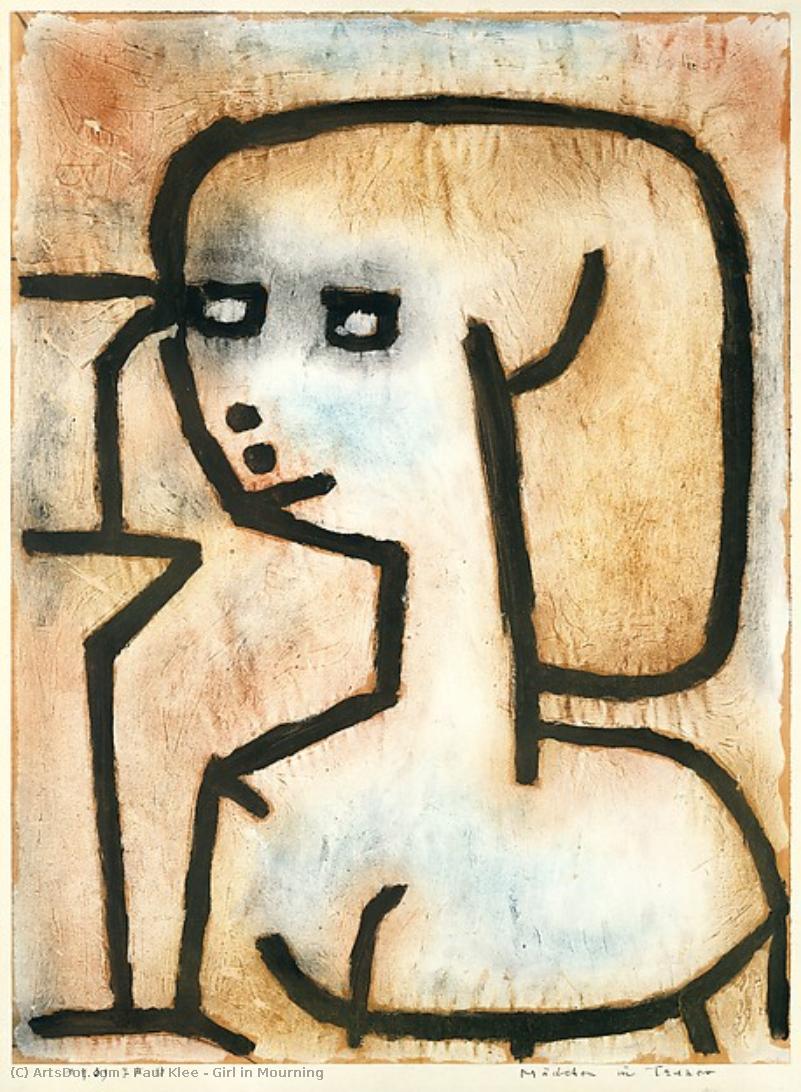
Delve into Paul Klee's poignant masterpiece, 'Girl in Mourning.' This evocative painting captures a moment of quiet sorrow through masterful abstraction and symbolic imagery—a timeless exploration of emotion.
Discover Paul Klee (1879-1940): Swiss-German artist blending Expressionism, Cubism & Surrealism. Explore his color theory, Bauhaus influence, and playfully insightful art.
A Portrait of Melancholy: Exploring Paul Klee’s “Girl in Mourning”
Paul Klee's "Girl in Mourning," painted in 1939, stands as a poignant testament to the artist’s masterful ability to distill complex emotions into deceptively simple forms. Created during the turbulent years of World War II, this monochrome watercolor and gouache depicts a young girl seated on a chair, her eyes closed in contemplation – an image that transcends its historical moment to resonate with universal themes of sorrow and introspection.
Style and Technique: Embracing Geometric Abstraction
Klee’s distinctive style is immediately recognizable through his embrace of geometric abstraction. Rather than striving for realistic representation, he employs interlocking squares and rectangles—a hallmark of his artistic vocabulary—to construct a visual landscape that feels both structured and organic simultaneously. The artist eschews traditional shading techniques, opting instead for subtle tonal variations achieved through layering washes of color, resulting in an ethereal quality that enhances the painting’s expressive power. This deliberate simplification allows Klee to focus on conveying mood and emotion directly, bypassing the constraints of visual detail.
Historical Context: Shadows of War
“Girl in Mourning” emerged from a period marked by profound anxieties about the unfolding global conflict. The looming threat of Nazi aggression permeated European culture, fostering an atmosphere of uncertainty and fear—feelings that undoubtedly informed Klee’s artistic sensibilities. Yet, despite its association with wartime apprehension, the painting refuses to succumb to despair. Instead, it presents a quiet dignity, suggesting resilience in the face of adversity. It's important to note that Klee himself was Jewish, adding another layer of significance to his artistic engagement during this challenging era.
Symbolism: Eyes Closed, Silent Sorrow
The girl’s closed eyes serve as a central symbol within the composition—representing not merely physical rest but also profound inner silence and contemplation. Her posture conveys vulnerability yet simultaneously embodies an unwavering gaze inward, inviting viewers to confront their own emotions of sadness and loss. The surrounding geometric shapes contribute to the painting's symbolic richness, mirroring the internal landscape of grief – where thoughts and feelings coalesce into a unified form.
Emotional Impact: A Resonance Beyond Time
Ultimately, “Girl in Mourning” succeeds in capturing a deeply felt emotional state—one that speaks to the human experience of sorrow with remarkable sensitivity. Its understated beauty and masterful execution evoke a profound sense of empathy, prompting contemplation on themes of mortality, remembrance, and the enduring power of artistic expression. This timeless piece continues to captivate audiences today, demonstrating Klee’s unparalleled ability to transform personal emotion into universal visual language—a legacy that ensures “Girl in Mourning” will endure as an icon of 20th-century art for generations to come.