A Symphony in Geometric Forms: The Soul of North German City
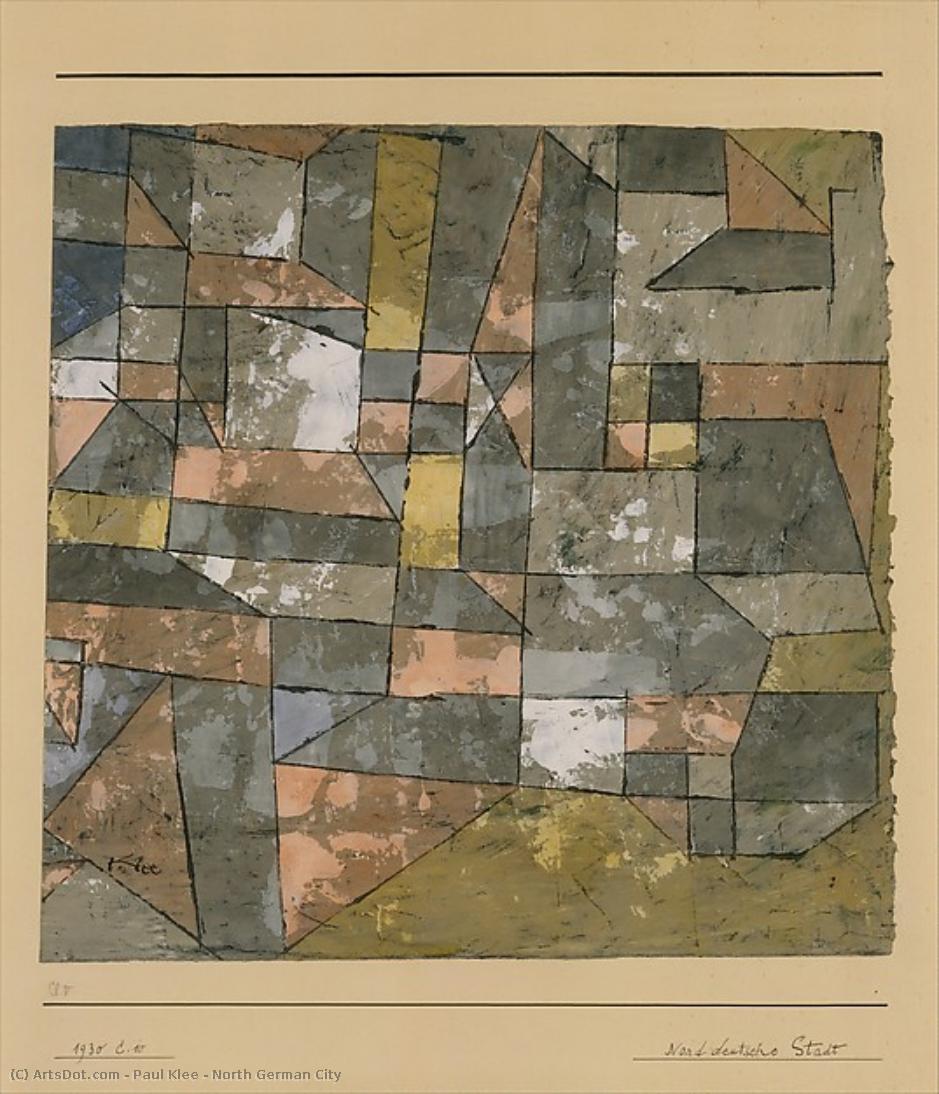
In the quiet, rhythmic dance of Paul Klee’s 1930 masterpiece, "North German City," we encounter more than a mere depiction of an urban landscape; we enter a dreamscape where architecture dissolves into pure emotion. Klee, a visionary who bridged the gap between the tangible world and the abstract subconscious, invites us to witness a cityscape constructed not of brick and mortar, but of light, color, and geometry. The painting presents a captivating arrangement of triangles, squares, and soft planes that suggest the presence of buildings without ever tethering them to reality. As one gazes upon the composition, there is a profound sense of movement—a visual melody where the eye wanders through pastel pinks, muted grays, and ethereal blues, discovering a world that feels both intimately familiar and wonderfully alien.
The technique employed in this work is a testament to Klee’s mastery of Expressionistic intuition. Eschewing the rigid boundaries of traditional realism, Klee utilized irregular planes of color and fragmented shapes to convey psychological impressions rather than physical objects. The texture of the piece suggests a delicate layering of pigment, creating an atmospheric depth that mimics the hazy, soft light of a winter afternoon. This method allows the artist to manipulate the viewer's perception, using color theory to evoke a sense of quiet contemplation. For the discerning collector or interior designer, this painting offers a sophisticated focal point; its balanced yet dynamic composition provides a sense of structural harmony that can anchor a room while simultaneously stimulating intellectual curiosity.
Historical Resonance and Emotional Depth
To understand "North German City," one must consider the turbulent era from which it emerged. Painted in 1930, during the mounting anxieties of the pre-war period, the work reflects a broader European movement toward abstraction and a rejection of academic conventions. While the world outside was fracturing, Klee sought refuge in the creation of a new visual language—one that drew inspiration from the harmony of music and the purity of design. The geometric simplicity of the city can be seen as a metaphor for resilience; amidst the chaos of history, there remains an inherent beauty in order, structure, and the fundamental elements of form.
The emotional impact of the piece lies in its ability to evoke solitude without loneliness. There is a certain stillness in the way the shapes interact, a quietude that resonates with anyone seeking peace within a modern, often overwhelming environment. The presence of a solitary figure, tucked subtly into the left side of the composition, serves as a poignant reminder of the human element within the vastness of the urban experience. For those looking to bring a piece of art history into their personal spaces, a high-quality reproduction of this work offers an opportunity to inhabit Klee's world—a realm where every line is a note and every color is a breath, providing a timeless sense of wonder and sophisticated grace.