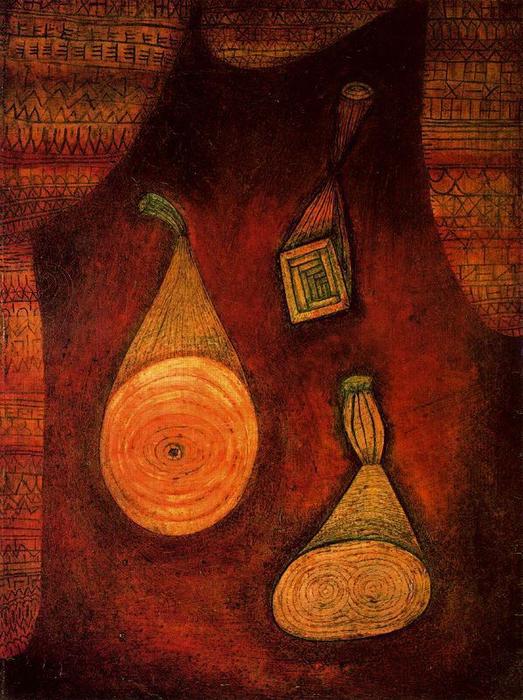
Paul Klee’s ‘Omega 5 (Attrappen)’ – a surreal oil painting blending abstraction & expressionism. Layered reds, symbolic forms, and unique texture create an enigmatic artwork.
Discover Paul Klee (1879-1940): Swiss-German artist blending Expressionism, Cubism & Surrealism. Explore his color theory, Bauhaus influence, and playfully insightful art.
A Surreal Echo: Paul Klee’s “Omega 5 (Attrappen)”
Paul Klee's "Omega 5 (Attrappen)," painted in 1927, isn’t merely a depiction of objects; it’s an invitation into a dreamscape—a carefully constructed world brimming with symbolic resonance and the artist’s signature playful abstraction. This oil on canvas work, now housed within the Museo Nacional Thyssen-Bornemisza in Madrid, exemplifies Klee's unique approach to art, blending elements of Expressionism, Cubism, and Surrealism into a powerfully emotive visual language. The painting immediately captivates with its dominant palette of deep reds—a color often associated with passion, danger, and the subconscious—contrasted against a textured background that seems to ripple with unseen patterns. Three organic forms, resembling elongated fruits or gourds, dominate the lower half of the canvas, their shapes deliberately ambiguous, inviting multiple interpretations. A smaller, square object sits centrally, acting as an anchor within this swirling composition.
The Language of “Attrappen” and Klee’s Bauhaus Period
The title itself, "Omega 5 (Attrappen)," offers a crucial key to understanding the work's genesis. *Attrappen* is a German word meaning “props,” or “stage dummies”—objects designed for theatrical use, often deliberately artificial. Klee employed this term not as a literal description but rather as a metaphor for the painting’s own constructed reality. During his time at the Bauhaus in Dessau—a revolutionary art school focused on integrating art and technology—Klee was deeply engaged with exploring the geometric foundations of form. He sought to understand how objects existed in space, moving beyond mere representation towards an exploration of their inherent qualities. This period saw him experimenting with spatial relationships and organic growth, concepts powerfully reflected in "Omega 5 (Attrappen)." The painting can be viewed as a visual distillation of these investigations—a deliberate attempt to create a self-contained world governed by its own internal logic.
Technique and Texture: A Masterclass in Impasto
Klee’s technique is immediately striking, characterized by bold brushstrokes and an abundant use of *impasto* – the application of thick layers of paint that create a tactile, almost sculptural surface. The background, particularly, is built up with countless layers of pigment, generating a rich, complex texture that seems to shift and change depending on the angle of observation. This textural density isn’t merely decorative; it contributes significantly to the painting's emotional impact, conveying a sense of unease and mystery. Notice how the brushstrokes themselves seem to vibrate with energy, mirroring the swirling dynamics of the composition. The deliberate roughness of the surface contrasts sharply with the smoother rendering of the central object, further emphasizing the work’s inherent tension. Klee’s masterful control of color and texture creates a dynamic interplay between form and feeling.
Symbolism and Emotional Resonance
Beyond its formal qualities, "Omega 5 (Attrappen)" is laden with symbolic potential. The ambiguous shapes of the organic forms could represent anything from nascent life to decaying matter—a visual meditation on cycles of creation and destruction. The central square object might symbolize stability or confinement within this fluid environment. Klee frequently employed symbols in his work, often drawing upon personal experiences and philosophical ideas. Considering Klee’s interest in music – he famously described painting as a form of musical arrangement – one can imagine the forms moving and shifting like notes on a score. The overall effect is profoundly melancholic, evoking a sense of isolation and perhaps even a subtle anxiety. The painting doesn't offer easy answers; instead, it invites viewers to project their own emotions and interpretations onto its enigmatic surface. It’s a testament to Klee’s ability to create art that resonates deeply with the human psyche.