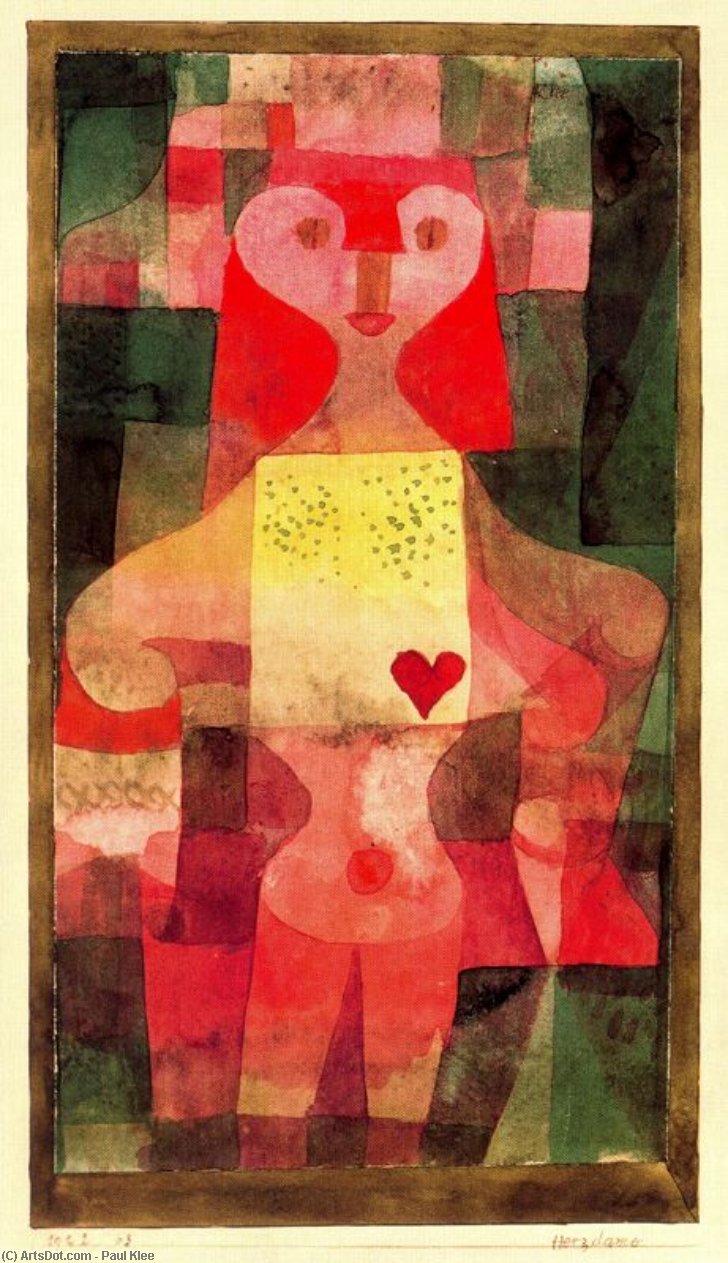
A Symphony of Color and Emotion: Unpacking Paul Klee’s “Queen of Hearts”
Paul Klee's "Queen of Hearts," painted in 1921, transcends mere visual representation; it embodies the artist’s profound engagement with color theory and his unwavering belief in art as a conduit for inner experience. This striking piece resides within The Art Institute of Chicago’s collection, offering visitors an unparalleled opportunity to delve into the heart of Expressionist innovation. As noted by curators, the painting's date is not precisely known but reflects the broader artistic currents of its time—a period marked by experimentation and a rejection of academic conventions in favor of subjective interpretation.
- Subject Matter: The composition centers around a woman’s figure – a deliberate departure from traditional portraiture – adorned with a vibrant yellow dress and dominated by a prominent heart emblem. This central motif isn't merely decorative; it symbolizes love, vulnerability, and perhaps even sacrifice—themes prevalent in Klee’s artistic explorations of human emotion.
- Style & Technique: Klee’s signature Expressionist style is immediately apparent. Bold brushstrokes create textured surfaces that convey movement and dynamism, prioritizing feeling over meticulous detail. The artist employs a reductive palette – primarily reds, yellows, and blues – to heighten emotional impact and distill complex ideas into simplified forms.
- Historical Context: “Queen of Hearts” emerged during Klee’s formative years at the Bauhaus school in Weimar, Germany, where he championed geometric abstraction alongside fellow artists like Wassily Kandinsky and Josef Albers. This influential environment fostered a collaborative spirit focused on exploring the relationship between art and science—a quest to unlock the expressive potential of visual language through systematic experimentation.
- Symbolism: Beyond the heart itself, Klee utilizes color symbolically. The crimson hue of the woman’s hair – meticulously rendered with a single brushstroke – represents passion and vitality, while simultaneously hinting at vulnerability and perhaps even danger. The yellow dress serves as a contrasting element, symbolizing optimism and warmth against the backdrop of emotional intensity.
- Emotional Impact: Ultimately, “Queen of Hearts” succeeds in capturing Klee’s deeply felt contemplation on human relationships and inner turmoil. It invites viewers to consider not just what is seen but how it feels—a testament to Klee's mastery of conveying emotion through abstract form and color.
Exploring Paul Klee’s Color Theory: A Foundation for Expressionism
Klee’s artistic vision was fundamentally rooted in his meticulous study of color theory, influenced by Goethe’s “Theory of Colors.” He believed that colors possessed inherent psychological qualities and could be harnessed to evoke specific moods and sensations. This conviction drove him to develop a systematic approach to pigment mixing—a technique he termed "chromatic synthesis"—that prioritized harmony and resonance over literal representation. As evidenced in numerous works, including “Queen of Hearts,” Klee’s palette is carefully calibrated to create visual experiences that resonate with profound emotional depth.
Bauhaus Influence: Geometric Abstraction and Artistic Collaboration
The Bauhaus school profoundly shaped Klee's artistic trajectory, fostering a collaborative environment where experimentation was paramount. Alongside luminaries like Kandinsky and Albers, Klee engaged in spirited debates about the role of art in society—a discussion centered on the pursuit of “programmed art,” which aimed to liberate visual language from representational constraints. This intellectual fervor fueled his exploration of geometric abstraction—particularly tessellations and interlocking shapes—as a means of conveying complex ideas through simplified forms.
A Legacy of Insightful Abstraction
Paul Klee’s “Queen of Hearts” stands as an enduring emblem of Expressionist innovation—a painting that prioritizes feeling over form and invites viewers to embark on a journey into the artist's inner landscape. Its vibrant colors, textured surfaces, and symbolic motifs resonate with timeless beauty and intellectual curiosity—qualities that continue to inspire artists and collectors alike. Reproductions from ArtsDot offer an exceptional opportunity to experience this masterpiece firsthand, preserving its artistic integrity while making it accessible to audiences worldwide.