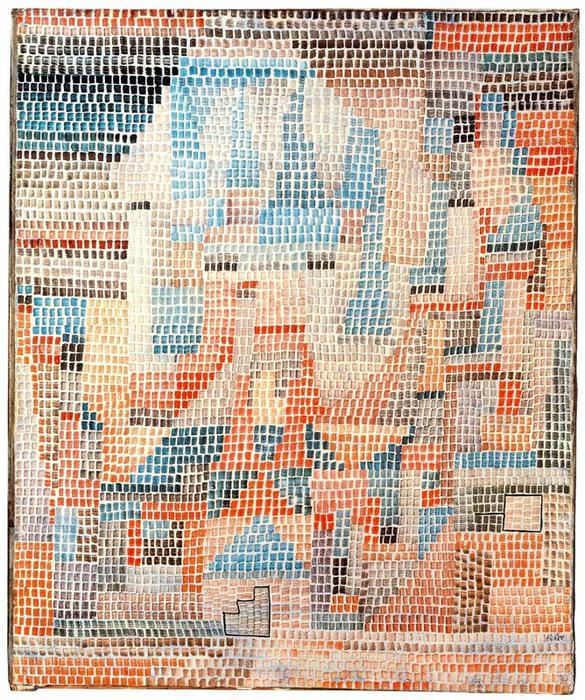
Ruins of Git – Paul Klee’s vibrant depiction captures architectural fragments interwoven with human presence against a backdrop of textured blues and greens, embodying the artist's signature blend of abstraction and emotive color palettes.
Discover Paul Klee (1879-1940): Swiss-German artist blending Expressionism, Cubism & Surrealism. Explore his color theory, Bauhaus influence, and playfully insightful art.
Paul Klee’s Ruins of Git: A Symphony in Fractured Color
The painting “Ruins of Git,” created by Paul Klee in 1937, stands as a testament to the artist's unwavering commitment to abstraction and his ability to distill complex emotions into visually arresting forms. More than just a depiction of crumbling structures—a motif recurrent throughout Klee’s oeuvre—the artwork embodies a profound meditation on memory, loss, and the enduring power of imagination amidst devastation. It resides within the broader context of Europe's turbulent years leading up to World War II, reflecting anxieties about societal upheaval and the fragility of human existence. Yet, despite its somber subject matter, “Ruins of Git” pulsates with an exuberant energy born from Klee’s distinctive artistic style.
Style and Technique: Embracing Geometric Harmony
Klee's approach to painting was characterized by a radical departure from representational conventions. He eschewed meticulous detail in favor of simplified geometric shapes—squares, rectangles, triangles—arranged in interlocking patterns that create an illusion of depth and movement. This technique, rooted in Cubism but infused with Klee’s own idiosyncratic vision, prioritizes visual harmony over accurate depiction. The artist employed a vibrant palette dominated by hues of blue, ochre, and crimson, applying paint thickly to the canvas – a process known as “grout”—to achieve textural richness and imbue the artwork with palpable physicality. This bold application of color isn’t merely decorative; it serves as a conduit for conveying emotional intensity, mirroring the fractured landscape depicted before the viewer's eyes.
Historical Context: Echoes of Uncertainty
“Ruins of Git” emerged during a period marked by escalating political tensions and looming war clouds across Europe. Klee, like many artists of his time, wrestled with existential questions about identity and purpose in the face of impending catastrophe. The painting’s desolate setting—a crumbling edifice surrounded by overgrown vegetation—mirrors the anxieties prevalent throughout the 1930s regarding societal collapse and the loss of stability. However, Klee refused to succumb to despair; instead, he channeled his apprehension into a celebration of artistic creativity as an antidote to nihilism. The artwork can be interpreted as a symbolic representation of the human spirit’s resilience in confronting adversity—a refusal to surrender to darkness but rather to illuminate it with the brilliance of imagination.
Symbolism: Fragments of Memory and Resilience
The crumbling building itself functions as a potent symbol of memory – specifically, recollections of past glories now irrevocably diminished. The scattered fragments of architectural elements suggest that time relentlessly erodes even the most enduring structures, leaving behind only traces of what once was. Simultaneously, the vibrant colors—particularly crimson—represent passion and vitality, asserting an unwavering belief in the transformative power of emotion. Furthermore, Klee’s geometric patterns embody a harmonious balance between order and chaos – mirroring the paradoxical nature of existence itself. They convey that even amidst ruin, beauty persists; creativity flourishes where destruction reigns supreme.
Emotional Impact: A Balm for Troubled Souls
Ultimately, “Ruins of Git” transcends mere visual representation to evoke profound emotional resonance. Its unsettling juxtaposition of decay and color compels viewers to confront uncomfortable truths about loss and impermanence while simultaneously inspiring a sense of wonder at the enduring capacity of art to transcend circumstance. The painting’s textured surface invites tactile engagement, fostering an intimate connection between observer and artwork—a reminder that beauty can be found even in places scarred by hardship. It serves as a poignant meditation on the human condition – acknowledging vulnerability without relinquishing hope; embracing imperfection while striving for transcendence. “Ruins of Git” remains a captivating masterpiece, inviting contemplation and inspiring admiration for Klee’s unparalleled artistic vision.