A Symphony of Color and Emotion
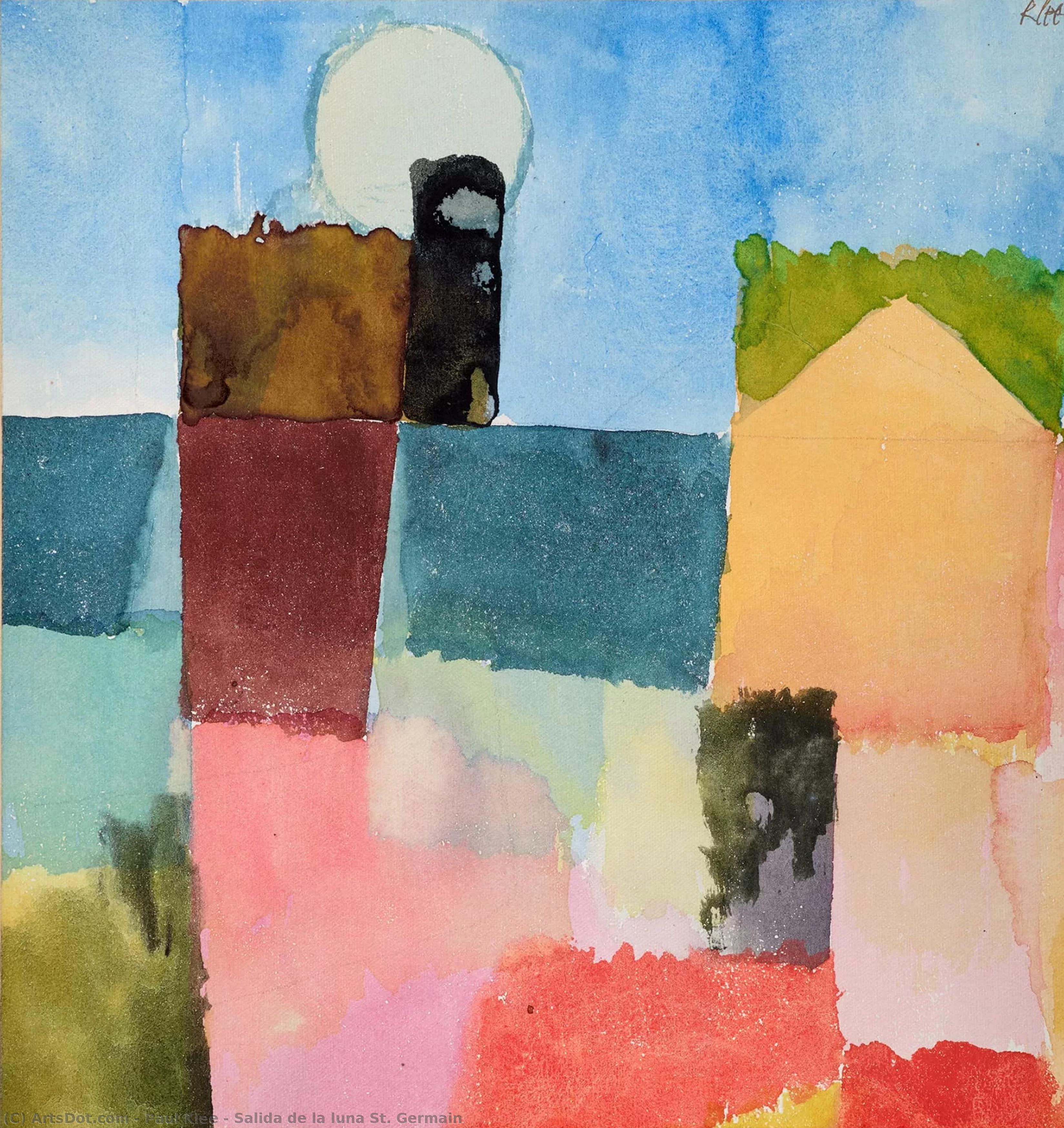
In the vast landscape of twentieth-century modernism, few works possess the quiet, rhythmic intensity found in Paul Klee’s “Salida de la luna St. Germain.” Created in 1915, this miniature masterpiece serves as a profound emblem of Klee’s burgeoning artistic vision, acting as a bridge between the tangible world and the realm of pure abstraction. Though measuring just 18 x 17 cm, the painting commands a presence far beyond its physical dimensions. It is a work that does not merely seek to represent a scene but rather to translate the very rhythm of existence into a visual poem. Through a masterful fusion of Expressionism and delicate geometric forms, Klee invites the viewer into a dreamlike nocturnal landscape where color and shape dance in a carefully orchestrated harmony.
The emotional resonance of the piece is deeply rooted in its luminous palette. One can almost feel the warmth radiating from the striking red building and its sun-bright yellow roof, which stand in vibrant defiance against the serene, deep blue of the night sky. This use of bold, primary hues—reds, yellows, and blues—is not accidental; it carries the sensory echoes of Klee’s transformative journey to Tunisia in 1914. The sun-drenched light and ochre earth tones of North Africa provided the essential stimulus for this period of experimentation, allowing Klee to break free from traditional European conventions and embrace a more primal, elemental way of seeing.
Symbolism and the Architecture of Dreams
Beyond its surface beauty, “Salida de la luna St. Germain” is a dense tapestry of symbolic meaning. The composition is anchored by a prominent clock tower, an element that serves as a poignant memento mori. In Klee’s personal iconography, such structures often embody the relentless passage of time and the inevitability of mortality. Yet, this heavy theme is balanced by the ethereal presence of the rising moon, which pierces the blue expanse to symbolize intuition, dreams, and the subconscious mind. This juxtaposition creates a fascinating tension between the structured, architectural world of man and the infinite, mysterious cycles of nature.
The simplified, almost childlike forms of the buildings contribute to an atmosphere of profound innocence and discovery. As the eye wanders across the canvas, it encounters smaller structures that suggest a larger, unseen community, perhaps even a figure standing near the center, lost in contemplation of the view. This sense of quiet observation makes the painting an incredibly intimate experience for the viewer. It is not a spectacle to be shouted from the rooftops, but a secret to be whispered—a delicate arrangement of light and shadow that rewards slow, meditative looking.
A Timeless Addition to the Modern Interior
For the discerning collector or interior designer, a high-quality reproduction of this Klee masterpiece offers much more than mere decoration; it provides a focal point of intellectual and aesthetic depth. The painting’s ability to blend Expressionist energy with abstract tranquility makes it a versatile treasure capable of anchoring diverse spaces. In a contemporary minimalist setting, its bold colors can provide a necessary pulse of life, while in a more classical or eclectic room, its historical significance and symbolic complexity add a layer of sophisticated storytelling.
Owning a piece that captures Klee’s "musical" approach to painting means bringing a sense of rhythmic balance into one's home. The work functions much like a musical score, where every line and pigment is a note contributing to a larger, symphonic arrangement. Whether viewed as an exploration of color theory or a window into the artist's soul, “Salida de la luna St. Germain” remains an enduring testament to the power of art to distill the complexities of human emotion into a single, breathtaking moment of clarity.