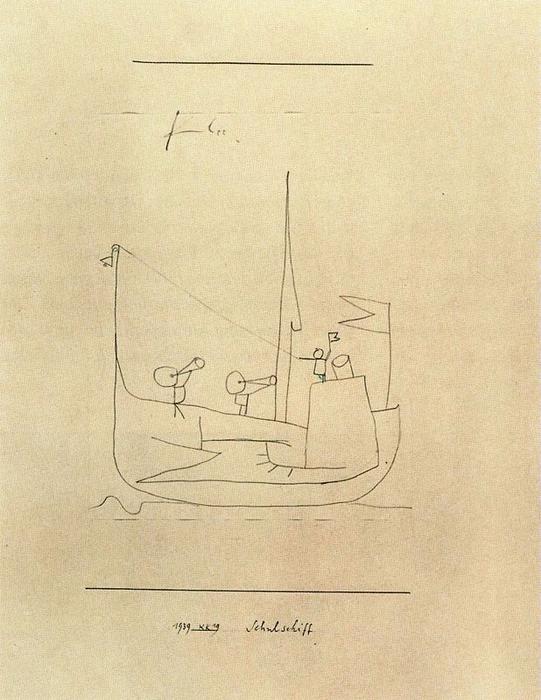
A Moment of Quiet Adventure: Paul Klee's "School Boat"
Paul Klee’s “School Boat” isn’t merely a depiction of a small sailboat; it’s an encapsulation of childhood dreams, the allure of the open sea, and the profound connection between art and experience. Painted in 1939, during a period of intense introspection for the artist amidst the looming shadows of war, this work reveals Klee's signature blend of naive abstraction and deeply felt emotion. The scene unfolds with a remarkable simplicity – a small boat, seemingly adrift on an expansive ocean, carrying three figures into the unknown. This unassuming subject matter belies a complex layering of meaning, inviting viewers to contemplate themes of freedom, exploration, and the inherent human desire for discovery.
Style and Technique: Klee’s Distinctive Approach
Klee's style in “School Boat” exemplifies his mature approach to abstraction. While rooted in representational forms – a recognizable sailboat and its occupants – the painting is far from realistic. Instead, he employs a deliberately flattened perspective, simplified shapes, and a vibrant, almost childlike palette of blues, greens, yellows, and browns. This technique, characteristic of his later work, prioritizes emotional resonance over precise depiction. The use of watercolor and gouache creates a luminous quality, with washes of color blending seamlessly to evoke the shimmering surface of the water and the hazy atmosphere of the sea. Notice the meticulous detailing in the boat’s construction – a subtle nod to Klee's earlier interest in technical drawing – juxtaposed against the overall sense of looseness and spontaneity.
Historical Context: A World on Edge
Created in 1939, “School Boat” was painted just months before the outbreak of World War II. This context profoundly influences our interpretation of the work. The boat itself can be seen as a symbol of escape – a yearning for refuge from the escalating tensions and anxieties of the time. Klee’s personal struggles with his health and the growing political instability in Europe are subtly reflected in the painting's mood, which is both hopeful and melancholic. The title, “School Boat,” adds another layer of meaning, suggesting a journey of learning and self-discovery, perhaps mirroring Klee’s own artistic evolution.
Symbolism and Emotional Impact
The three figures on the boat are deliberately ambiguous, representing not specific individuals but rather archetypes – the child, the teacher, and the explorer. The vastness of the ocean symbolizes the unknown, inviting viewers to project their own hopes and fears onto the scene. The painting’s emotional impact is profoundly evocative; it taps into a primal human desire for adventure and the freedom to chart one's own course. “School Boat” remains a testament to Klee’s ability to distill complex emotions into deceptively simple forms, creating a work that continues to resonate with audiences today. Its quiet beauty and profound symbolism make it a compelling addition to any collection or a thoughtful choice for interior design.