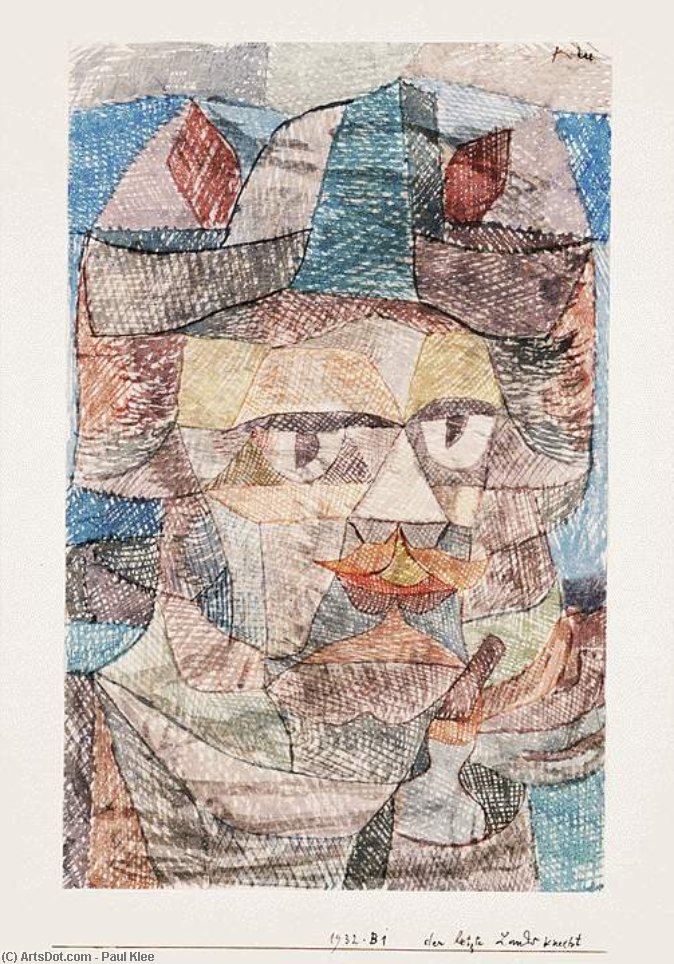
Paul Klee’s surrealist watercolor 'The Last of the Mercenaries' captures an enigmatic man’s face against a vibrant blue backdrop, accompanied by whimsical cats and birds—a testament to Klee’s expressive style and 1931’s artistic fervor. Explore this captivating piece and bring its beauty into your home.
A Fragmented Portrait of Existential Anxiety
Paul Klee’s “The Last of the Mercenaries,” painted in 1931 during his prolific period of experimentation, transcends mere visual representation; it embodies a complex tapestry of emotion and intellectual inquiry characteristic of Surrealist art. The artwork depicts a solitary male face against a serene blue backdrop—a deceptively tranquil surface concealing layers of psychological depth. This seemingly simple composition is imbued with symbolic resonance, reflecting Klee’s preoccupation with themes of isolation, vulnerability, and the precariousness of human existence.
- Style & Technique: The painting exemplifies Surrealist style, prioritizing dreamlike imagery and subconscious associations over literal depiction. Klee employed watercolor—a medium known for its luminous qualities and ability to capture subtle tonal variations—to achieve a delicate yet expressive effect. His distinctive technique involved layering washes of color onto the paper, creating textured surfaces that contribute to the artwork’s overall atmosphere.
- Historical Context: Created amidst the turbulent backdrop of Europe in the early 1930s, “The Last of the Mercenaries” speaks to anxieties prevalent during this era—specifically concerns about societal upheaval and the looming shadow of impending conflict. Surrealism emerged as a reaction against rational thought and artistic conventions established by preceding movements like Cubism and Expressionism, seeking instead to tap into the realm of irrationality and fantasy.
- Symbolism & Imagery: The inclusion of two cats—one positioned prominently near the upper left corner and another centrally located—adds a layer of enigmatic symbolism. Cats have historically represented independence, cunning, and intuition within Western iconography, mirroring Klee’s artistic ethos of defying conventional boundaries. Similarly, the bird nestled in the lower right corner symbolizes freedom and aspiration, juxtaposed against the melancholic gaze of the central figure.
- Emotional Impact: “The Last of the Mercenaries” evokes a palpable sense of introspection—a quiet contemplation punctuated by subtle gestures of unease. The muted palette and amorphous contours contribute to an atmosphere of vulnerability and solitude, inviting viewers to ponder questions of identity and existential uncertainty. Klee’s masterful use of watercolor captures not only visual beauty but also the intangible essence of human emotion.
Interior Design Considerations: This artwork's ethereal quality lends itself beautifully to minimalist interiors—particularly spaces bathed in soft blues or greens. Its textural surface and understated color scheme create a calming focal point without dominating the room’s aesthetic, offering collectors and designers alike a piece that speaks volumes about artistic vision and emotional resonance.