A Window Into Emotion: Decoding Paul Klee's Masterpiece
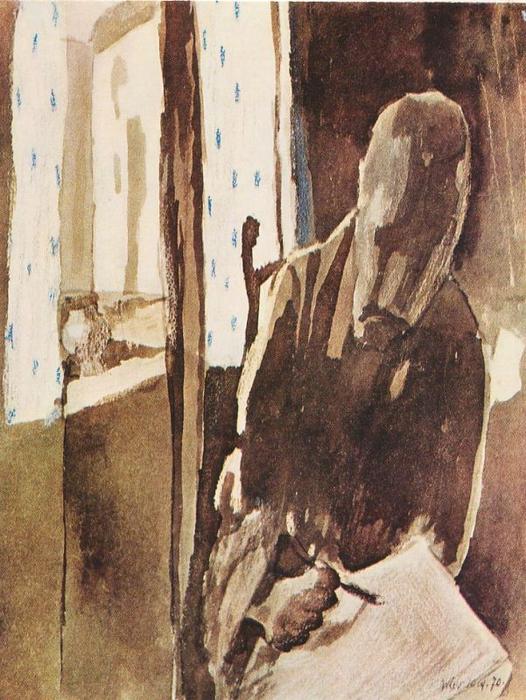
Paul Klee’s “The Signatories to the Window,” painted in 1909, transcends mere visual representation; it embodies a profound meditation on solitude and observation—themes central to Klee’s artistic philosophy. This watercolor depicts a solitary figure positioned at a window frame, gazing outwards into an ambiguous landscape that speaks volumes about the artist's inner world. More than just a depiction of space, it’s a carefully constructed tableau designed to evoke contemplation and invite viewers to consider their own relationship with the external environment.
Expressionist Roots: Color Theory and Texture
Executed in the Expressionist style—a movement that prioritized emotional intensity over objective realism—the painting utilizes a muted palette dominated by earthy browns, beige, grey, and subtle washes of pale blue. These colors aren’t merely decorative; they contribute to an atmosphere of melancholic introspection, mirroring Klee's preoccupation with conveying feelings rather than documenting reality. The watercolor technique itself is masterful, layering pigments to create rich textural surfaces punctuated by visible brushstrokes—a deliberate choice that underscores the artist’s tactile engagement with his medium.
Composition and Form: Simplifying Reality
The composition adheres to a flattened perspective, characteristic of Cubist influences, where depth is suggested through tonal variations rather than traditional linear recession. The window frame serves as a dividing element, subtly demarcating the foreground from the background—a technique that enhances the sense of enclosure and reinforces the figure’s contemplative stance. Klee employs simplified forms, eschewing anatomical detail in favor of expressive gestures, emphasizing the emotional core of his subject matter.
Symbolism Beyond Sight: The Window as Metaphor
Beyond its formal elements, “The Signatories to the Window” resonates with symbolic significance. The window itself functions as a potent metaphor for transition—representing both an outward gaze toward the world and an inward reflection on one’s own thoughts and feelings. Klee's deliberate ambiguity regarding the landscape beyond invites viewers to project their own experiences onto the scene, fostering a dialogue between art and perception.
Legacy of Influence: Klee's Notebooks and Bauhaus
Paul Klee’s artistic legacy extends far beyond his paintings; his “Paul Klee Notebooks,” published alongside Leonardo da Vinci’s notebooks, offer invaluable insights into his creative process and theoretical framework. These writings reveal Klee’s unwavering belief in the power of abstraction to communicate emotion—a conviction that aligns seamlessly with the Bauhaus aesthetic—solidifying his position as a pivotal figure in shaping modern art.