Discover Paul Klee (1879-1940): Swiss-German artist blending Expressionism, Cubism & Surrealism. Explore his color theory, Bauhaus influence, and playfully insightful art.
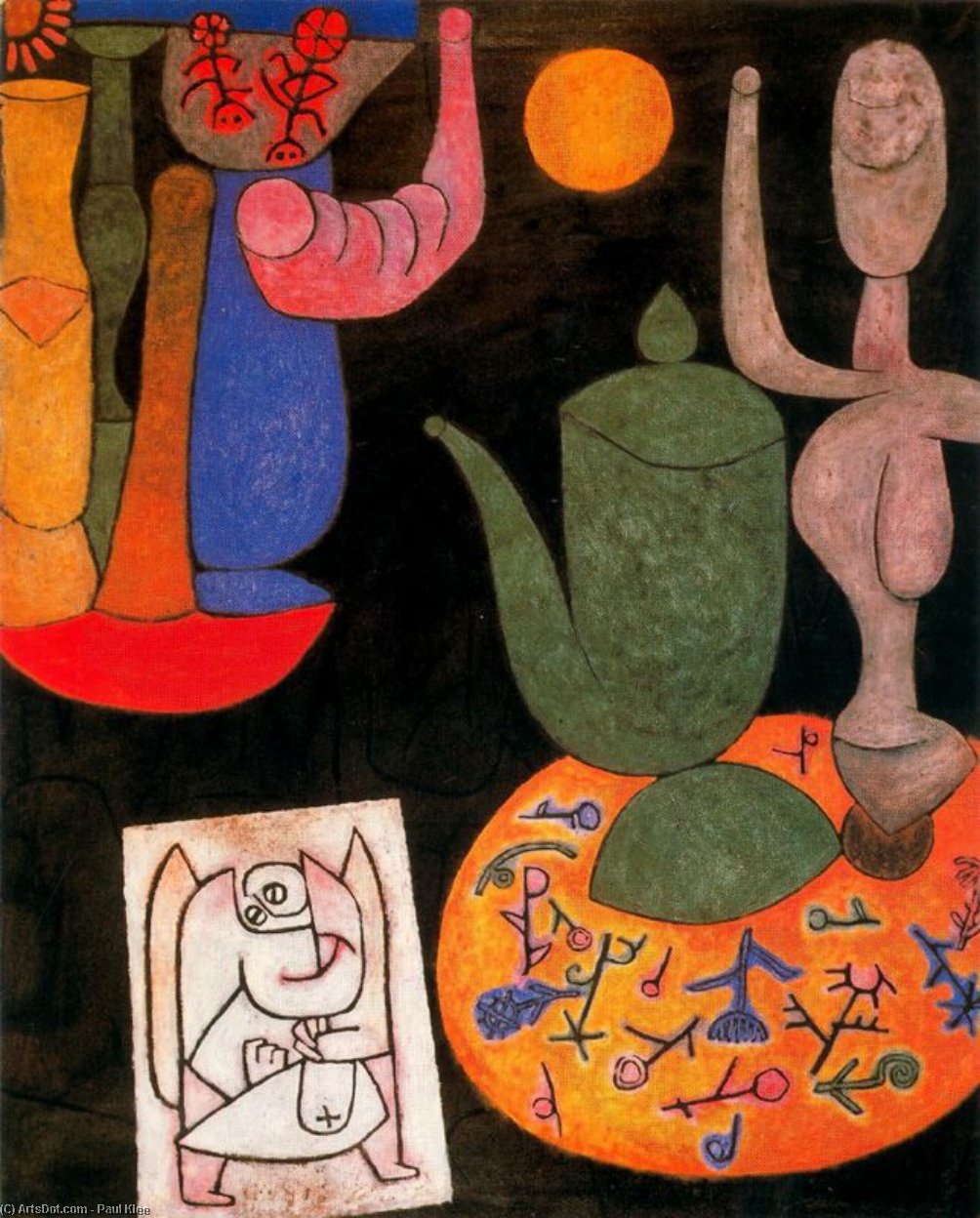
A Dance of Color and Form: Exploring Paul Klee’s Untitled Still Life
Paul Klee, born in Münchenbuchsee, Switzerland, in 1879, stands as a singular figure within the tapestry of modern art—a testament to artistic independence and an unwavering commitment to exploring the expressive potential of abstraction. His formative years instilled in him a profound appreciation for both visual and auditory harmony, nurtured by his father’s musical instruction and his mother’s vocal performances. This early exposure would profoundly influence his artistic vision, shaping not only his compositional sensibilities but also his intellectual grasp of art as a conduit for conveying emotion through non-representational means—a concept remarkably prescient for its time. Initially captivated by drawing, Klee swiftly transitioned to experimenting with color theory, recognizing its transformative capacity to imbue artwork with depth and resonance. This dedication would become the cornerstone of his artistic practice, propelling him toward groundbreaking innovations that defied conventional stylistic boundaries.
The Style of Playful Abstraction
Klee’s distinctive style—characterized by a mesmerizing blend of geometric shapes, organic forms, and vibrant hues—represents a radical departure from academic realism. He embraced the tenets of Expressionism alongside influences from Cubism and Surrealism, resulting in compositions that prioritize feeling over precise depiction. Unlike artists striving for photographic accuracy, Klee sought to capture the essence of experience, translating inner states into visual symbols. His canvases pulsate with an energy born from improvisation and intuition, mirroring the rhythms and harmonies of musical notation—a deliberate connection he articulated extensively in his influential Writings on Form and Design Theory (Schriften zur Form und Gestaltungslehre). This notebook serves as invaluable insight into Klee’s artistic philosophy, demonstrating his conviction that art should transcend mere imitation to achieve a state of profound communicative power.
Technique and Composition: A Delicate Balance
Klee employed a technique rooted in watercolor washes and gouache—a masterful combination that allowed for layering colors and achieving subtle gradations of tone. The resulting surfaces possess an ethereal quality, reminiscent of stained glass windows or illuminated manuscripts—references that underscore Klee’s fascination with visual storytelling and his desire to evoke contemplation. Within the depicted still life, the artist meticulously arranges objects—vases, cups, bowls, bottles—creating a balanced composition that draws the eye across its expanse. The placement of each element contributes to the overall narrative, subtly hinting at themes of stillness, reflection, and interconnectedness. Notably, Klee’s use of color is deliberately unconventional; he eschews naturalistic palettes in favor of hues that are emotionally charged and psychologically suggestive—a characteristic trait of Expressionist painters who sought to convey subjective experience rather than objective observation.
Symbolism Within the Everyday
The seemingly simple subject matter of this untitled still life belies a deeper symbolic resonance. Each object—the vases, cups, bottles—represents not merely tangible items but also concepts associated with domesticity, ritual, and contemplation. The artist’s deliberate choice to depict these commonplace objects elevates them to the realm of art, transforming them into vehicles for conveying profound emotional truths. Furthermore, Klee's exploration of color extends beyond mere aesthetic pleasure; he employs hues to communicate psychological states—warm reds and oranges symbolizing passion and vitality, cool blues and greens evoking serenity and introspection. This masterful manipulation of color underscores Klee’s belief that art possesses the capacity to illuminate hidden dimensions of human experience.
Emotional Impact: A Quiet Revelation
Ultimately, Paul Klee's Untitled Still Life transcends mere visual representation; it invites viewers into a meditative space where emotion and intellect converge. The painting’s understated beauty—its harmonious blend of color and form—promotes contemplation and encourages us to consider the significance of everyday objects within the broader context of human existence. Like many Expressionist masterpieces, this artwork speaks to our deepest anxieties and aspirations, reminding us that true artistic achievement lies in capturing not just what we see but also what we feel—a legacy that continues to inspire artists and collectors alike.