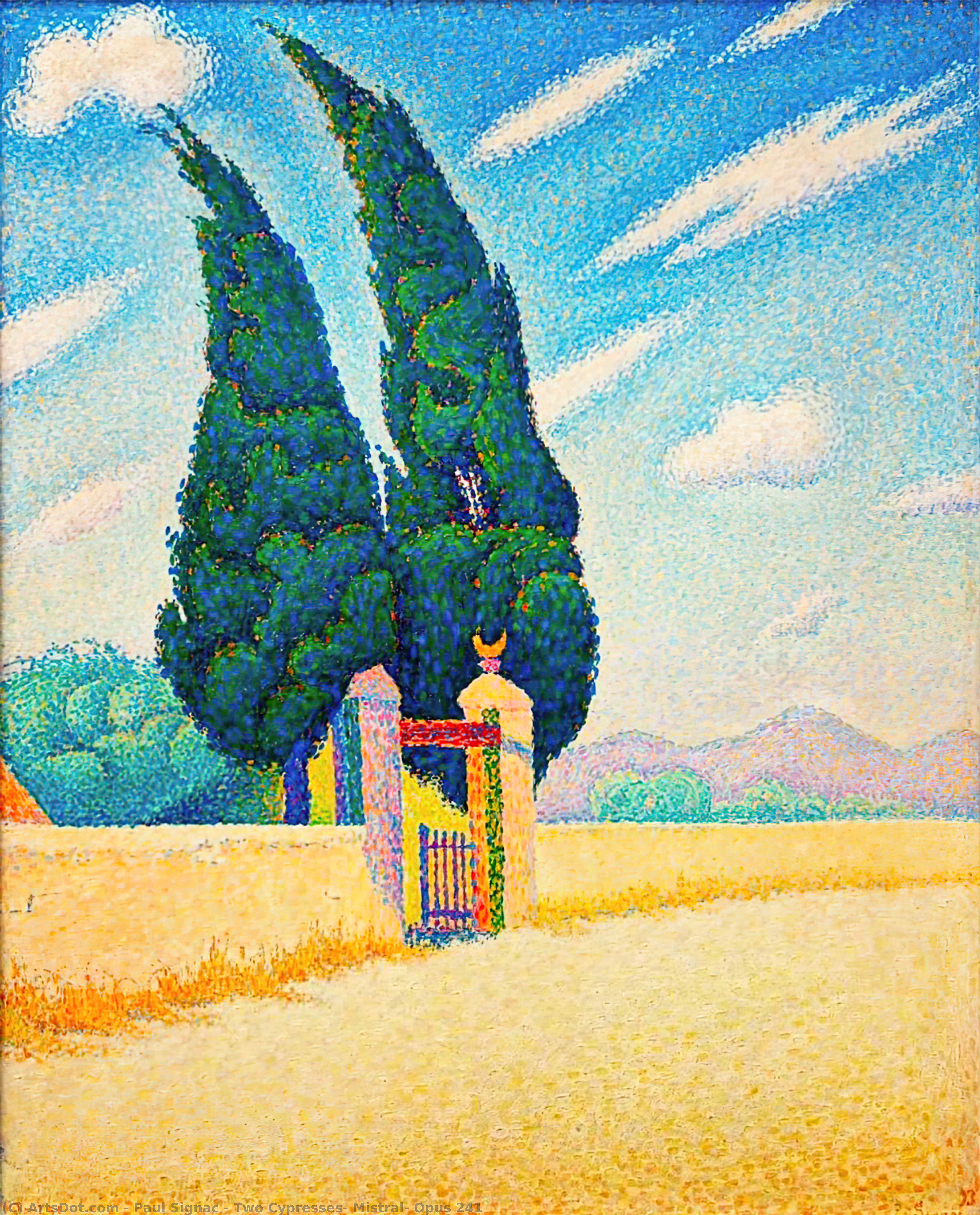
A Symphony of Light and Color: The Essence of Two Cypresses
In the quiet halls of the Kröller-Müller Museum, there exists a window into a world where light does not merely fall upon objects but seems to vibrate from within them. Paul Signac’s Two Cypresses, Mistral, Opus 241, painted in 1893, is far more than a landscape; it is a rhythmic, breathing testament to the power of Neo-Impressionism. At first glance, the viewer is greeted by the commanding presence of two dark, verdant cypress trees that pierce the sky like silent sentinels. These towering forms, rendered with a geometric precision that hints at Signac’s architectural sensibilities, anchor a composition that feels both grounded in the earth and ethereal in its atmosphere. The scene captures a specific moment in the Mediterranean landscape, where the fierce Mistral wind sweeps through the trees, adding an invisible layer of movement and energy to the stillness of the canvas.
The magic of this masterpiece lies in Signac’s revolutionary application of Pointillism. Moving away from the spontaneous, fleeting strokes of traditional Impressionism, Signac embraced a more scientific, disciplined approach to color theory. He meticulously applied countless tiny dots of pure, unblended pigment onto the canvas, trusting the human eye to perform the work of mixing. When standing close, the painting reveals itself as a mosaic of distinct, brilliant flecks—azure, emerald, ochre, and soft white. Yet, as one retreats, these fragments dissolve into a cohesive, luminous reality. This optical blending creates a shimmering effect, where the sky appears to pulse with sunlight and the dry, golden grasses seem to sway under the weight of the warm French sun.
Symbolism and the Soul of the Mediterranean
Beyond its technical brilliance, the artwork is steeped in profound symbolism that resonates deeply with the human experience. The cypress tree, a perennial fixture of the Mediterranean landscape, has long been regarded as a symbol of both mourning and immortality. In Signac’s hands, these trees become icons of resilience, standing steadfast against the turbulent Mistral wind. This tension between the permanence of the trees and the ephemeral nature of the wind creates a poignant dialogue about the endurance of life amidst the inevitable changes of time. The warm orange gate and the symmetrical pillars in the foreground provide a human touch, suggesting a threshold between the cultivated world and the wild, untamed beauty of nature.
For the discerning collector or interior designer, bringing a reproduction of this work into a living space offers more than just aesthetic decoration; it introduces a sense of profound tranquility and intellectual depth. The painting’s palette—a harmonious balance of cool blues and warm, sun-drenched yellows—possesses a unique ability to transform the mood of a room, providing a focal point that is both stimulating and serene. It serves as an invitation to slow down, to observe the minute details of our world, and to find beauty in the structured harmony of light. To possess such a piece is to hold a fragment of art history, a window into a moment where science and soul converged to redefine the very nature of sight.