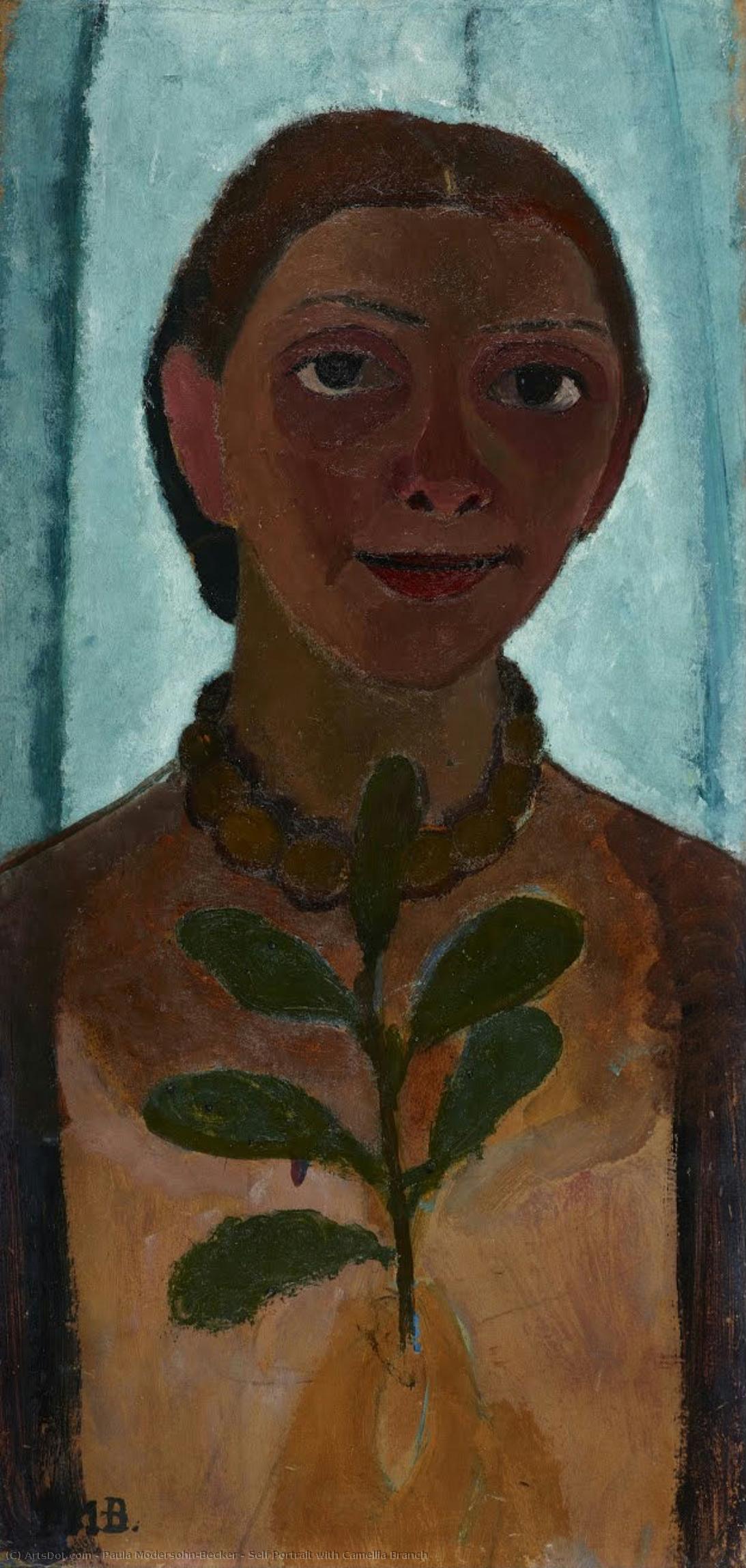
Admire Paula Modersohn-Becker’s "Self Portrait with Camellia Branch." A poignant Expressionist masterpiece showcasing her unique style & artistic talent. Explore this iconic work.
Discover Paula Modersohn-Becker (1876-1907), a pioneering Expressionist renowned for her daring self-portraits & intimate depictions of motherhood, shaping early 20th-century art with emotional depth and innovation.
Explore Museum Folkwang's stunning collection of Impressionist masterpieces & German Expressionism alongside innovative architecture – a legacy forged in vision.
A Quiet Revelation: Exploring Paula Modersohn-Becker’s ‘Self Portrait with Camellia Branch’
Paula Modersohn-Becker's “Self Portrait with Camellia Branch,” painted in 1906/07, stands as a cornerstone of Expressionist art and a poignant meditation on femininity, mortality, and the enduring beauty of nature. More than just a depiction of her likeness—though undeniably striking—the painting embodies Becker’s profound engagement with inner vision and her unwavering commitment to portraying the complexities of human emotion. It resides within the Museum Folkwang in Essen, Germany, where its serene presence continues to captivate viewers decades after its creation.
The Artist's Vision: Expressionism at Its Core
Becker’s artistic approach firmly rooted itself in the burgeoning Expressionist movement, a reaction against Impressionistic idealism and a fervent desire to convey subjective experience rather than objective reality. Rejecting academic conventions, she embraced bold colors—primarily blues and greens—to imbue her canvases with palpable emotion. The painting's flattened perspective and simplified forms prioritize feeling over meticulous detail, mirroring the stylistic hallmarks of artists like Edvard Munch and Ernst Ludwig Kirchner. This deliberate distortion serves not to deceive but to amplify the artist’s inner state, inviting contemplation on themes of vulnerability and resilience.
Symbolism Woven into Detail
The inclusion of a camellia branch—a flower associated with mourning and remembrance—is laden with symbolic significance. Camellias are traditionally used in funeral wreaths, representing purity and devotion while acknowledging the inevitability of loss. In “Self Portrait,” Becker’s gaze directs outwards, seemingly confronting the viewer with an awareness of her own mortality. Simultaneously, the camellia itself symbolizes rebirth and regeneration – a subtle counterpoint to the solemnity of its association with death. The artist's careful positioning of the branch—a gesture of quiet contemplation—underscores the painting’s contemplative mood.
Technique: A Delicate Balance Between Observation and Emotion
Becker employed oil paints on canvas, utilizing a technique characterized by thick impasto – applying paint in textured layers – to achieve remarkable depth and luminosity. This method allowed her to capture not only the visual appearance of her subject but also the tactile qualities of skin and foliage. The subtle blending of colors contributes to an ethereal atmosphere, enhancing the painting’s emotional resonance. Her meticulous attention to detail—particularly the rendering of her eyes—reveals a masterful understanding of portraiture and a desire to convey psychological insight.
A Legacy of Quiet Intensity
“Self Portrait with Camellia Branch” transcends mere representation; it is an invitation to engage in a dialogue about identity, emotion, and the human condition. Paula Modersohn-Becker’s courageous exploration of inner experience—coupled with her masterful artistic technique—solidifies her place as one of the most important figures in early 20th-century art. Its enduring appeal lies in its ability to evoke empathy and contemplation, reminding us that beauty can reside not only in outward appearances but also in the quiet depths of our own souls.