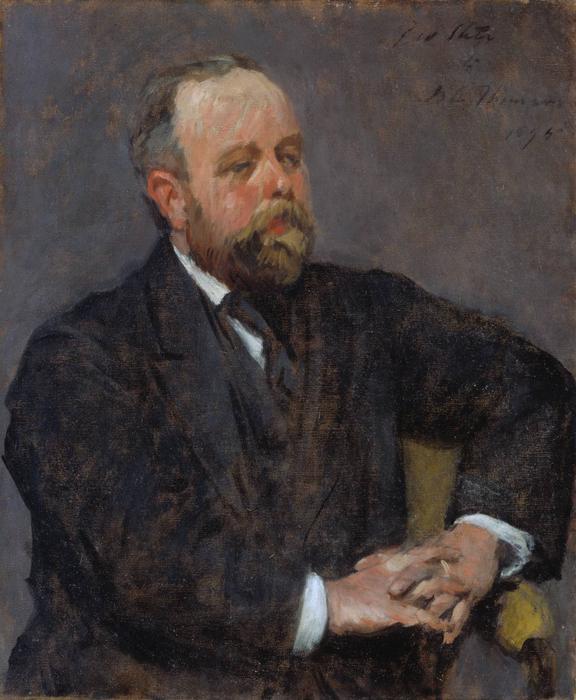
A Silvered Moment: Philip Wilson Steer’s ‘David Croal Thomson’
Philip Wilson Steer's “David Croal Thomson,” painted in 1895, isn’t merely a portrait; it’s a carefully constructed distillation of light, atmosphere, and the quiet dignity of a man lost in thought. The canvas breathes with a subtle luminescence, a hallmark of Steer’s distinctive Impressionist style – one that sought to capture not just appearances but the fleeting sensations of a particular moment. The painting depicts David Croal Thomson, a Scottish journalist and critic, seated in an armchair within what appears to be his study or perhaps a well-appointed drawing room. He is a figure of understated elegance, rendered with a remarkable sensitivity to texture and light. The composition draws the eye immediately to Thomson’s face – a portrait of thoughtful contemplation, framed by a neatly trimmed beard and a hint of melancholy in his expression. Steer masterfully employs a muted palette dominated by silvery greys, blues, and browns, creating an almost dreamlike quality that envelops the scene.
The Impressionist’s Dance with Light
Steer's artistic journey was deeply influenced by his time in Paris during the 1880s. He absorbed the revolutionary techniques of Monet and Renoir, learning to break down forms into their constituent elements of light and color. However, unlike many of his Parisian contemporaries, Steer never fully abandoned a distinctly British sensibility. He retained a fascination with the English countryside – particularly the coastal regions of Suffolk and Walberswick – which became a recurring subject in his work. “David Croal Thomson” exemplifies this fusion; it’s not simply an Impressionist study but one imbued with a uniquely British atmosphere, reminiscent of misty mornings on the Norfolk coast. The brushstrokes are loose and visible, creating a sense of movement and immediacy—a deliberate departure from the smooth, polished surfaces favored by academic painters of the time.
Symbolism in Seclusion
Beyond its technical brilliance, “David Croal Thomson” is rich with subtle symbolism. The setting itself – a comfortable armchair, a table laden with books and papers, a clock subtly suggesting the passage of time—evokes a sense of intellectual pursuit and quiet contemplation. Thomson’s posture, seated in repose, suggests a man absorbed in thought, perhaps reviewing his work or simply lost in reflection. The muted colors contribute to this atmosphere of introspection, creating a space where the viewer is invited to share in Thomson's private world. The inclusion of the clock adds an element of temporal awareness, reminding us that even moments of profound contemplation are fleeting and transient.
A Legacy of Atmospheric Painting
Philip Wilson Steer’s influence extended far beyond his own lifetime. He played a pivotal role in establishing British Impressionism as a recognized movement, and his work continues to resonate with contemporary viewers. “David Croal Thomson” stands as a testament to his skill and vision—a captivating portrait that transcends the limitations of mere representation. It's a painting that invites us to linger, to observe the nuances of light and shadow, and to contemplate the quiet dignity of a man lost in thought. Reproductions of this piece offer a remarkable opportunity to bring Steer’s atmospheric mastery into any interior space, adding a touch of timeless elegance and intellectual depth.
Further Exploration
- Original Artwork:** Tate Britain, London
- Learn more about Philip Wilson Steer:Wikipedia
- Discover David Croal Thomson’s life and work:Tate Images