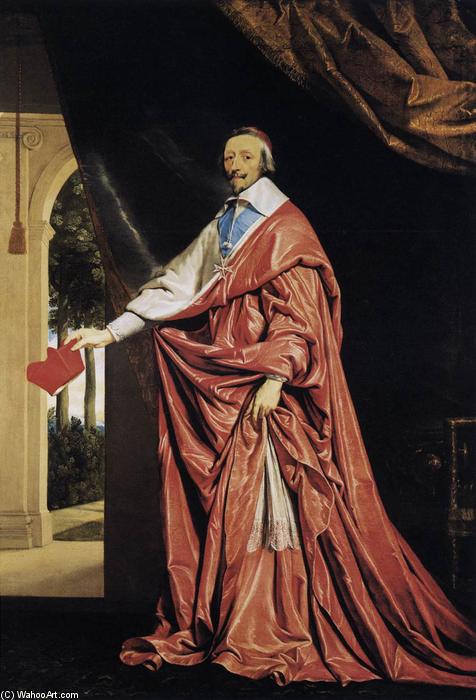
A Portrait Steeped in Majesty: Exploring Philippe de Champaigne’s Cardinal Richelieu
The painting “Cardinal Richelieu,” executed by Philippe de Champaigne in 1637, stands as a testament to the grandeur and sophistication of Baroque art—a style that sought to overwhelm the senses with dramatic lighting, opulent textures, and an unwavering focus on conveying emotion. More than just a depiction of a prominent figure, it’s a carefully constructed visual narrative brimming with symbolism and reflecting the intellectual currents of its time.
Commissioned during Richelieu's reign as Cardinal and Duke of Parma, this monumental oil painting transcends mere portraiture; it aspires to embody power and authority. Champaigne skillfully employs chiaroscuro—the interplay between light and shadow—to sculpt Richelieu’s form against a dark curtain backdrop. This technique isn’t merely decorative; it serves to elevate the subject, highlighting his face and robes while simultaneously creating an illusion of depth and dimensionality that draws the viewer into the scene. The drapery folds are rendered with painstaking detail, mirroring the influence of Rubens—Champaigne's Flemish mentor—who championed realism and masterful brushwork. These folds aren’t simply draped; they appear to ripple with movement, conveying a sense of regal bearing and commanding presence.
The composition itself is deliberately balanced, placing Richelieu centrally within the frame, emphasizing his importance as a political leader. The arched doorway and foliage beyond contribute to this spatial illusion, guiding the eye upwards and reinforcing the impression of grandeur. Champaigne’s meticulous attention to detail extends to every element—the subtle shading on Richelieu's face, the intricate embroidery on his robes, even the texture of the curtain fabric. These details speak volumes about the artist’s commitment to capturing not just appearance but also character and status.
- Artist: Philippe de Champaigne
- Year Created: 1637
- Medium: Oil on Canvas
- Location: National Gallery, London
The painting’s symbolism is equally compelling. Richelieu's crimson robes—a color traditionally associated with royalty and piety—represent his position as both a religious figure and a ruler wielding considerable influence. He holds a book aloft, symbolizing knowledge and spiritual contemplation – an emblem that underscores the humanist ideals prevalent during the Renaissance and Baroque periods. The dark curtain serves as more than just a backdrop; it symbolizes obscurity and mystery, hinting at the complexities of Richelieu’s character and concealing aspects of his life beyond the portrait's gaze.
Ultimately, “Cardinal Richelieu” succeeds in evoking a profound emotional response. Its dramatic lighting and masterful brushwork convey not only visual splendor but also an aura of solemn dignity and unwavering conviction. It invites contemplation on power, faith, and the enduring legacy of one of Europe’s most formidable statesmen—a masterpiece that continues to captivate audiences centuries after its creation.
Discover High-Quality Reproductions at ArtsDot.com
Learn More About Philippe de Champaigne & His Works: /art/list/?Filter=8Y3VW8-Philippe-De-Champaigne-Cardinal-Richelieu
Explore Other Notable Works by Rubens & Rembrandt at The National Gallery: https://AllPaintingsStor