A Window Into Majesty: The Soul of Philippe de Champaigne
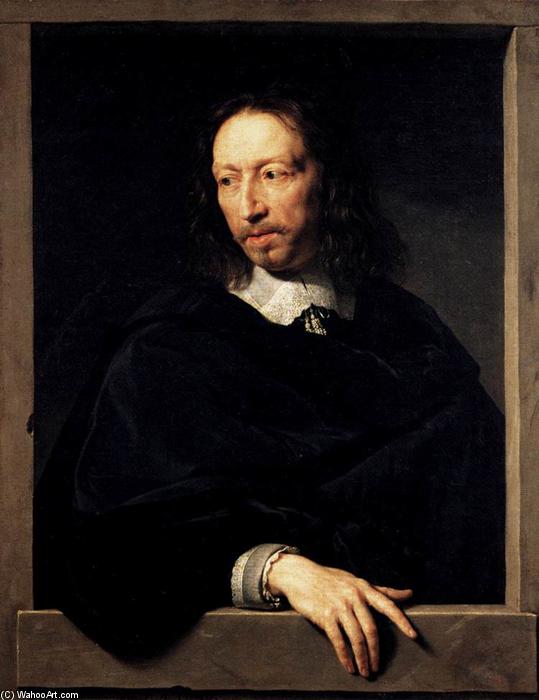
In the year 1650, within the vibrant, shifting atmosphere of Brussels, a masterpiece was quietly brought to life that would eventually transcend its era to become a profound meditation on the human condition. Philippe de Champaigne, a painter whose name is synonymous with the grandeur of the French Baroque, crafted this Portrait of a Man not merely as a likeness, but as an exploration of nobility and contemplative solemnity. Measuring 91 x 72 cm, the canvas serves as a gateway into the seventeenth century, capturing a gentleman of considerable standing whose very presence commands the room. To gaze upon this work is to encounter a man caught in a moment of quiet dignity, his identity woven into the rich textures of his era and the heavy, atmospheric shadows of the Baroque style.
The brilliance of Champaigne’s technique lies in his masterful command of chiaroscuro. He employs dramatic contrasts between light and shadow to sculpt the subject's features, imbuing the flesh and fabric with a palpable, three-dimensional vitality. The light falls with intentional precision upon the man’s face and hands, pulling him forward from a dark, enigmatic background, while leaving much of the periphery in a state of mysterious obscurity. This interplay of light does more than just define form; it creates an emotional resonance, suggesting a depth of character that lies just beneath the surface of his composed exterior. His gaze, directed steadily toward the viewer, establishes an intimate connection that bridges the centuries, inviting collectors and admirers alike to participate in this silent dialogue.
Symbolism and the Architecture of Presence
Beyond the mere depiction of a high-ranking individual, the composition is rich with symbolic weight. The subject is framed by a window, an element that serves as a powerful metaphor for both observation and confinement. This architectural boundary creates a shallow depth, pressing the figure toward the viewer and fostering a sense of closeness, yet it also suggests a separation between the private world of the sitter and the external reality of the observer. The rigid, geometric lines of the window frame provide a stark, structural contrast to the softer, organic curves of the man’s face and the flowing textures of his attire, creating a visual tension that is quintessential to the Baroque aesthetic.
The color palette is a masterclass in understated elegance, dominated by somber tones of black, deep brown, and charcoal gray. These dark hues are punctuated only by the crisp white of a collar or cuff and the subtle, warm flesh tones of the subject’s skin. This restrained use of color directs all attention to the psychological weight of the portrait. For the interior designer or art enthusiast, this piece offers a sophisticated anchor for a room; its muted tones and dignified atmosphere provide a sense of historical gravity and timelessness that can elevate any space, from a formal study to a contemporary gallery setting.
A Legacy of Precision and Emotion
Every brushstroke in this work speaks to the meticulous precision of Champaigne’s hand. The texture of the subject's beard, the heavy weight of his opulent clothing, and the smooth, luminous quality of his skin are all rendered with a realism that borders on the miraculous. This level of detail was not merely for show; it was intended to glorify the sitter’s lineage and solidify his social position through the sheer excellence of the medium. As a founding member of the Académie royale de peinture et de sculpture, Champaigne brought a disciplined, academic rigor to his work that never sacrificed emotional depth for technical accuracy.
Owning or displaying a high-quality reproduction of this portrait is an opportunity to bring a piece of history into the modern home. It is more than a decoration; it is an invitation to reflect on themes of power, perception, and the enduring nature of the human spirit. Whether you are drawn to its dramatic lighting, its historical significance, or its ability to evoke a sense of quiet majesty, Portrait of a Man remains a profound testament to the transformative power of Baroque art.