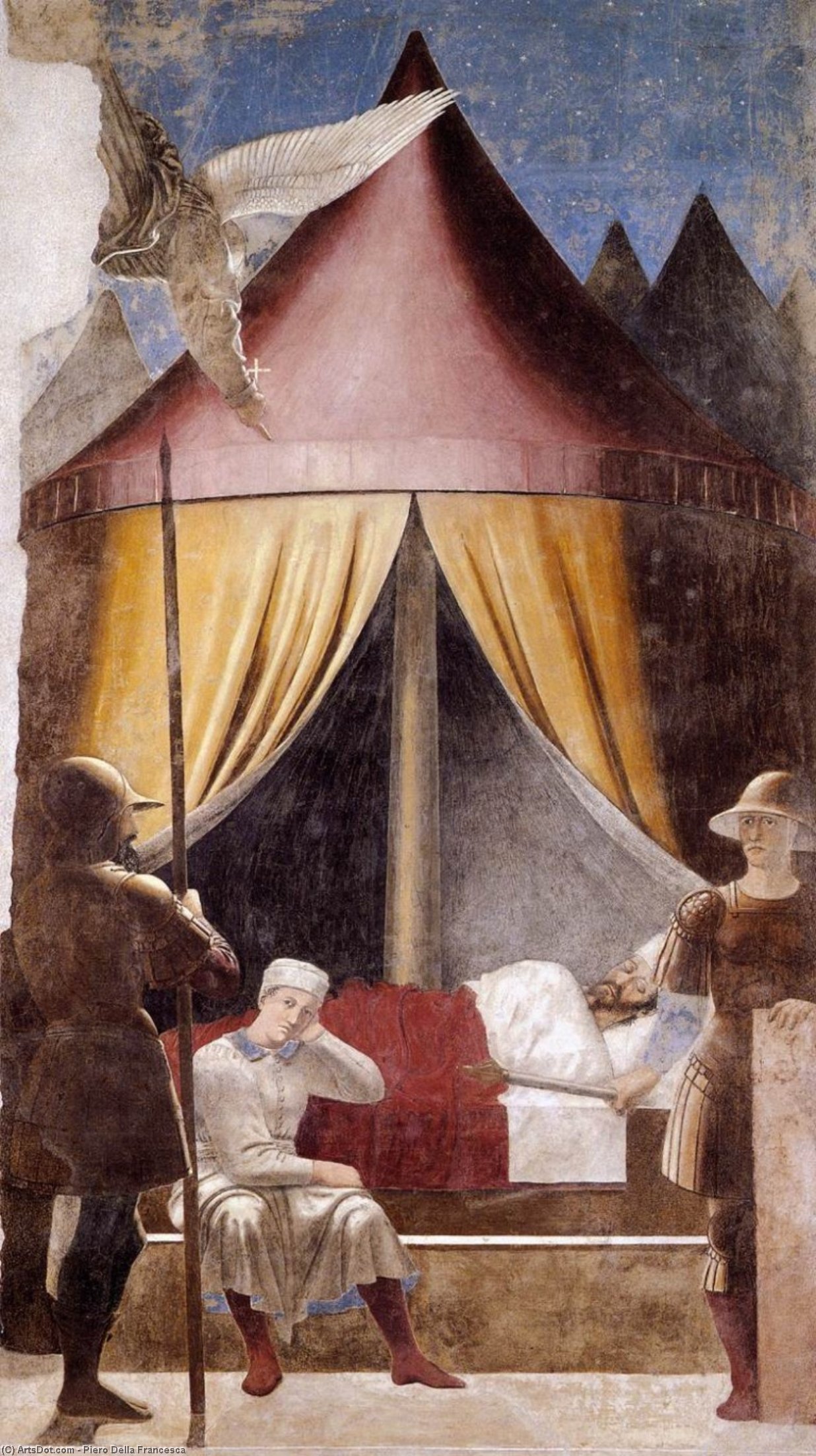
Piero della Francesca's masterful use of linear perspective transformed artistic representation, establishing him as a pioneer. The painting’s serene composition features a central figure holding an emblem resembling a sword or spear, alongside two birds symbolizing faith and vigilance.
Piero della Francesca: A Renaissance Pioneer
Piero della Francesca (c. 1415 – 1492), born in San Sepolcro, Tuscany, stands as one of the most influential artists of the Early Renaissance—a figure whose meticulous observation and groundbreaking innovations continue to inspire awe centuries later. His work transcends mere representation; it embodies a profound understanding of geometry, perspective, and humanist ideals that fundamentally reshaped artistic practice.
- Early Training: Piero’s formative years were spent absorbing the Gothic traditions prevalent in central Italy, likely influenced by artists like Domenico Veneziano. Antonio Alberti served as his mentor, fostering a dedication to classical principles alongside medieval aesthetics.
- Florence – A Crucible of Change: Around 1439, Piero relocated to Florence—a city undergoing rapid transformation under the patronage of Lorenzo Ghiberti and Filippo Brunelleschi—where he absorbed the Florentine emphasis on realism, anatomy, and spatial illusionism.
The Legend of the True Cross: A Narrative Vision
Among Piero della Francesca’s celebrated commissions was ‘The Legend of the True Cross,’ a monumental fresco cycle undertaken for the Basilica di San Francesco in Arezzo. This ambitious project—commissioned by Benedetto Bembo, Bishop of Arezzo—demonstrates Piero's mastery in storytelling through art and his unwavering commitment to conveying complex theological ideas with unparalleled clarity.
- Inspired by Jacopo da Varagine: The cycle drew heavily from Jacopo da Varagine’s “The Golden Legend,” a medieval compilation of miraculous tales—a source material that demanded artistic interpretation.
- Spatial Innovation: Piero della Francesca revolutionized painting technique with his masterful use of linear perspective, creating an illusionistic space that defies conventional representation. This groundbreaking approach established him as a pioneer in the Renaissance.
‘4. Vision of Constantine’: Light and Geometry
'4. Vision of Constantine,' arguably Piero’s most iconic work within the Legend cycle—located on the central wall of the Bacci Chapel—captures a pivotal moment in Christian history: the Battle of Milvian Bridge (312 AD). This fresco exemplifies Piero's signature style, characterized by serene composition and precise geometric construction.
- Compositional Structure: The chapel’s wall is divided into three horizontal levels—a technique that reinforces the sense of depth and guides the viewer’s gaze through the narrative.
- Symbolism of Light: Piero della Francesca employed chiaroscuro—the dramatic interplay between light and dark—to illuminate the figures and create a palpable atmosphere of solemn contemplation. The radiant light emanating from the angel symbolizes divine grace and illuminates the Emperor's face, conveying the certainty of victory.
Conservation Efforts & Legacy
Despite weathering challenges over time—resulting in some pigment loss—‘4. Vision of Constantine’ remains an extraordinary testament to Piero della Francesca’s artistic genius. Ongoing conservation efforts spearheaded by the Italian government and local authorities ensure that this masterpiece continues to inspire future generations.
Piero della Francesca's influence extends far beyond his own time, shaping the aesthetic sensibilities of artists throughout Europe. His unwavering dedication to observation, mathematical precision, and humanist ideals cemented his place as one of the foremost figures in Renaissance art—a legacy that resonates powerfully even today.