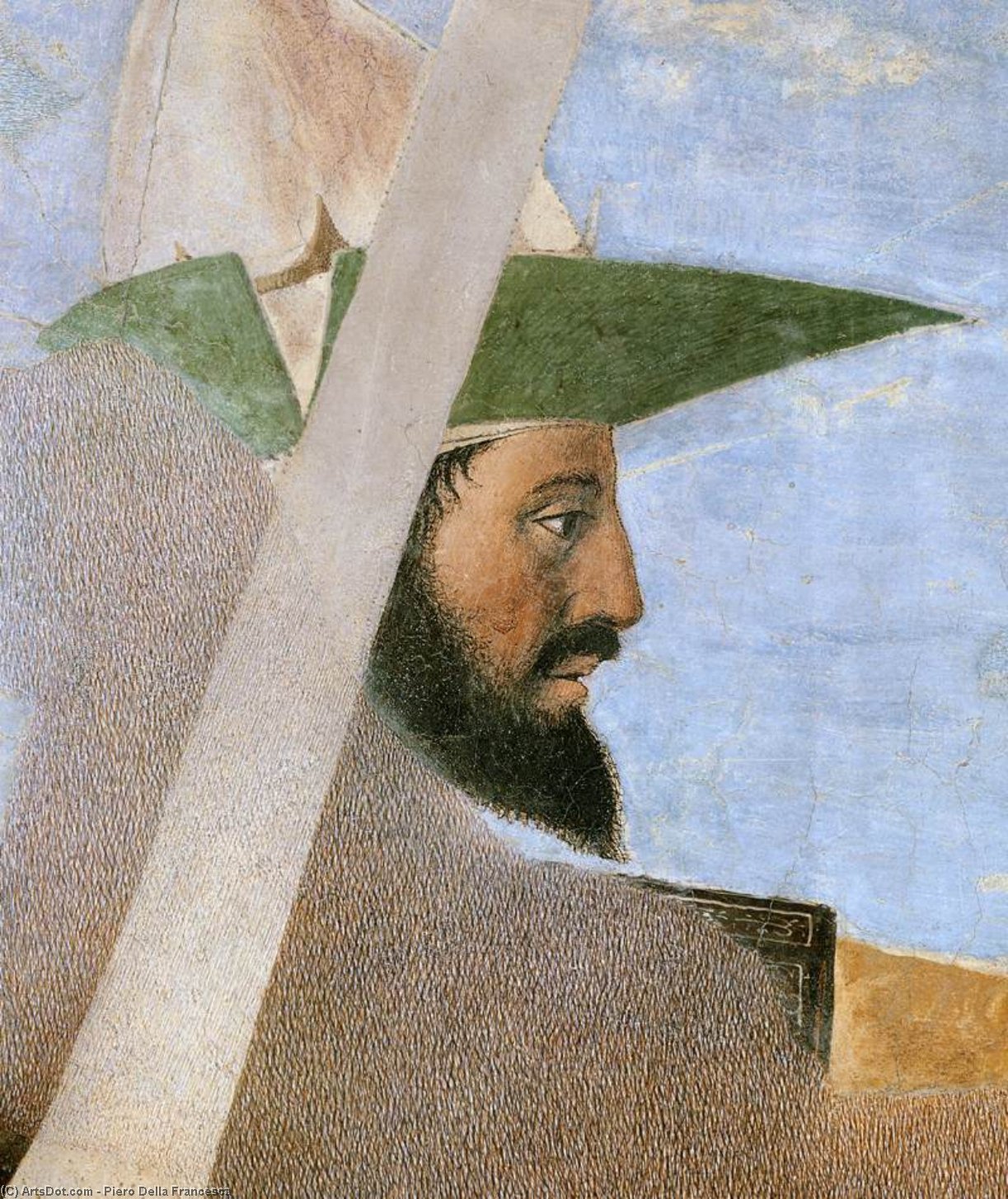
Piero della Francesca’s ‘Constantine’s Victory over Maxentius (detail)’ – A Renaissance Masterpiece of Perspective and Power
Within the serene walls of the Basilica of San Francesco in Arezzo, Italy, resides a fresco that continues to exert a profound influence on artists and art enthusiasts alike: Piero della Francesca's ‘Constantine’s Victory over Maxentius (detail)’. Completed between 1452 and 1466 as part of his monumental “Legend of the True Cross” cycle, this work is more than just a depiction of a pivotal historical battle; it’s a testament to Renaissance innovation, a study in light and space, and a powerful meditation on faith and empire. The detail presented here offers a glimpse into the artist's masterful command of perspective, his meticulous attention to realism, and the profound symbolism woven throughout the scene.
The fresco chronicles the Battle of Milvian Bridge in 312 AD, where Emperor Constantine decisively defeated his rival Maxentius. Piero della Francesca eschews the dramatic, chaotic portrayal often associated with battle scenes. Instead, he presents a remarkably ordered and controlled depiction – a deliberate choice that speaks volumes about his artistic philosophy. The composition is anchored by a sophisticated use of linear perspective, drawing the viewer’s eye into the heart of the action with an almost disconcerting clarity. The vanishing point, subtly placed within the central sarcophagus, creates a sense of immense depth and spatial realism rarely achieved in earlier Italian art. This isn't merely a representation of a battlefield; it’s a carefully constructed illusion of reality.
Central to the painting’s impact is Piero’s masterful manipulation of light. He employs a bright, diffused illumination that seems to emanate from an unseen source, casting dramatic shadows and highlighting the textures of armor, clothing, and horse hides. The interplay of light and shadow not only enhances the realism but also imbues the scene with a sense of solemnity and grandeur. Notice, for example, how the light catches the polished surfaces of the Roman soldiers’ helmets, creating a dazzling effect that contrasts sharply with the darker tones of the fleeing enemy. The use of color is equally restrained yet effective – primarily earthy tones punctuated by flashes of gold and crimson, further emphasizing the importance of the moment.
Beyond its technical brilliance, ‘Constantine’s Victory over Maxentius (detail)’ is rich in symbolic meaning. The figures themselves are not merely historical characters; they represent broader concepts of power, faith, and destiny. Constantine, depicted as a figure of serene authority, embodies the triumph of Christianity. Maxentius, on the other hand, is portrayed with a sense of vulnerability and defeat, his army dissolving into chaos before him. The inclusion of the Christian symbol – the Chi-Rho monogram – prominently displayed on Constantine’s standard underscores the pivotal role of this battle in establishing Christianity as the dominant religion of the Roman Empire. The scene also subtly references classical antiquity through the architectural elements and the idealized portrayal of the figures, reflecting Piero's deep engagement with both Renaissance humanism and the artistic traditions of the past.
Piero della Francesca’s ‘Constantine’s Victory over Maxentius (detail)’ remains a cornerstone of Renaissance art. Its innovative use of perspective, its luminous realism, and its profound symbolic depth continue to captivate viewers centuries after its creation. Reproductions offered by ArtsDot.com allow you to experience the breathtaking beauty and intellectual richness of this masterpiece firsthand, bringing the drama and serenity of Arezzo’s Basilica into your home or office. Explore more works by Piero della Francesca on ArtsDot.com for a deeper appreciation of his extraordinary talent.