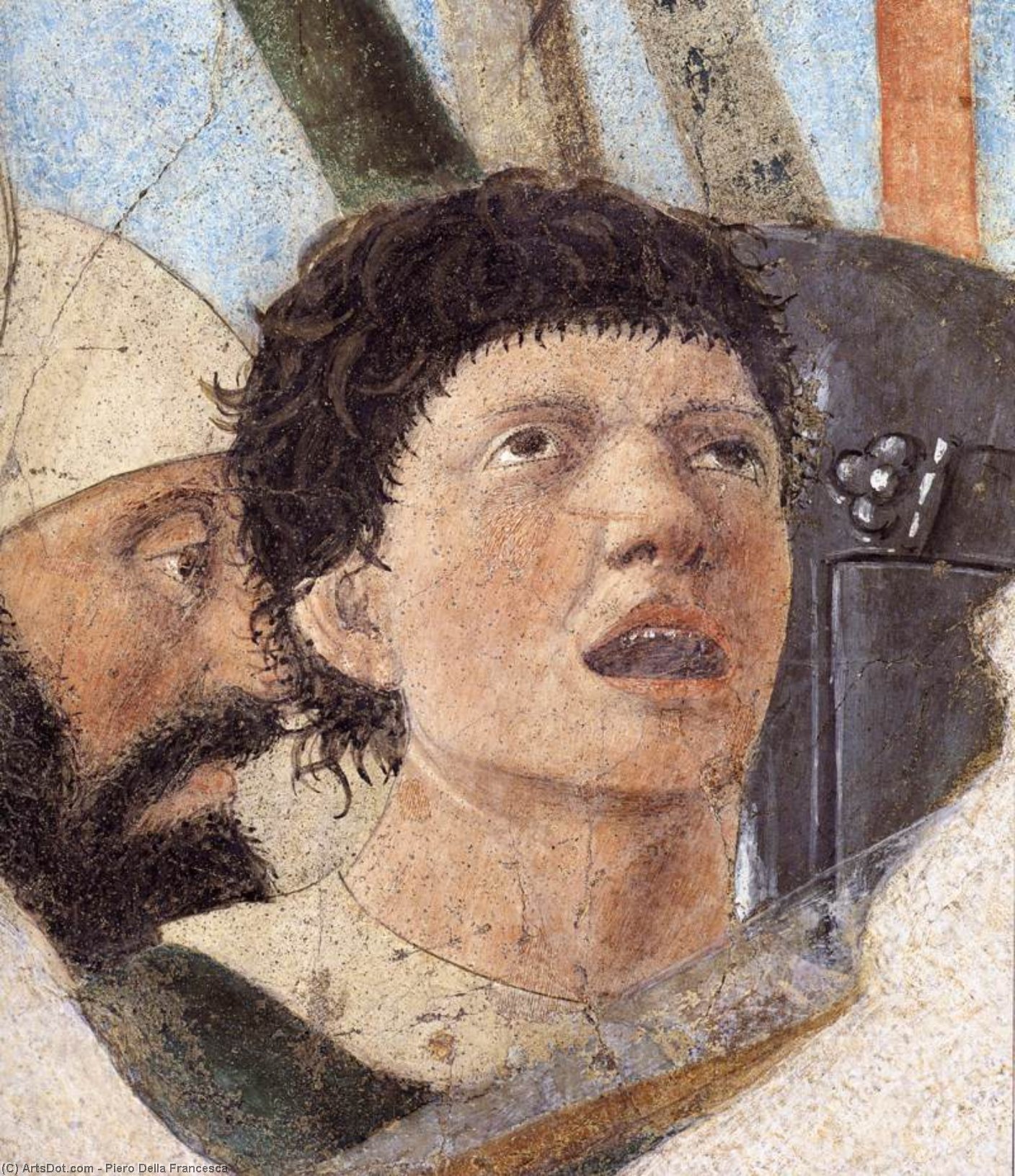
Piero Della Francesca’s “Constantine’s Victory over Maxentius (detail) (13)” – A Renaissance Masterpiece of Perspective and Power
Within the serene walls of the Basilica of San Francesco in Arezzo, Italy, resides a fresco that transcends mere historical depiction; it is a profound meditation on power, faith, and the very nature of reality. Piero della Francesca’s “Constantine’s Victory over Maxentius (detail) (13),” part of his monumental “Legend of the True Cross” cycle, stands as a testament to the artist's revolutionary approach to perspective and his ability to imbue biblical narrative with an almost palpable sense of drama. This meticulously rendered scene captures not just a pivotal moment in Roman history – the Battle of Milvian Bridge – but also embodies the burgeoning humanist ideals that defined the early Renaissance.
Painted between 1452 and 1466, this fresco is far more than a straightforward historical record. It’s an exercise in visual mastery, meticulously constructed to create an illusion of depth and space that was remarkably innovative for its time. Piero della Francesca, already known for his rigorous geometric approach to art, employs linear perspective with astonishing precision. The vanishing point, subtly integrated into the composition, draws the viewer's eye deep into the scene, creating a convincing sense of three-dimensionality. Notice how the arrangement of figures – the imposing Constantine, the defeated Maxentius, and the legions arrayed on either side – is carefully orchestrated to reinforce this spatial illusion. The dynamic sky, filled with billowing clouds rendered in vibrant hues, further contributes to the immersive experience, suggesting both the drama of the battle and the vastness of the heavens.
Historical Context and Biblical Symbolism
The fresco’s narrative is rooted in Christian legend: the story of Constantine's conversion to Christianity after witnessing a vision of the cross. The Battle of Milvian Bridge, depicted here, marks a turning point – the moment when Constantine, embracing Christianity, secured his victory over Maxentius, effectively paving the way for its rise as the dominant religion in the Roman Empire. However, the scene is not simply a recounting of historical events; it’s interwoven with potent religious symbolism. The prominent display of the Christian cross, held aloft by Constantine's soldiers, serves as a visual declaration of faith and divine favor. The angel appearing to Constantine before the battle, a detail often overlooked, reinforces the idea that victory is granted through God’s intervention.
Furthermore, the composition subtly references classical Roman imagery. The defeated Maxentius lies prone on the ground, reminiscent of depictions of fallen emperors in ancient sculpture. This juxtaposition of Christian and classical elements reflects the Renaissance interest in reviving the artistic traditions of antiquity while simultaneously forging a new, distinctly Christian aesthetic.
Artistic Techniques and Visual Impact
Piero della Francesca’s mastery lies not only in his understanding of perspective but also in his skillful use of light and color. The scene is bathed in a bright, almost theatrical lighting that dramatically illuminates the figures and creates strong contrasts between light and shadow. This technique heightens the sense of drama and emphasizes the key elements of the composition. The armor reflects the light with remarkable realism, while the shadows cast by the horses’ hooves ground the scene in a tangible reality. The vibrant colors – the deep reds of the soldiers' tunics, the blues of the sky, and the earthy tones of the landscape – contribute to the overall visual impact, creating a rich and engaging tableau.
The figures themselves are rendered with an almost sculptural quality. Their poses are carefully constructed to convey both power and vulnerability. Constantine stands tall and resolute, radiating authority, while Maxentius lies defeated, his expression one of despair. The artist’s attention to detail – the intricate folds of the soldiers' clothing, the expressions on their faces, the texture of the ground – is remarkable, demonstrating a deep understanding of human anatomy and form.
Relevance in Modern Times and Reproductions
“Constantine’s Victory over Maxentius (detail) (13)” remains a profoundly influential work of art. It exemplifies the Renaissance ideal of *disegno*, emphasizing careful planning, precise execution, and intellectual rigor. Its innovative use of perspective continues to inspire artists and designers today. ArtsDot offers meticulously crafted hand-painted reproductions that faithfully capture the essence of this masterpiece, allowing you to experience its beauty and historical significance in your own home or studio.
Explore our high-quality reproductions – available in a range of sizes and materials – and bring this iconic Renaissance fresco into your world. For more information on Piero della Francesca’s life and work, visit ArtsDot.com or delve deeper into the history of the Basilica of San Francesco, Arezzo at Wikipedia.