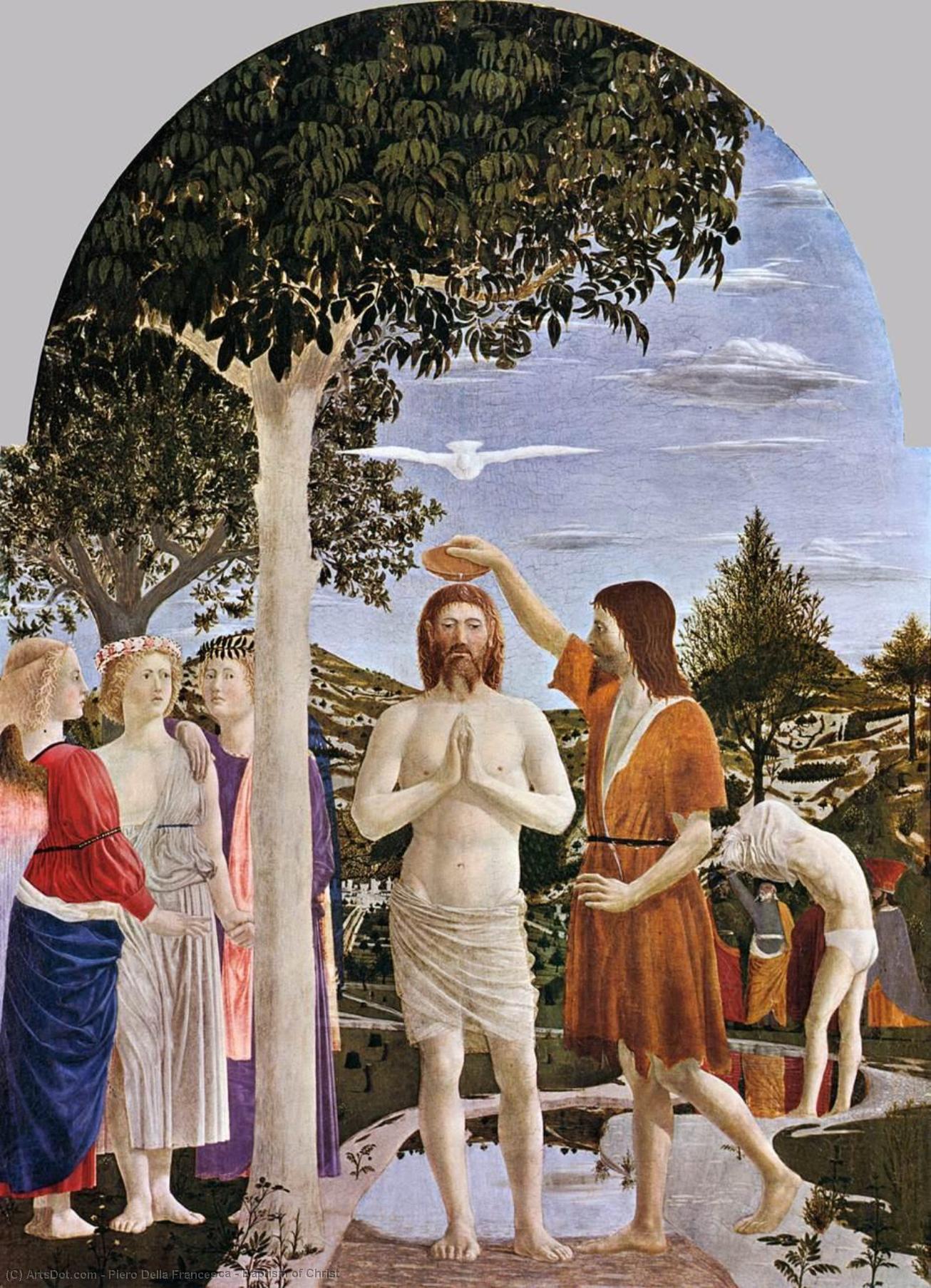
Baptism of Christ: A Geometric Revelation
Piero della Francesca’s
Baptism of Christ stands as a cornerstone of Early Renaissance art—a testament to the artist's unparalleled mastery of geometric composition and his profound understanding of religious iconography. Executed in tempera on wood panel around 1450 for the altar of San Sepolcro Abbey, this monumental painting transcends mere depiction; it embodies an intellectual rigor that continues to fascinate scholars and inspire artists today. Its serene beauty belies a complex layering of mathematical precision and symbolic resonance, reflecting Della Francesca’s unwavering commitment to humanist ideals.
Historical Context: Patronage and Artistic Influences
The commission for this triptych arose from the fervent desire of the Camaldolese monks of San Sepolcro to reaffirm their unity with the Papacy following the Western Schism. Piero della Francesca, deeply rooted in Florentine artistic traditions—influenced by Domenico Veneziano’s pioneering use of light painting and Masaccio's groundbreaking exploration of perspective—responded to this challenge with an innovative approach that blended classical ideals with Christian spirituality. The Abbey’s ambition to portray the sacred event was matched by Della Francesca’s determination to elevate it through visual harmony and intellectual clarity.
Compositional Genius: Geometry as Divine Order
At first glance,
Baptism of Christ presents a deceptively simple façade—a central panel dominated by Jesus Christ and John the Baptist before a stylized tree. However, beneath this surface lies an intricate geometric framework that speaks volumes about Della Francesca’s artistic philosophy. The artist meticulously calculated the angles formed by John’s arm and leg, mirroring each other with astonishing accuracy—a deliberate gesture symbolizing the reconciliation of East and West during the Reformation. This masterful use of perspective creates a palpable sense of depth and space, transporting viewers into the sacred realm depicted within the painting.
Technique: Tempera on Wood – Luminosity and Stability
Della Francesca’s choice of tempera paint—mixed with egg yolk—on wooden panel represents a pivotal advancement in artistic technique during his era. Unlike oil paints, tempera dries quickly, allowing for greater control over color and luminosity—qualities that are exquisitely captured in
Baptism of Christ’s ethereal glow. The resulting surface is remarkably stable and resistant to deterioration, ensuring that this masterpiece will endure for centuries to come. Furthermore, Della Francesca's meticulous layering of pigments—a technique honed through years of experimentation—contributes to the painting’s remarkable visual richness and textural subtlety.
Legacy: An Icon of Renaissance Humanism
Baptism of Christ remains an enduring symbol of Early Renaissance humanism—a celebration of intellect and beauty that transcends temporal boundaries. Its influence can be seen in countless subsequent artworks, cementing Della Francesca’s place as one of the most influential painters of his time. Today, housed at the National Gallery in London, this painting continues to captivate audiences worldwide, prompting contemplation on themes of faith, reconciliation, and divine order—a testament to the enduring power of artistic genius.